
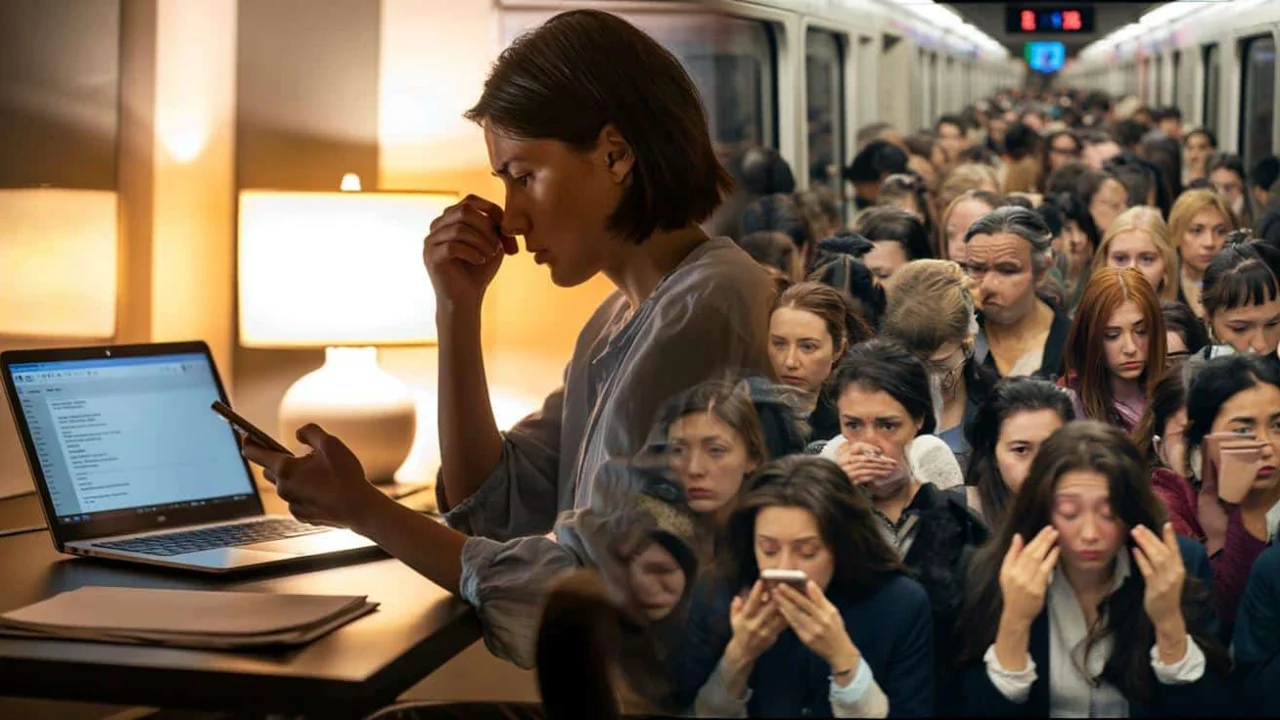
Sarah stares at her phone for the third time today, thumb hovering over her friend’s contact. She wants to call about the promotion she didn’t get, but something familiar stops her cold. “She’s probably busy,” Sarah whispers to herself, setting the phone face-down on her desk. “I don’t want to be one of those people who dumps their problems on everyone.”
Three states away, Marcus does the exact same thing. Different phone, different friend, same internal voice saying he shouldn’t “burden” people with his feelings. Both Sarah and Marcus would swear this hesitation is uniquely theirs—a quirk of personality, maybe even a strength.
They’re both wrong. Psychology research shows their emotional habits aren’t personal fingerprints at all. They’re shared scripts, running in millions of minds simultaneously.
The illusion of emotional uniqueness
Your emotional habits feel intensely personal because you live inside them every single day. That knot in your stomach when someone raises their voice? The way you automatically smile when you’re uncomfortable? These responses feel like they belong to you alone.
But psychologists have mapped these patterns across thousands of people, and the results are startling. Dr. Jennifer Aaker from Stanford University explains, “We think our emotional responses are unique signatures, but they’re actually common human software running on individual hardware.”
Consider how emotional habits develop. A child learns that crying brings criticism, so they swallow tears. Another discovers that anger gets attention, so they amplify it. These early lessons become automatic responses that feel deeply personal decades later.
Yet research reveals most people share surprisingly similar emotional patterns:
- Conflict avoidance that masquerades as “keeping the peace”
- Emotional numbing disguised as being “logical” or “practical”
- People-pleasing that feels like “just being nice”
- Hyper-independence labeled as “not wanting to bother anyone”
The woman who apologizes before speaking and the man who never asks for help both learned the same lesson: their needs might be too much for others to handle.
Common emotional patterns we all recognize
Researchers have identified several universal emotional habits that transcend culture, age, and background. These patterns repeat so consistently that therapists can often predict them.
| Emotional Habit | Surface Behavior | Hidden Pattern | Common Triggers |
|---|---|---|---|
| Preemptive Rejection | Not reaching out to friends | Avoiding disappointment by withdrawing first | Past abandonment, criticism |
| Emotional Buffering | Making jokes during serious moments | Using humor to avoid vulnerability | Uncomfortable with intensity |
| Perfectionist Paralysis | Procrastinating on important tasks | Fear of producing imperfect work | High expectations, fear of judgment |
| Caretaker Override | Always helping others, ignoring own needs | Earning love through usefulness | Childhood responsibility, conditional love |
Dr. Susan David, author of “Emotional Agility,” notes, “These patterns feel personal because we experience them from the inside, but they’re actually predictable responses to universal human experiences like rejection, criticism, and uncertainty.”
The “overthinking spiral” provides a perfect example. You replay a conversation, analyzing every word and facial expression. You’re convinced this mental loop is evidence of your particular neurosis. Actually, cognitive researchers find that 95% of people engage in this exact same pattern when they feel socially uncertain.
Even the specific thoughts repeat across individuals:
- “What did they really mean when they said that?”
- “I should have said something different”
- “They probably think I’m weird now”
- “I’m reading too much into this”
Why recognizing shared patterns matters
Understanding that emotional habits are widely shared changes everything about how we see ourselves and others. When you realize your “personal flaws” are actually common human responses, shame loses its grip.
Take the woman who thought she was uniquely “too sensitive.” Learning that heightened emotional reactivity affects roughly 20% of the population helped her stop seeing sensitivity as a character defect. Instead, she began understanding it as a trait requiring different strategies, not different worth.
This recognition has practical benefits:
- Reduced isolation: Knowing others share your struggles decreases loneliness
- Increased self-compassion: Common patterns feel less shameful than personal failings
- Better relationships: Understanding shared emotional habits improves empathy
- Targeted solutions: Known patterns have established coping strategies
Clinical psychologist Dr. Kristin Neff explains, “When people realize their emotional struggles aren’t unique character flaws, they can approach change with curiosity instead of self-criticism. That shift alone accelerates healing.”
The research also reveals why certain therapeutic approaches work consistently. Cognitive behavioral therapy succeeds partly because it addresses shared thought patterns rather than individual quirks. The anxious person who catastrophizes and the depressed person who assumes the worst both benefit from similar techniques for examining thought accuracy.
Breaking free from automatic responses
Recognizing shared emotional patterns is the first step toward changing them. When you understand that your knee-jerk responses aren’t personality but learned habits, you can begin choosing different responses.
The key lies in catching yourself mid-pattern. Sarah, the woman who wouldn’t call her friend, learned to recognize the “I don’t want to bother them” thought as a predictable script, not truth. This awareness created space for a different choice.
Change becomes possible when you realize you’re not broken—you’re human, running common human software that can be updated with practice and awareness.
FAQs
Why do emotional habits feel so personal if they’re shared?
We experience emotions from inside our own minds, making them feel unique to us, even when the patterns are universal.
Can emotional habits actually be changed?
Yes, with awareness and practice, you can develop new emotional responses to replace automatic ones that no longer serve you.
How do I identify my own emotional habits?
Notice your automatic responses to stress, conflict, or uncertainty—these repetitive patterns are likely emotional habits.
Is it normal to have multiple emotional habits?
Absolutely, most people have several emotional patterns that activate in different situations or relationships.
Do emotional habits serve any purpose?
Many emotional habits developed as protective mechanisms, but they may outlive their usefulness and become limiting instead.
How long does it take to change an emotional habit?
Research suggests it takes 66 days on average to form new habits, but emotional patterns may require months of consistent practice to shift.