
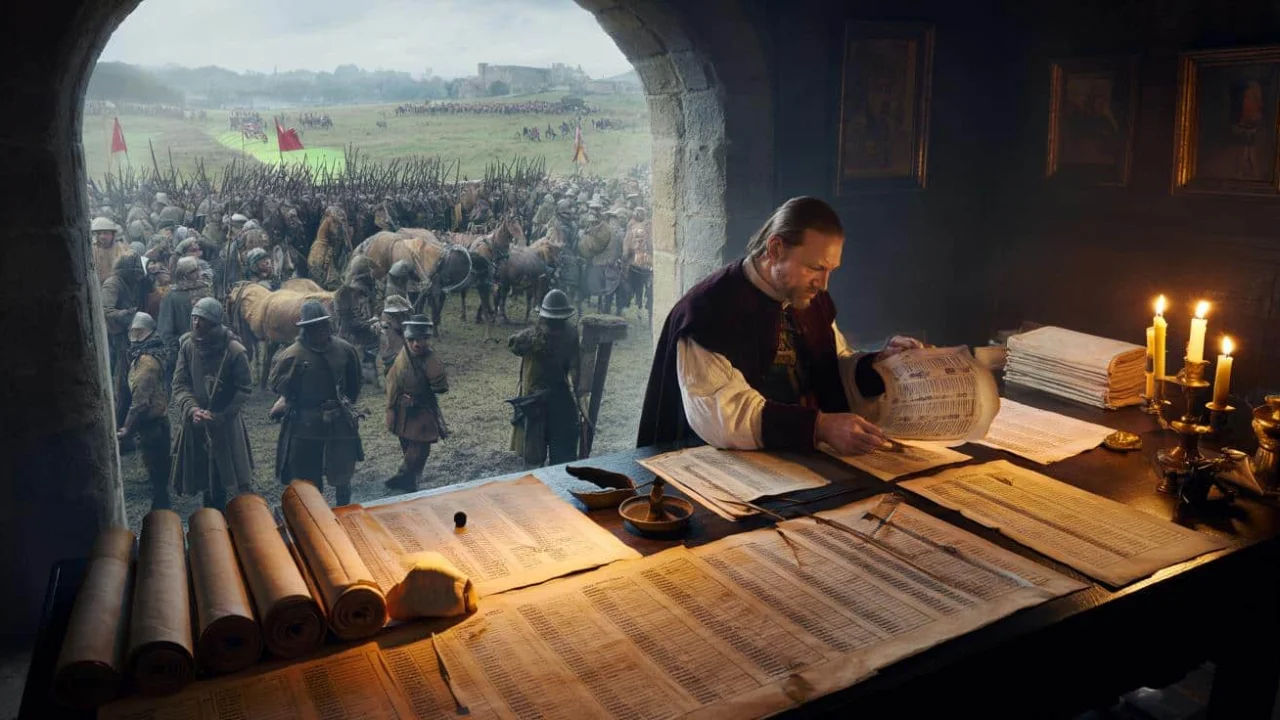
John Fletcher had no idea his ancestor was anything special. The family story passed down through generations painted great-great-grandfather William as just another poor farmer who got swept up in some medieval war. But when John typed “William Fletcher” into the Medieval Soldier Database last year, everything changed.
The screen lit up with entries spanning nearly two decades. William wasn’t just some unlucky peasant dragged into battle—he was a career soldier who served in France, earned promotions, and apparently made enough money to buy land back home. “I always wondered how our family got that first piece of property,” John says. “Turns out great-great-granddad was basically a medieval professional.”
John’s discovery is happening thousands of times over as people dig into what might be the most revealing window we’ve ever had into medieval military life. The Medieval Soldier Database is turning everything we thought we knew about medieval English soldiers upside down.
When Old Paperwork Becomes Digital Gold
For centuries, the real stories of medieval English soldiers sat buried in dusty archives. Scholars who wanted to understand medieval warfare had to squint at faded Latin documents, decipher abbreviated names, and try to piece together fragments scattered across different repositories.
That nightmare ended when researchers at the University of Southampton launched the Medieval Soldier Database in 2009. What started as an ambitious digitization project has become something extraordinary—a searchable collection of nearly 290,000 military service records covering English soldiers from the 1350s through 1453.
These aren’t just random names in a list. Each entry comes from official “muster rolls”—the medieval equivalent of military payroll records that captains had to submit to royal officials. The documents show who served where, for how long, and in what capacity.
“We’re not looking at propaganda or heroic chronicles anymore,” explains Dr. Anne Curry, who helped establish the database. “These are the actual bureaucratic records. They show us what medieval English soldiers were really doing, not what poets wanted us to think they were doing.”
The Numbers Tell a Completely Different Story
The database reveals that medieval English armies were far more professional and organized than popular imagination suggests. Gone is the old image of desperate peasants grabbed from their fields and handed weapons.
Here’s what the records actually show about medieval English soldiers:
| Career Length | Percentage of Soldiers | What This Means |
|---|---|---|
| 1-2 campaigns | 45% | Short-term service, often local conflicts |
| 3-10 campaigns | 35% | Regular soldiers, backbone of the army |
| 11-20 campaigns | 15% | Career professionals, often promoted |
| 20+ campaigns | 5% | Elite veterans, small but crucial group |
The data demolishes several persistent myths about medieval warfare:
- Professional over peasant: Most soldiers served multiple campaigns, building expertise over years
- Social mobility: Records show archers becoming men-at-arms, commoners earning officer positions
- Geographic spread: Soldiers came from across England, not just local levies
- Specialization: Clear distinctions between roles like longbowmen, crossbowmen, and heavy infantry
- Financial motivation: Regular pay records suggest military service as legitimate career choice
“The stereotype of the medieval soldier as an untrained farmer with a pitchfork just doesn’t hold up,” says military historian Dr. Michael Jones. “These records show us armies that looked much more like modern professional forces than we ever imagined.”
Real Stories Behind the Statistics
The database doesn’t just provide numbers—it brings individual medieval English soldiers back to life. Take Thomas Walkington, a Yorkshire archer who first appears in the records during the 1415 Agincourt campaign. The database tracks him through 23 separate military expeditions over 31 years, watching him rise from simple archer to captain of a company.
Or consider Robert Knolles, who started as a common soldier and became one of the wealthiest men in England through his military earnings. The records show his progression from foot soldier to knight to landowner, all documented in dry bureaucratic entries that reveal an extraordinary life.
These aren’t isolated cases. The database reveals hundreds of similar stories—medieval English soldiers who used military service as a path to social advancement that would have been impossible in civilian life.
“What we’re seeing is war as opportunity,” notes historian Dr. Craig Lambert. “For many young men, especially younger sons with no inheritance, military service offered the only real chance to change their circumstances.”
The records also reveal the human cost of medieval warfare. Soldiers disappear from the rolls without explanation—likely casualties of battle or disease. Others appear briefly and never return, suggesting they found military life unsuitable or were discharged for various reasons.
How This Changes Everything We Know
The implications extend far beyond academic history. The database is forcing textbooks to be rewritten and museum exhibits to be reconsidered. Popular culture’s image of medieval warfare—think “Braveheart” or “Game of Thrones”—suddenly looks wildly inaccurate.
Genealogists are having a field day. Families across England and beyond are discovering military ancestors they never knew existed. The searchable format means someone in Australia can trace their English roots through medieval military service in ways that were impossible just 15 years ago.
The database is also revealing patterns that help explain how England managed to sustain the Hundred Years’ War for so long. Rather than desperate conscription, the records suggest a system that attracted volunteers with competitive pay and advancement opportunities.
“England basically created Europe’s first professional army,” argues Dr. Curry. “They just did it 400 years before anyone thought professional armies existed.”
What Comes Next
The project continues to expand. Researchers are adding more records from different periods and exploring connections with French archives to get both sides of major battles. There’s talk of incorporating Scottish and Welsh records to provide a complete picture of British Isles military activity.
The database has also inspired similar projects focusing on other periods and regions. Medieval soldiers from other countries are getting the same treatment, creating a web of interconnected military history that spans continents.
For families like John Fletcher’s, the revelations keep coming. “I thought I was descended from farmers,” John reflects. “Turns out I’m descended from international military professionals. It completely changes how I think about my family history.”
The Medieval Soldier Database proves that sometimes the most exciting discoveries come not from dramatic archaeological finds, but from the patient digitization of boring paperwork. Those medieval clerks keeping careful records of pay and service had no idea they were creating one of the most revealing windows into their world.
FAQs
How can I search for my ancestors in the Medieval Soldier Database?
The database is freely searchable online at medievalsoldier.org, where you can enter names, locations, or time periods to find records.
Why are these records so much more reliable than other medieval sources?
Unlike chronicles or poems, muster rolls were official payroll documents that had to be accurate for financial and legal purposes, making them extremely reliable primary sources.
Did medieval English soldiers really make good money?
Yes, military pay was often significantly better than agricultural wages, and successful soldiers could earn enough to buy land and change their social status permanently.
How long did typical military campaigns last in medieval times?
Most campaigns lasted 3-12 months, but soldiers often served in multiple campaigns over many years, creating de facto professional military careers.
Were there really 290,000 different soldiers in medieval English armies?
The database contains 290,000 entries, but many soldiers appear multiple times across different campaigns, so the actual number of individual soldiers was probably around 100,000-150,000 over the century covered.
What happened to soldiers when wars ended?
Many returned to civilian life, but successful soldiers often used their earnings to buy land, start businesses, or continue military service in other conflicts across Europe.