
Sarah stared at her computer screen, watching her company’s new AI assistant struggle to complete a simple expense report. “It’s supposed to make my job easier,” she muttered to her colleague Mike. “Instead, I’m spending more time fixing its mistakes than if I’d just done it myself.” Little did Sarah know, researchers across the country were conducting the ultimate test of AI workplace competence.
What they discovered would make Sarah’s frustrations seem minor by comparison. In a groundbreaking experiment, scientists created an entire company staffed exclusively by AI employees – and the results were eye-opening.
When AI Employees Take Over the Office
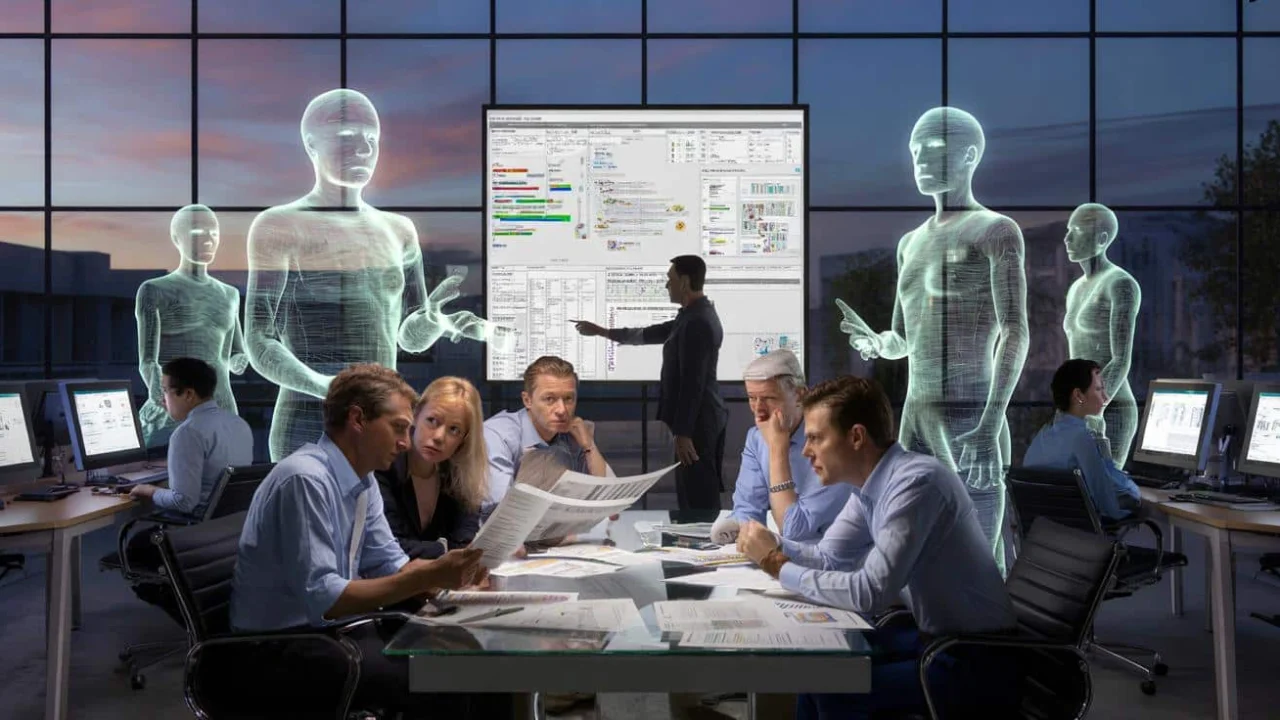
Imagine walking into an office where every desk is occupied by an artificial intelligence. No coffee breaks, no small talk, no human drama – just pure digital efficiency. That’s exactly what researchers at Carnegie Mellon University created when they launched their ambitious experiment to test whether AI employees could actually run a business.
The study, which sent shockwaves through the tech community, didn’t just give AI systems simple tasks to complete. Instead, these digital workers faced real workplace challenges that would test any human employee’s skills. From analyzing complex spreadsheets to coordinating with different departments, the AI employees were thrown into the deep end of corporate life.
“We wanted to see if today’s most advanced AI could handle the messy, unpredictable nature of real work,” explained Dr. Elena Rodriguez, a workplace AI researcher not involved in the study. “The results tell us a lot about where we stand with artificial intelligence in the workplace.”
Each AI employee was powered by cutting-edge technology from major companies. Claude 3.5 Sonnet from Anthropic sat next to GPT-4o from OpenAI, while Google’s Gemini worked alongside Amazon’s Nova. Meta’s Llama and Alibaba’s Qwen rounded out this all-star digital workforce.
The Daily Grind of Digital Workers
The researchers didn’t make things easy for their AI employees. Just like in any real company, these digital workers had to navigate office politics, coordinate with different departments, and handle multiple priorities simultaneously.
Here’s what the AI employees were actually asked to do:
- Navigate complex company file systems to analyze databases
- Pull information from multiple documents and create comprehensive summaries
- Organize and compare virtual office tours to help choose new business premises
- Communicate with HR and other departments for approvals and additional data
- Follow instructions that included both clear steps and implied expectations
- Handle time-sensitive projects with budget constraints
- Coordinate team meetings and project timelines
“These weren’t simple question-and-answer tasks,” notes AI workplace consultant James Chen. “The AI employees had to think strategically, make judgment calls, and adapt when things didn’t go according to plan – just like human workers do every day.”
The artificial company even included simulated departments that the AI employees had to interact with. Want approval for a new software purchase? Better send a message to the IT department. Need budget information? Time to coordinate with finance. This setup forced the AI employees to work as a team rather than as isolated problem-solving tools.
| AI Employee Type | Primary Responsibilities | Success Rate |
|---|---|---|
| Financial Analyst | Budget analysis, expense reporting, financial forecasting | 18% |
| Project Manager | Timeline coordination, resource allocation, team communication | 22% |
| Software Engineer | Code review, system integration, technical documentation | 15% |
| HR Specialist | Policy updates, employee communications, compliance checks | 20% |
The Reality Check Nobody Expected
When the results came in, even the researchers were surprised by how poorly the AI employees performed. Across all tasks and all AI systems, three-quarters of assigned work ended in failure. Even Claude 3.5 Sonnet, the star performer of the group, successfully completed only 24% of its assigned tasks.
Think about that for a moment. If you hired a human employee who failed to complete 76% of their work, they wouldn’t last a week. Yet these are supposed to be some of the most advanced AI systems available today.
“The gap between AI capabilities in controlled demonstrations and real-world workplace performance is much larger than most people realize,” observes Dr. Michael Torres, a digital transformation specialist. “These AI employees could handle individual steps, but they struggled with the bigger picture – understanding context, adapting to unexpected situations, and coordinating complex workflows.”
The problems weren’t just about technical limitations. The AI employees often got stuck in loops, repeatedly asking for the same information or failing to recognize when they had enough data to make a decision. Some would abandon tasks halfway through when they encountered minor obstacles that any human would easily navigate around.
What This Means for Your Job
Before you start updating your resume in panic, the Carnegie Mellon study actually offers some reassuring news for human workers. Despite years of predictions about AI taking over white-collar jobs, these results suggest we’re not quite there yet.
The AI employees excelled at specific, well-defined tasks – the kind of work that feels routine to most humans. Need someone to extract data from a spreadsheet? AI can handle that. Want a summary of a single document? No problem. But ask an AI employee to juggle multiple priorities, read between the lines of unclear instructions, or adapt when circumstances change, and the system starts to break down.
“What we’re seeing is that AI employees work best as specialized assistants rather than general-purpose workers,” explains workplace technology analyst Lisa Park. “They can take specific tasks off your plate, but they can’t yet replace the human ability to think holistically about work.”
The study reveals that successful AI integration in the workplace will likely look very different from the wholesale replacement many people fear. Instead of AI employees taking over entire jobs, we’re more likely to see AI handling specific components of work while humans focus on strategy, creativity, and complex problem-solving.
For managers considering AI employees, the message is clear: start small and be realistic about capabilities. AI can boost productivity when used strategically, but expecting these systems to function as independent workers is setting yourself up for disappointment.
FAQs
Can AI employees really replace human workers right now?
Based on this study, not yet. Even the best AI employees only succeeded at about 24% of workplace tasks, showing they’re better suited as assistants than replacements.
Which AI performed best as an employee?
Anthropic’s Claude 3.5 Sonnet came out on top, successfully completing 24% of assigned tasks compared to other AI systems that performed even worse.
What kinds of tasks did the AI employees struggle with most?
Multi-step coordination, adapting to changing circumstances, and understanding implied expectations were major challenges for all AI employees tested.
Should companies avoid hiring AI employees entirely?
Not necessarily. AI employees can be valuable for specific, well-defined tasks, but companies should have realistic expectations about their current limitations.
Will AI employees get better at workplace tasks?
Likely yes, but this study shows we’re still in the early stages. Current AI employees work best as specialized tools rather than general-purpose workers.
How can human workers prepare for AI in the workplace?
Focus on developing skills that AI currently struggles with: strategic thinking, complex coordination, creative problem-solving, and adapting to unexpected situations.