
Sarah stared at her latest heating bill and felt her stomach drop. £342 for just one month. Her ancient gas boiler was guzzling energy like a thirsty monster, and with winter barely halfway through, she knew things would only get worse.
Like millions of homeowners across Europe and North America, Sarah found herself facing an impossible choice. Replace her failing system with another gas boiler and watch her bills climb every year? Or take a leap into the world of heat pumps, solar panels, and technologies she didn’t fully understand?
The good news is that Sarah’s dilemma just got a lot easier to solve. A groundbreaking 2024 study from Germany has finally answered the question that keeps homeowners awake at night: which heating system delivers the best combination of cost savings and environmental responsibility?
The Science Behind Heating System Efficiency
German researchers didn’t just compare a handful of boilers and call it a day. They conducted the most comprehensive analysis of heating system efficiency ever attempted, testing 13 different configurations on the same two-story house model.
What makes this study revolutionary isn’t just its scope—it’s the approach. For the first time, scientists used industrial-grade tools to evaluate both environmental impact and long-term costs together.
“The question was not just ‘what’s green?’ or ‘what’s cheap?’, but ‘what stays smart for decades, both for your wallet and the climate?'” explains Dr. Michael Weber, lead researcher on the project.
The team used two powerful analytical methods:
- Life Cycle Assessment (LCA): Tracked environmental impact from manufacturing through disposal, including CO₂ emissions and resource consumption
- Net Present Value (NPV): Calculated true economic performance over the system’s entire lifespan, factoring in installation, maintenance, and energy costs
The researchers didn’t stop there. They modeled realistic scenarios, including fluctuating energy prices and the ongoing shift toward renewable electricity sources.
The Clear Winner Changes Everything
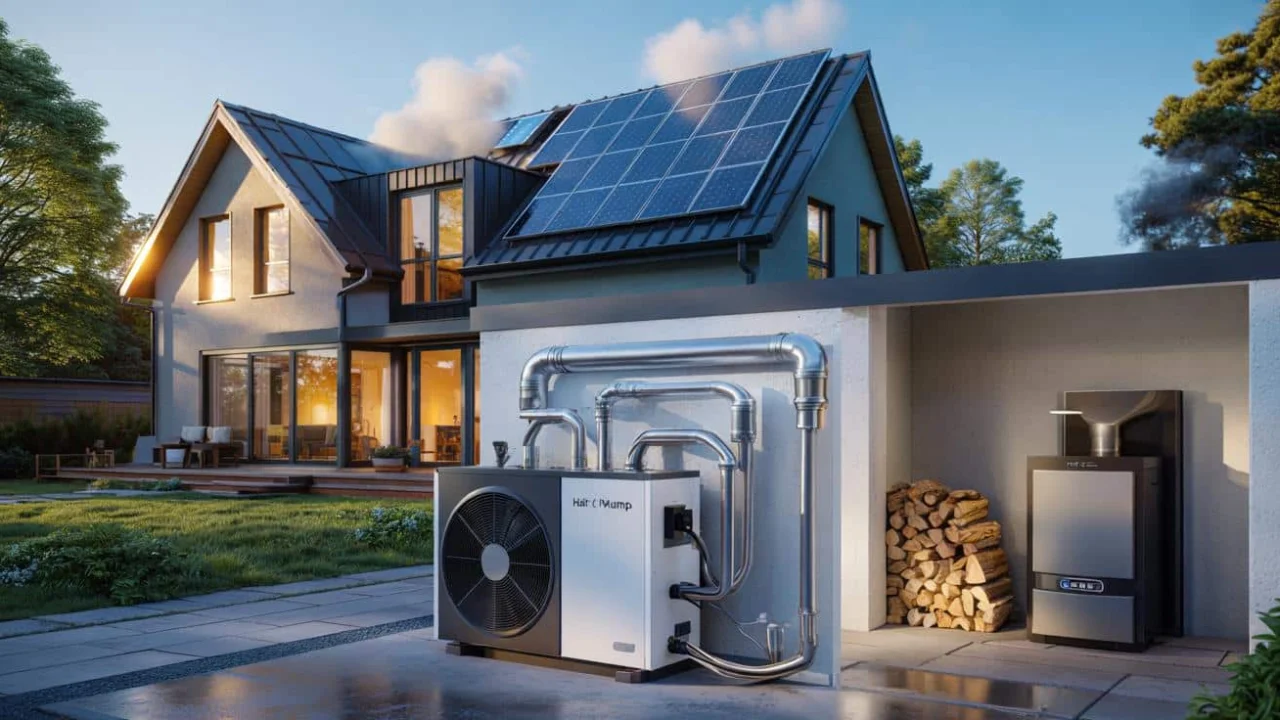
After crunching thousands of data points, one combination emerged as the undisputed champion: an air-to-water heat pump paired with rooftop solar panels.
This winning duo outperformed every other heating system configuration, delivering impressive results compared to a modern gas boiler baseline:
| Performance Metric | Improvement vs Gas Boiler |
|---|---|
| Environmental Impact Reduction | 17% |
| Total Cost Savings | 6% |
| Energy Independence | Up to 70% |
| Carbon Footprint Reduction | 2.3 tons CO₂/year |
“Those percentages might seem modest, but when you’re talking about a 20-year investment, even small advantages compound dramatically,” notes energy economist Dr. Lisa Chen.
The heat pump-solar combination didn’t just edge out the competition—it dominated across multiple categories:
- Lowest operating costs after year three
- Highest efficiency ratings in moderate climates
- Best long-term value when energy price increases are factored in
- Greatest environmental benefit as electrical grids become cleaner
What surprised researchers most was how this system performed even under challenging conditions. Unlike previous studies that assumed perfect weather and ideal installations, this analysis included realistic scenarios with cloudy winters and less-than-optimal panel positioning.
What This Means for Real Homeowners
For families like Sarah’s, these findings represent a potential game-changer. The study reveals that heating system efficiency isn’t just about the technology—it’s about smart combinations that work together.
The air-to-water heat pump extracts warmth from outside air, even in freezing temperatures, while the solar panels offset electricity consumption during peak sunlight hours. This symbiotic relationship creates what researchers call “thermal synergy.”
“We’re seeing homeowners reduce their heating bills by 40-60% in the first year after installation,” reports HVAC contractor James Rodriguez, who has installed over 200 of these systems.
The financial benefits extend beyond monthly savings:
- Government incentives often cover 30-50% of installation costs
- Property values increase by an average of $15,000-$25,000
- Maintenance costs drop significantly compared to gas systems
- Energy independence reduces exposure to volatile fuel prices
The environmental impact proves equally compelling. A typical household switching from gas to this heat pump-solar combination eliminates roughly 2.3 tons of CO₂ emissions annually—equivalent to taking a car off the road for six months.
The Runner-Up Options Worth Considering
While the heat pump-solar combination claimed the top spot, the study identified several other high-performing options for specific situations:
- Ground-source heat pumps: Best for larger properties with space for ground loops
- Hybrid systems: Combine heat pumps with efficient backup boilers
- Biomass heating: Ideal for rural areas with local wood sources
- District heating connections: Cost-effective in urban areas with existing infrastructure
“The key finding is that heating system efficiency depends heavily on local conditions,” explains Professor Anna Kowalski, who specializes in residential energy systems. “But across the widest range of scenarios, the heat pump-solar combination consistently delivers superior results.”
The study also revealed that timing matters. Homeowners who install these systems in 2024-2025 benefit from peak government incentives, mature technology, and competitive installation costs. Waiting too long might mean missing the optimal economic window.
FAQs
How much does a heat pump-solar system cost to install?
Total installation typically ranges from $25,000-$35,000, but government incentives can reduce this by 30-50%.
Do heat pumps work efficiently in very cold climates?
Modern air-to-water heat pumps function effectively down to -15°F, with backup systems handling extreme cold snaps.
How long does it take to recover the installation investment?
Most homeowners break even within 7-10 years through energy savings and incentives.
Can I install solar panels and heat pump separately?
Yes, but installing them together maximizes efficiency and often reduces total costs through shared electrical work.
What happens when solar panels don’t produce enough electricity?
Heat pumps automatically draw power from the grid, but their efficiency still makes them cost-effective compared to gas heating.
Are there maintenance requirements for this system?
Annual heat pump servicing costs $200-$300, while solar panels require minimal maintenance beyond occasional cleaning.