
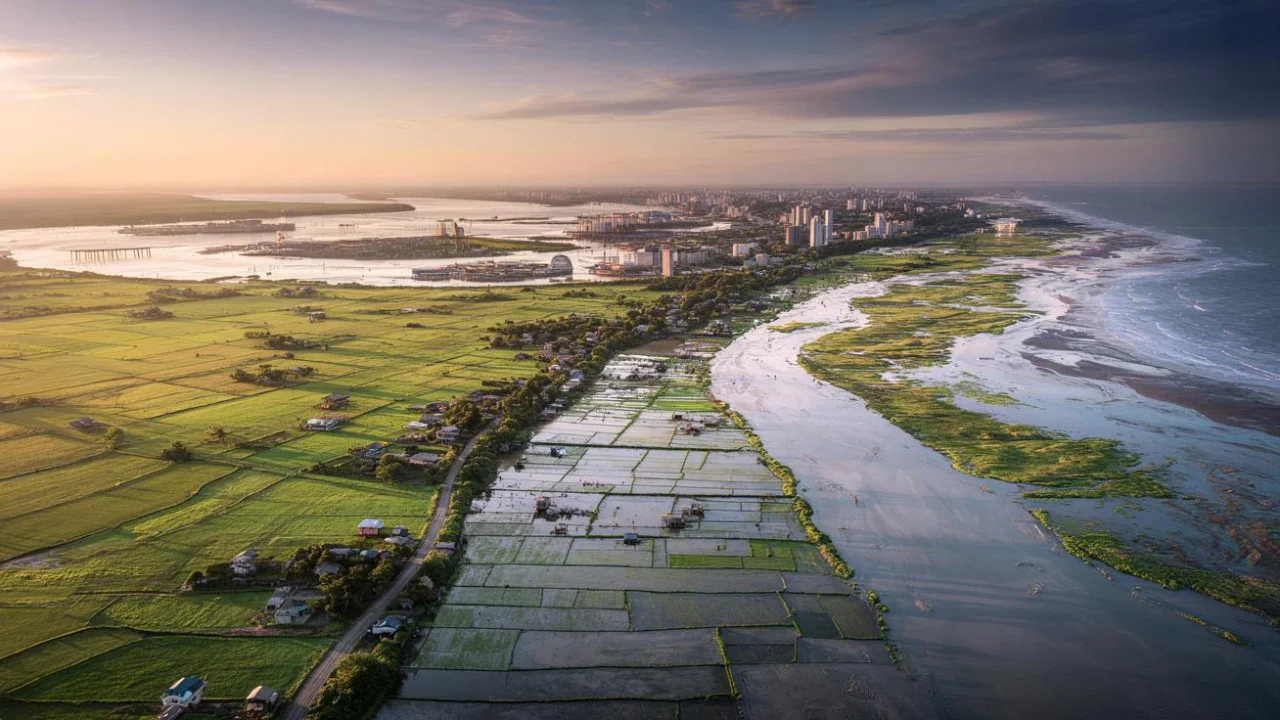
Maria Nguyen remembers when her childhood home in the Mekong Delta sat comfortably above the high-tide line. Today, that same house floods during ordinary rainstorms. “My grandmother used to say the river was rising,” Maria recalls, “but now I know the truth is scarier—our land is disappearing beneath our feet.”
What Maria discovered isn’t unique to her Vietnamese village. Across the globe, millions of people are experiencing the same alarming reality: their ground is dropping faster than the seas are rising.
This phenomenon, called land sinking or subsidence, is quietly reshaping entire regions at a pace that makes rising sea levels seem slow by comparison. While we’ve spent decades worrying about melting glaciers and thermal expansion of oceans, the earth itself is collapsing under some of our most populated areas.
The Hidden Crisis Affecting Millions
Land sinking affects river deltas from the Mekong to the Mississippi, but most people living there don’t realize what’s happening. Scientists have been tracking this vertical land motion with sophisticated satellites, and the numbers are startling.
In several major delta regions, the ground drops by centimeters each year while global sea levels rise by mere millimeters. That’s a rate difference of ten to one in some cases.
“We’re seeing land subsidence rates that completely dwarf sea-level rise,” explains Dr. Sarah Chen, a coastal geologist at Stanford University. “In parts of the Mekong Delta, we’re measuring ground loss of 5 centimeters annually. That’s equivalent to 50 years of global sea-level rise happening in just one year.”
This dramatic difference means that coastal flooding, which scientists predicted would become problematic by 2050, is already wreaking havoc today. Storm surges that once stayed near the shoreline now push miles inland, flooding homes and farms that never experienced saltwater intrusion before.
Where the Ground is Disappearing Fastest
The most affected regions share common characteristics: they’re river deltas with dense populations, intensive agriculture, and heavy industrial activity. Here’s what researchers have documented:
| Region | Sinking Rate (cm/year) | Population Affected | Primary Cause |
|---|---|---|---|
| Mekong Delta, Vietnam | 3-5 | 17 million | Groundwater extraction |
| Mississippi Delta, USA | 2-4 | 2 million | Oil/gas extraction, levees |
| Jakarta, Indonesia | 15-25 | 10 million | Excessive groundwater pumping |
| Nile Delta, Egypt | 1-3 | 60 million | Dam construction, pumping |
| Po Delta, Italy | 2-8 | 1.5 million | Gas extraction, agriculture |
The worst case is Jakarta, Indonesia’s capital, where some neighborhoods sink more than two feet annually. Parts of the city have dropped 13 feet since 1990, forcing the government to plan relocating the entire capital.
Key factors driving land sinking include:
- Excessive groundwater pumping for cities and agriculture
- Oil and natural gas extraction removing underground fluids
- Dam construction blocking sediment that would naturally replenish deltas
- Heavy urban development compressing soft soils
- Mining activities destabilizing underground formations
The process becomes a vicious cycle. As land sinks, communities become more vulnerable to flooding, which drives them to pump even more groundwater for freshwater supplies when saltwater contaminates surface sources.
The Science Behind Disappearing Ground
Land sinking happens because river deltas are naturally unstable environments. These regions formed over thousands of years as rivers deposited fine sediments and organic materials layer by layer. The resulting soil is soft, spongy, and filled with water.
“Think of delta soil like a wet sponge,” explains Dr. James Mitchell, a hydrogeologist at UC Davis. “When you squeeze the water out, the sponge shrinks and doesn’t bounce back to its original size.”
When people extract groundwater faster than natural processes can replace it, the soil particles compress together. This compaction is essentially permanent—even if aquifers refill, the ground doesn’t rise back up.
Modern satellite technology called InSAR (Interferometric Synthetic Aperture Radar) can measure ground movement with millimeter precision. These measurements reveal that human activities now drive land sinking at rates far exceeding natural geological processes.
Natural subsidence in deltas typically occurs at rates of 1-3 millimeters per year. Human-induced sinking can reach 10-250 millimeters annually—up to 100 times faster than natural rates.
Real People, Real Consequences
The human cost of rapidly sinking land extends far beyond inconvenience. In the Mekong Delta, farmers like Tran Van Duc watch saltwater creep further upstream each year, destroying rice paddies that fed his family for generations.
“The salt comes earlier and stays longer now,” Duc explains. “My father could grow three rice crops per year. I’m lucky to get one good harvest.”
Urban areas face different but equally serious challenges. In Jakarta, luxury malls built on reclaimed land now sit below sea level. Residents pump water from their flooded basements daily, and many buildings lean at dangerous angles as foundations sink unevenly.
Infrastructure takes a massive beating too:
- Roads crack and buckle as the ground shifts beneath them
- Bridges require constant adjustment as their endpoints sink at different rates
- Airport runways become unusable when they drop below safe elevations
- Sewage systems flow backward when gravity can’t move waste uphill
- Flood defenses become less effective as they sink below design heights
“We’re essentially building cities on quicksand and wondering why everything breaks,” notes Dr. Chen. “The maintenance costs alone are staggering, not to mention the human displacement.”
Economic impacts ripple outward from affected regions. Agricultural losses in major deltas affect global food prices. Coastal cities relocating millions of residents strain resources across entire countries. Some estimates suggest land subsidence costs the global economy tens of billions annually.
Fighting Back Against Sinking Ground
Some communities are taking action to slow or stop land sinking, though solutions often require difficult trade-offs. The most effective approach is reducing groundwater extraction, but this means finding alternative water sources for millions of people.
California’s Central Valley offers a success story. After decades of severe subsidence, water management authorities imposed strict groundwater pumping limits and invested in alternative supplies. Land sinking has slowed dramatically in regulated areas.
“You can’t reverse subsidence, but you can stop it from getting worse,” explains water engineer Dr. Lisa Rodriguez. “The key is acting before you’ve pumped aquifers dry.”
Other promising strategies include:
- Artificial groundwater recharge using treated wastewater
- Switching to surface water sources where available
- Improving irrigation efficiency to reduce water demand
- Building floating or stilted structures that adapt to changing ground levels
- Managed retreat from the most vulnerable areas
Unfortunately, many regions lack the resources or political will to implement these solutions before irreversible damage occurs.
FAQs
How fast is land sinking compared to sea level rise?
In the worst-affected areas, land sinks 10-100 times faster than global sea levels rise, with some regions dropping several centimeters annually versus 3-4 millimeters of sea level rise.
Can sinking land be reversed?
No, land subsidence from groundwater pumping is essentially permanent on human timescales. Even refilling aquifers won’t lift the ground back up once soil has compacted.
Which cities are most at risk from land sinking?
Jakarta, Bangkok, Manila, Ho Chi Minh City, New Orleans, and parts of California’s Central Valley face the most severe subsidence rates currently.
What causes land to sink so quickly?
The primary cause is excessive groundwater pumping, which removes water from underground spaces and allows soil to compress. Oil and gas extraction also contribute in some areas.
How do scientists measure land sinking?
Satellite-based radar technology called InSAR can detect ground movement with millimeter precision by comparing radar images taken months or years apart.
Is climate change making land sinking worse?
Indirectly yes—as droughts become more severe due to climate change, communities pump more groundwater, accelerating subsidence rates in vulnerable areas.