
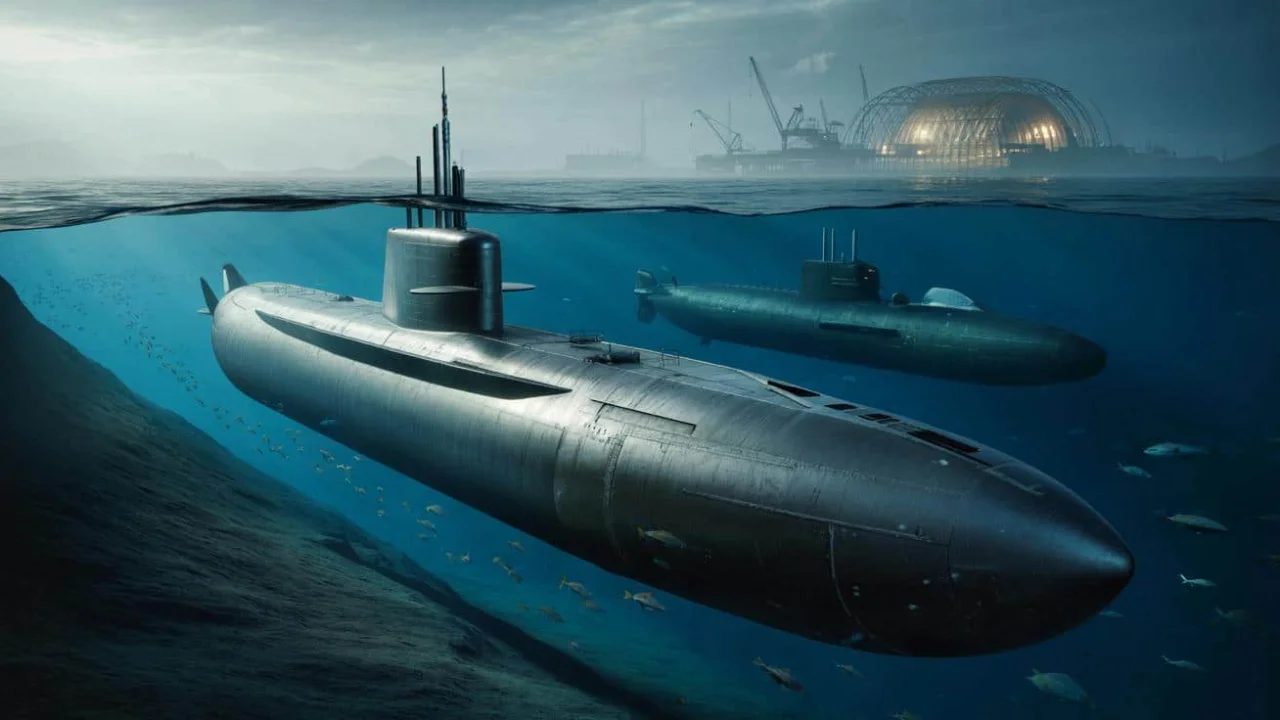
Captain Viktor Petrov still remembers the first time he stepped aboard a Soviet Alfa-class submarine in 1982. The hull felt different under his boots – lighter somehow, with a strange metallic ring when tools dropped. “This isn’t steel,” his chief engineer whispered, running weathered hands along the gleaming interior. “This is something else entirely.”
That “something else” was titanium, a metal so expensive and difficult to work with that even the mighty U.S. Navy had rejected it for submarine construction. Yet here was the Soviet Union, betting their naval future on Russian titanium submarines that would rewrite the rules of underwater warfare.
What drove Moscow to gamble everything on this exotic metal while America stuck with proven steel designs? The answer reveals one of the most fascinating engineering stories of the Cold War.
When the Ocean Became a Battleground
The nuclear submarine race wasn’t just about building bigger boats – it was about surviving the unthinkable. Both superpowers knew that if World War III ever began, the submarines hiding in the depths would likely determine who lived and who died.
American shipyards took the methodical approach. They perfected their steel submarine designs through generations, from the George Washington class to the powerful Ohio-class ballistic missile submarines. Each new design pushed steel technology further, creating stronger alloys and thicker hulls.
But Soviet naval planners looked at America’s steel submarines and saw an opportunity. Why compete directly when you could leapfrog the entire game?
“The Americans had better electronics and quieter propulsion,” explains former Soviet naval engineer Dmitri Komarov. “We needed something that would give us a different kind of advantage – speed and depth that steel simply couldn’t match.”
The Titanium Gamble That Changed Everything
Russian titanium submarines weren’t born from a single eureka moment. They emerged from a calculated decision to sacrifice cost and production simplicity for raw performance advantages that no Western submarine could match.
The properties of titanium made it almost perfectly suited for submarine construction:
- Strength-to-weight ratio nearly double that of steel
- Complete immunity to saltwater corrosion
- Non-magnetic properties that defeated many detection systems
- Ability to withstand crushing depths that would implode steel hulls
| Submarine Type | Maximum Speed | Operating Depth | Hull Material |
|---|---|---|---|
| US Los Angeles Class | 25 knots | 450 meters | Steel |
| Soviet Alfa Class | 42+ knots | 700+ meters | Titanium |
| Soviet Sierra Class | 35 knots | 750 meters | Titanium |
These numbers tell an incredible story. Soviet Alfa-class submarines could dive deeper than most Western torpedoes could follow and outrun virtually anything the U.S. Navy could deploy against them.
The speed advantage was particularly devastating. “Imagine trying to hit a target moving at highway speeds underwater,” notes submarine warfare expert James Mitchell. “American sonar operators had never encountered anything like it.”
The Engineering Nightmare Nobody Talks About
Building Russian titanium submarines nearly broke the Soviet industrial system. Titanium welding required completely new techniques, specialized equipment, and workers trained in processes that didn’t exist anywhere else in the world.
The metal itself cost roughly ten times more than high-grade submarine steel. Worse, titanium catches fire when heated improperly, turning welding mistakes into dangerous infernos. Soviet shipyards had to develop entirely new safety protocols and construction methods.
Only a handful of facilities could handle titanium submarine construction. The primary shipyard in Severodvinsk became a closely guarded secret, with workers sworn to silence about the exotic boats taking shape in their dry docks.
“We lost more submarines to construction accidents than to enemy action,” recalls former shipyard supervisor Alexei Volkov. “The metal was unforgiving – one mistake and months of work could literally go up in flames.”
Why America Never Built Titanium Submarines
The U.S. Navy studied titanium submarines extensively but ultimately decided the costs outweighed the benefits. American naval doctrine prioritized reliability, maintainability, and the ability to build large numbers of submarines quickly.
Russian titanium submarines required specialized maintenance that could only be performed at a few facilities. If a titanium boat broke down far from home, repairs became nearly impossible. Steel submarines, by contrast, could be serviced at dozens of naval bases worldwide.
The economic calculation was brutal. For the cost of one titanium submarine, the U.S. could build three or four steel boats with comparable overall capability when electronics and weapons systems were factored in.
“The Soviets bet everything on superior hull performance,” explains naval historian Dr. Sarah Chen. “We bet on superior systems integration and operational flexibility. History suggests we were both partially right.”
The Legacy That Lives Beneath the Waves
Today, Russian titanium submarines remain active in the Russian Navy, though no new ones have been built since the Soviet collapse. The expertise required to construct them largely disappeared with the USSR, making these boats irreplaceable museum pieces that still patrol the oceans.
Modern submarine designers study the titanium boats with a mixture of admiration and bewilderment. They achieved performance levels that contemporary submarines still struggle to match, but at costs that would bankrupt most naval budgets today.
The few remaining Akula and Sierra-class boats serve as reminders of what engineering can accomplish when cost becomes secondary to performance. They’re also sobering examples of why sustainable design usually trumps spectacular capabilities.
FAQs
How many titanium submarines did the Soviet Union build?
The Soviets built approximately 45 titanium-hulled submarines across several classes, including Alfa, Mike, Sierra, and some Akula variants.
Are Russian titanium submarines still in service?
Yes, several Sierra and Akula-class titanium submarines remain active in the Russian Navy, though they’re becoming increasingly difficult to maintain.
Why didn’t other countries build titanium submarines?
The extreme cost, complex manufacturing requirements, and specialized maintenance needs made titanium submarines impractical for most navies beyond the resource-rich Soviet military-industrial complex.
How fast could titanium submarines really go?
Declassified sources suggest Soviet Alfa-class boats could exceed 40 knots submerged, making them faster than most surface warships of their era.
Could titanium submarines be detected by sonar?
Despite their non-magnetic properties, titanium submarines were still detectable by acoustic sonar, though their high speed made them difficult targets to track and engage.
Will anyone build titanium submarines again?
Current submarine programs focus on advanced steel alloys and new materials like carbon fiber composites, as titanium remains prohibitively expensive for most military budgets.