
Maria Fernandez was tending her vineyard in Portugal’s Douro Valley when she noticed something odd. The ancient stone walls that had marked her family’s property for generations seemed slightly… different. Not broken or damaged, just positioned at angles that didn’t match her childhood memories.
Her grandfather dismissed it as tricks of memory, but Maria couldn’t shake the feeling. What she didn’t know was that beneath her feet, the entire Iberian Peninsula was slowly, imperceptibly spinning like a massive geological record player.
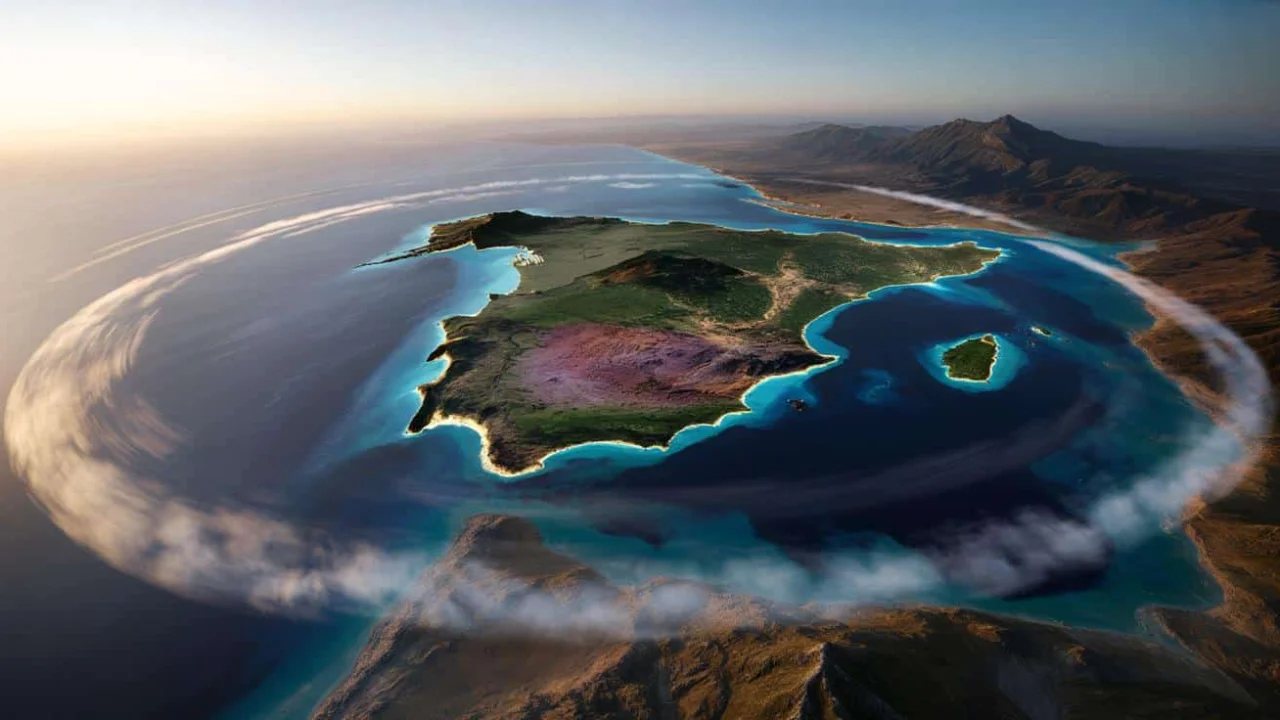
Scientists have now confirmed what Maria’s intuition suggested: Spain and Portugal aren’t just sitting still. The ground beneath these two countries is undergoing a subtle but measurable rotation that’s reshaping our understanding of how continents move.
The Great Iberian Twist: What’s Really Happening
For generations, geology textbooks painted tectonic plates as giant conveyor belts sliding past each other in neat, predictable patterns. The Iberian Peninsula rotation throws that simple picture out the window.
According to new research published in Gondwana Research, the landmass containing Spain and Portugal isn’t just drifting northward with the Eurasian plate. Instead, it’s performing a slow clockwise spin, driven by the complex collision between the African and Eurasian plates.
“The Iberian Peninsula is experiencing a slow clockwise rotation, generated by uneven forces from the colliding African and Eurasian plates,” explains lead researcher Dr. Asier Madarieta.
The movement is incredibly slow – we’re talking about 4 to 6 millimeters per year, roughly the rate your fingernails grow. But over geological time, this rotation could fundamentally change the landscape and earthquake patterns across southwestern Europe.
The Science Behind the Spin: Key Facts and Measurements
This isn’t your typical plate boundary story. While most tectonic interactions follow predictable patterns, the western Mediterranean region refuses to play by the rules.
Here’s what makes the Iberian Peninsula rotation so unique:
- The rotation occurs because stresses from the African-Eurasian collision are unevenly distributed
- Southern compression combines with sideways Mediterranean forces to create a twisting effect
- The boundary between plates becomes blurred rather than forming a clean fault line
- Multiple smaller geological structures absorb and redirect the movement
| Measurement | Value | Comparison |
|---|---|---|
| Rotation Speed | 4-6 mm/year | Fingernail growth rate |
| Direction | Clockwise | Like a slow-motion record player |
| Force Source | Africa-Europe collision | Continental-scale pressure |
| Affected Area | Entire Iberian block | 580,000 square kilometers |
“Instead of a single, obvious fault zone, stresses are spread across a broad swath of crust from the Atlantic, past the Strait of Gibraltar, and into the western Mediterranean,” notes Dr. Sarah Thompson, a structural geologist not involved in the study.
This distribution creates what scientists call a “diffuse plate boundary” – imagine trying to tear a piece of paper that’s been reinforced with tape in random places. The tear doesn’t follow a straight line but zigzags around the reinforcements.
What This Means for Earthquake Risk and Daily Life
While the Iberian Peninsula rotation won’t affect your morning commute, it could significantly impact earthquake patterns and risk assessment across the region.
Traditional earthquake prediction models assume plates move in straight lines. But if Iberia is rotating, stress builds up differently than scientists previously thought. This could mean:
- Earthquake zones might shift over time
- Seismic activity could concentrate in unexpected areas
- Building codes may need updating for new stress patterns
- Coastal areas could experience subtle changes in elevation
The rotation also explains some puzzling geological observations. Ancient rock formations that should align perfectly between Spain and Morocco show slight mismatches. Magnetic signatures in the seafloor reveal curved patterns that make sense only if the peninsula has been turning.
“This discovery helps us understand why earthquake activity in southern Spain doesn’t always follow the patterns we’d expect from a simple north-south collision,” explains Dr. Miguel Santos, a seismologist at the University of Lisbon.
The Bigger Picture: When Continents Dance
The Iberian Peninsula rotation represents something larger than just two countries spinning slowly. It demonstrates how complex and dynamic our planet’s surface really is.
While the African and Eurasian plates push against each other with tremendous force, that energy doesn’t just disappear at the collision zone. Instead, it gets redirected, absorbed, and expressed in unexpected ways across hundreds of thousands of square kilometers.
This research opens up new questions about other regions where plates don’t behave as textbooks suggest. Could similar rotations be happening in the eastern Mediterranean? What about the complex boundary between India and Asia in the Himalayas?
“Every time we think we understand how the Earth works, it shows us something new,” reflects Dr. Elena Rodriguez, who studies Mediterranean tectonics. “Iberia’s rotation reminds us that our planet is far more dynamic and unpredictable than we often give it credit for.”
For residents of Spain and Portugal, this geological revelation adds a fascinating chapter to their countries’ long histories. The land beneath their feet isn’t just ancient and stable – it’s actively participating in one of Earth’s grandest, slowest dances.
As Maria Fernandez tends her vines in the Douro Valley, she now knows her intuition was right. Those stone walls really are shifting, part of a continental pirouette that began millions of years ago and continues today, one imperceptible millimeter at a time.
FAQs
How fast is the Iberian Peninsula rotating?
The rotation occurs at about 4-6 millimeters per year, roughly the same rate as fingernail growth.
Can people feel this rotation happening?
No, the movement is far too slow and gradual for humans to perceive directly.
Will this rotation affect earthquake risk?
Potentially yes, as it could change stress patterns and earthquake locations over geological time.
How long has this rotation been occurring?
Scientists believe the rotation has been ongoing for millions of years as part of the ongoing collision between Africa and Europe.
Could other regions be rotating similarly?
It’s possible that other complex plate boundary zones experience similar rotational movements that haven’t been detected yet.
What causes the Iberian Peninsula to rotate instead of just moving straight?
Uneven forces from the African-Eurasian collision create a twisting effect rather than simple linear movement, like pushing on one corner of a door instead of the center.