
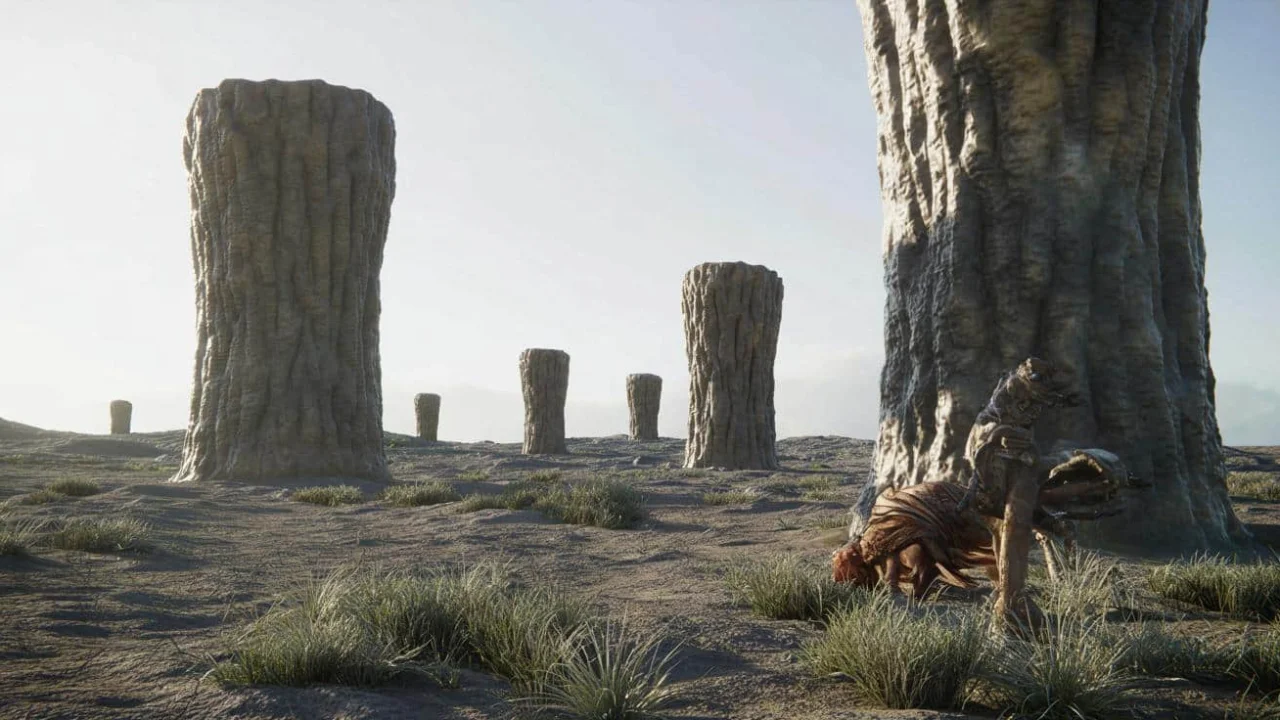
Picture walking into your local forest and seeing something that makes your brain freeze. Among the familiar oaks and pines stands a towering column, smooth and featureless, reaching higher than any tree around it. No branches. No leaves. Just a massive organic pillar that shouldn’t exist. You’d probably stand there wondering what on earth you were looking at.
That’s exactly how scientists have felt for over 160 years when examining prototaxites fossils. These mysterious giants dominated ancient landscapes long before the first trees ever existed, and they still leave researchers scratching their heads today.
Imagine if aliens visited Earth 400 million years ago and left behind structures so bizarre that we still can’t figure out what they were. That’s essentially what happened, except these weren’t alien artifacts – they were living organisms unlike anything we see today.
When Giants Ruled a World Without Trees
Step back 400 million years into the Devonian period, and you’d find yourself in a world that looks nothing like today’s green landscapes. The tallest plants barely reached your ankles – think moss, simple ferns, and scraggly ground cover. This was Earth before trees figured out how to grow tall.
Yet towering above this humble plant carpet stood massive columns, some reaching an astounding 25 feet high and as thick as modern tree trunks. These were Prototaxites, and they dominated the landscape like lonely skyscrapers in a vast, empty plain.
“These organisms were the tallest things on land for millions of years,” explains paleobotanist Dr. Sarah Mitchell. “Nothing else even came close to their height during this period.”
When Victorian-era scientists first discovered prototaxites fossils in 1843, they naturally assumed they’d found ancient tree trunks. The name “Prototaxites” literally means “first yew,” reflecting their initial belief that these were primitive ancestors of yew trees. But when researchers sliced thin sections and peered through microscopes, that theory crumbled immediately.
Instead of neat tree rings and organized wood grain, they found chaos. Tangled tubes twisted through patchy, mottled tissue that looked nothing like any plant they knew. No growth rings. No leaf scars. No root systems. Just organic complexity that refused to fit any familiar category.
The Fossil Mystery That Won’t Go Away
For decades, scientists have wrestled with two main theories about prototaxites fossils. Either these were enormous fungi – possibly the largest that ever lived – or they represented something completely different, a unique form of life that went extinct without leaving any modern relatives.
Recent research published in Science Advances has thrown fresh weight behind the second, more intriguing possibility. When researchers compared prototaxites fossils with genuine ancient fungi found in the same rock layers, the differences were striking:
- Internal structure: Prototaxites shows chaotic, branching tubes unlike the ordered networks seen in fungi
- Chemical composition: No clear traces of chitin, the tough molecule that forms fungal cell walls
- Growth patterns: The patchy “marbled” texture has no match in known fungal groups
- Size scale: Far larger than any fungi known from that time period
- Distribution: Found scattered individually rather than in the clusters typical of ancient fungi
The absence of chitin particularly puzzles researchers. Other fossil fungi from the same sites still show clear chemical signatures of this crucial fungal component. If preservation conditions were good enough to maintain chitin in nearby fungi, why not in Prototaxites?
“It’s like finding a car engine in a pile of bicycle parts,” notes geobiologist Dr. Mark Chen. “Everything about these fossils suggests we’re looking at something fundamentally different from anything else preserved at these sites.”
Here’s what we know about these ancient giants:
| Characteristic | Prototaxites | Ancient Fungi |
|---|---|---|
| Height | Up to 7.5 meters | Rarely over 1 meter |
| Internal structure | Chaotic tubes | Ordered filaments |
| Chitin presence | Absent or unclear | Clearly detectable |
| Growth pattern | Patchy, marbled | Uniform networks |
| Distribution | Individual columns | Clustered growth |
What This Means for Our Understanding of Ancient Life
If prototaxites fossils truly represent a unique, extinct lineage, it would reshape our understanding of early life on land. These organisms would have been Earth’s first experiments with large-scale terrestrial life, predating trees by tens of millions of years.
Think about the implications: while tiny plants struggled to colonize land, these mysterious giants had already mastered the art of growing tall. They somehow figured out structural engineering that wouldn’t be matched by plants until much later in Earth’s history.
“These fossils force us to imagine a completely alien ecosystem,” explains evolutionary biologist Dr. Lisa Rodriguez. “Picture a world where the tallest living things looked nothing like anything alive today – no leaves, no obvious way of feeding, just silent pillars reaching toward the sky.”
The discovery also raises fascinating questions about evolutionary dead ends. If Prototaxites represented a successful life strategy – growing tall to capture light or nutrients – why did this lineage disappear? What advantages did early trees and fungi have that ultimately replaced these giants?
Modern ecosystems show us that life finds incredibly diverse ways to thrive. From deep-sea tube worms to desert lichens, organisms exploit niches we never expected. Prototaxites fossils remind us that ancient Earth may have supported forms of life so alien to our experience that we struggle to imagine how they functioned.
For paleontologists, these fossils represent both a triumph and a humbling reminder. We can preserve and study organisms from 400 million years ago, yet we still can’t definitively say what they were. It’s a testament to both the power of fossil preservation and the limits of our understanding.
“Every time we think we’ve figured out ancient life, something like Prototaxites reminds us how much we still don’t know,” reflects paleontologist Dr. James Harrison. “These fossils are living proof – or rather, ancient proof – that Earth’s history contains chapters we’re still trying to read.”
FAQs
What exactly were Prototaxites?
Scientists still aren’t sure – they appear to be extinct organisms unlike anything alive today, possibly representing a unique evolutionary lineage that died out millions of years ago.
How big did Prototaxites grow?
The largest prototaxites fossils reach up to 7.5 meters (about 25 feet) tall and could be as thick as modern tree trunks.
When did Prototaxites live?
These organisms dominated landscapes during the Devonian period, roughly 400 million years ago, long before trees existed.
Where have Prototaxites fossils been found?
Fossil remains have been discovered worldwide, including in North America, Europe, and other continents, suggesting they were globally distributed.
Why did Prototaxites go extinct?
The exact cause is unknown, but their disappearance coincided with the rise of early trees and forests, suggesting they may have been outcompeted for resources.
Could anything like Prototaxites exist today?
No modern organisms match their unique combination of size, structure, and growth patterns, making them truly unique in Earth’s history.