
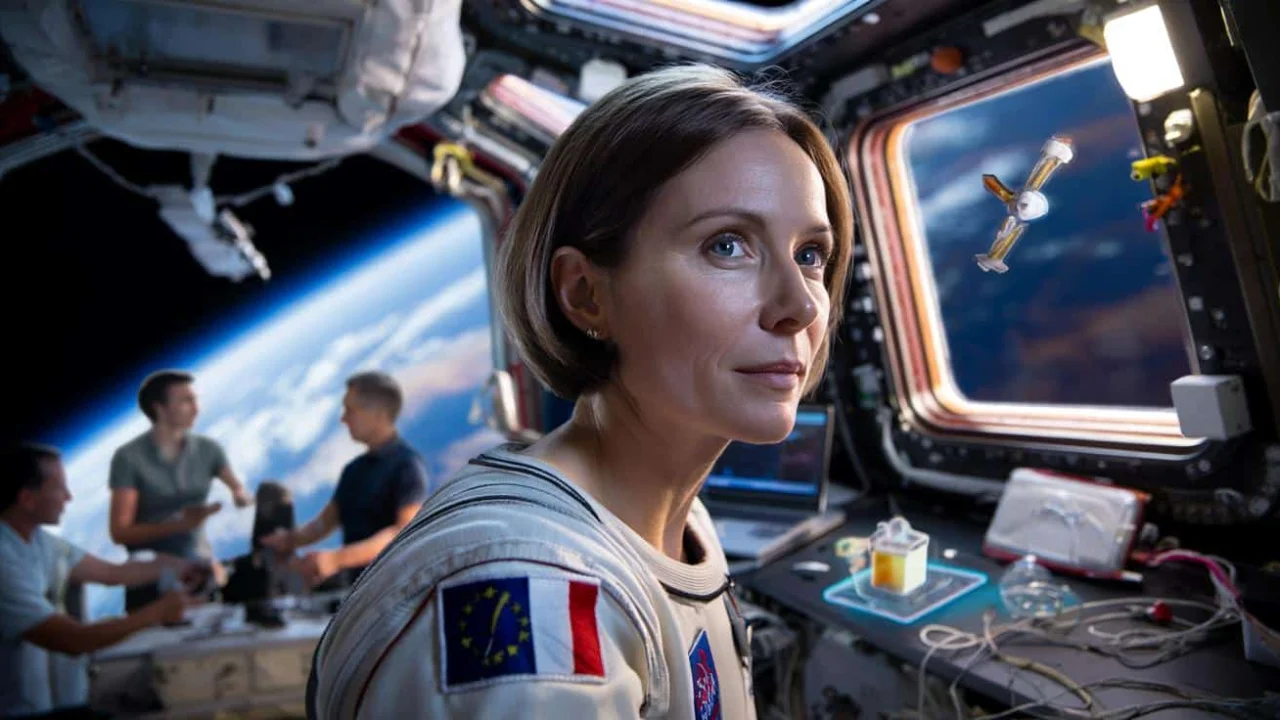
Marie-Claude sits at her kitchen table in Lyon, watching her 8-year-old daughter Amélie trace rocket ships in her homework notebook. “Maman, can girls really become astronauts?” Amélie asks, looking up with curious eyes. Marie-Claude pauses, remembering her own childhood dreams of space that seemed impossibly distant for French girls back then. “Yes, ma chérie,” she says softly, “and very soon, you’ll see proof.”
That proof is coming sooner than expected. After more than two decades since Claudie Haigneré became the first and only French woman to travel to space, France is about to witness history repeat itself. This time, it’s Sophie Adenot who will carry the tricolor beyond Earth’s atmosphere, marking a new chapter in French space exploration.
For countless French families like Marie-Claude’s, this moment represents more than just another space mission. It’s validation that the stars truly are within reach for everyone, regardless of gender.
Sophie Adenot: From Test Pilot to Space Pioneer
Sophie Adenot didn’t stumble into becoming a French woman astronaut by accident. At 41, she’s already conquered challenges that would leave most people breathless. Her journey began in the skies above France, where she worked as a helicopter test pilot – one of the most demanding aviation jobs imaginable.
Picture this: while most people worry about Monday morning traffic, Adenot was testing experimental aircraft, pushing machines to their limits to ensure safety for future pilots. Her educational background reads like a aerospace enthusiast’s dream – the prestigious Supaero aerospace school in Toulouse, followed by advanced studies at MIT.
When the European Space Agency opened applications for their latest astronaut class, Adenot stood among thousands of hopefuls. She didn’t just make the cut; she became the first from her ESA class to receive a mission assignment. That’s like being the top student in an already elite graduate program.
“Sophie represents everything we value in modern astronauts,” explains a former ESA instructor. “Technical excellence, calm decision-making, and the ability to inspire others. She’s exactly what France needs in space right now.”
The Historic Gap That’s Finally Closing
To understand why Adenot’s mission matters so much, you need to know about the gap she’s filling. Claudie Haigneré flew her last space mission in 2001 – when flip phones were cutting-edge technology and social media didn’t exist. Since then, Thomas Pesquet has brilliantly represented France in orbit, but the absence of French women in space has been glaring.
Here’s what French space representation has looked like over the past decades:
| Astronaut | Gender | Mission Years | Total Space Days |
|---|---|---|---|
| Claudie Haigneré | Female | 1996, 2001 | 25 days |
| Thomas Pesquet | Male | 2016-2017, 2021 | 396 days |
| Sophie Adenot | Female | 2025 (planned) | ~240 days (estimated) |
The numbers tell a story of missed opportunities and changing times. Adenot’s upcoming eight-month stay will make her one of France’s most experienced astronauts by total time in space.
“We’re not just sending another astronaut to space,” notes a CNES spokesperson. “We’re showing an entire generation of French girls that their dreams have no ceiling – literally.”
Inside the Crew-12 Mission Details
Adenot won’t be traveling alone on her historic journey. The Crew-12 mission brings together an international team that showcases space cooperation at its finest. Her crewmates include American astronauts Jessica Meir and Jack Hathaway, plus Russian cosmonaut Andrey Fedyaev.
The mission timeline looks intense:
- Launch Date: February 11, 2025 (weather permitting)
- Launch Vehicle: SpaceX Falcon 9 rocket with Crew Dragon capsule
- Launch Location: Kennedy Space Center, Florida
- Mission Duration: Approximately 8 months
- Primary Destination: International Space Station
Those eight months represent serious commitment. Imagine being confined to a space roughly the size of a six-bedroom house, shared with international colleagues, while traveling at 17,500 miles per hour. Every day follows a rigid schedule of scientific experiments, maintenance tasks, exercise routines, and communication with ground control centers in Houston, Toulouse, and Moscow.
Before launch, the crew enters quarantine at NASA’s Johnson Space Center in Houston. This isolation protects the ISS from infections that could spread rapidly in the station’s closed environment. Think of it as the ultimate pre-travel health precaution.
What This French Woman Astronaut Will Actually Do in Space
Adenot’s mission goes far beyond being a space tourist with a French passport. Under supervision from CNES through their Cadmos control center in Toulouse, she’ll juggle multiple demanding roles as both experiment operator and research subject.
Her scientific workload includes:
- Materials science experiments in microgravity conditions
- Biological research on plant growth in space
- Medical studies on bone density changes during long-duration flight
- Technology demonstrations for future space missions
- Educational outreach programs for French schools
The educational component particularly excites French educators. Adenot will conduct live sessions with students across France, demonstrating physics concepts impossible to show on Earth. Imagine explaining fluid dynamics while floating water droplets dance in mid-air around you.
“Sophie will become a real-time science teacher for an entire generation,” explains a education ministry official. “Kids will see physics principles demonstrated by a French woman floating 400 kilometers above their heads.”
Breaking Barriers Beyond French Borders
While Adenot’s nationality makes headlines in France, her impact extends throughout Europe and beyond. The European Space Agency has invested heavily in diversifying their astronaut corps, recognizing that space exploration benefits from varied perspectives and experiences.
Her mission coincides with Europe’s broader space ambitions. The continent is developing its own crew transportation capabilities and planning lunar missions for the 2030s. Having experienced European astronauts like Adenot provides crucial expertise for these future endeavors.
NASA’s partnership with ESA has evolved dramatically since the early space station days. Today’s collaborations involve shared crew positions, joint research projects, and integrated mission planning. Adenot’s flight represents this cooperation at its most visible.
“International space cooperation isn’t just about politics,” observes a space policy analyst. “It’s about combining the best minds and resources to push human knowledge forward. Sophie embodies that principle perfectly.”
FAQs
Who was the first French woman in space?
Claudie Haigneré was the first and only French woman astronaut before Sophie Adenot, flying missions in 1996 and 2001.
How long will Sophie Adenot stay in space?
Adenot’s Crew-12 mission is planned for approximately eight months on the International Space Station.
When does Sophie Adenot launch to space?
The Crew-12 mission is scheduled to launch on February 11, 2025, though the date could change due to weather or technical considerations.
What makes Sophie Adenot qualified to be an astronaut?
Adenot brings extensive experience as a helicopter test pilot, plus education from France’s elite Supaero aerospace school and MIT.
Will Sophie Adenot conduct experiments in space?
Yes, she’ll manage numerous scientific experiments for CNES and participate in educational outreach programs with French schools.
How does Sophie Adenot’s mission compare to Thomas Pesquet’s flights?
While Pesquet has completed two missions totaling 396 days in space, Adenot’s single eight-month mission will make her highly experienced among French astronauts.