
Pierre stared at his monthly electricity bill, shaking his head as the number seemed to climb higher each year. Like many rural homeowners in France, he was tired of feeling helpless against rising energy costs. But unlike most people who simply grumble and pay up, Pierre decided to do something radical.
He walked out to his garage, looked at a pile of old laptop batteries he’d been collecting, and had what he calls his “lightbulb moment.” What if these discarded batteries could power his entire home?
Eight years later, that crazy idea has become a reality. Pierre’s laptop battery power system has kept his lights on, his refrigerator running, and his heating working without drawing a single kilowatt from the grid.
When Trash Becomes Treasure
Back in 2016, home energy storage was expensive and complicated. Tesla Powerwalls cost tens of thousands of dollars, and most solar setups still left homeowners dependent on the grid after sunset. Pierre had already installed basic solar panels and an old forklift battery, but the storage capacity barely lasted through the night.
That’s when he started looking at laptop batteries differently. Every day, businesses, schools, and individuals throw away laptop battery packs that can no longer hold enough charge to run a computer for more than an hour. Most people see electronic waste. Pierre saw opportunity.
“I realized these batteries weren’t dead – they were just tired,” Pierre explains. “A laptop needs consistent, high-level power. But for home storage, even degraded cells can do useful work.”
He began collecting discarded laptop batteries from computer repair shops, office buildings, and even neighbors. Each battery pack contains multiple 18650 cells – the same cylindrical batteries used in everything from flashlights to electric vehicles.
Over several years, more than 1,000 laptop battery packs passed through Pierre’s hands. He carefully tested each one, salvaging usable cells and properly recycling the rest. About 650 packs contributed cells to his growing energy storage system.
Building a Backyard Power Plant
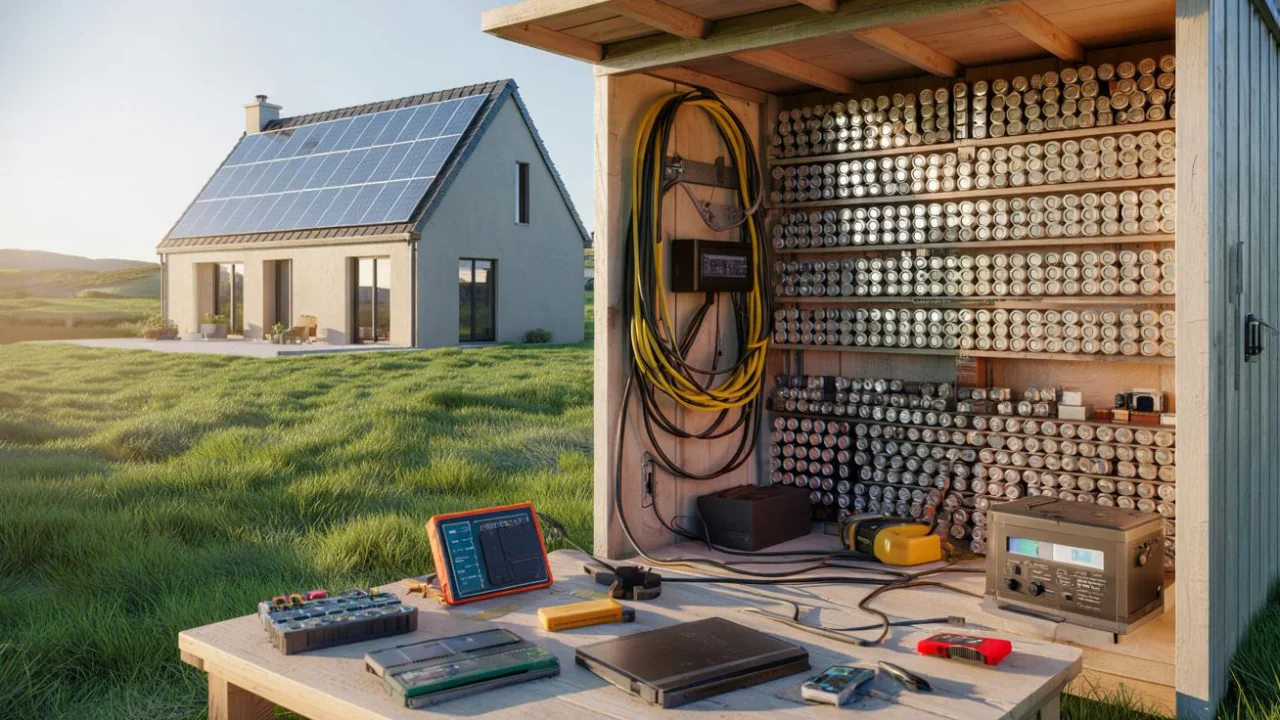
As his collection grew, Pierre’s garage corner became too small. He constructed a dedicated shed about 50 meters from his house – far enough for safety, close enough for convenience.
Inside this modest building sits what experts call an impressive feat of DIY engineering. Wall-mounted racks hold hundreds of battery modules, each containing carefully matched 18650 cells. Thick copper cables connect everything to inverters and charge controllers that manage the flow of electricity.
The system specifications tell the story:
| Component | Details |
|---|---|
| Total battery capacity | 40+ kWh usable storage |
| Solar input | 6kW solar panel array |
| Power output | Up to 10kW continuous |
| System voltage | 48V DC battery bank |
| Backup duration | 3-5 days without sun |
“The hardest part wasn’t the technical side – it was convincing my wife I wasn’t going to burn the house down,” Pierre laughs.
His laptop battery power system includes multiple safety features:
- Individual cell monitoring to prevent overcharging
- Automatic disconnect switches for emergencies
- Temperature sensors throughout the battery bank
- Fire suppression equipment in the shed
- Ventilation systems to prevent gas buildup
The Numbers That Matter
After eight years of operation, Pierre’s results speak for themselves. His electricity bill? Zero euros per month. His carbon footprint? Dramatically reduced. His energy independence? Complete.
But the financial benefits go beyond just avoiding utility bills. Building the entire system cost Pierre approximately 3,000 euros – mostly for inverters, charge controllers, and safety equipment. The batteries themselves cost nothing except time and effort.
“Traditional home battery systems would have cost me 20,000 euros or more,” Pierre notes. “I built something better for less than a sixth of that price.”
Energy experts are taking notice. Dr. Marie Dubois, who researches renewable energy systems, says Pierre’s approach addresses a growing problem: “We’re creating millions of tons of battery waste while simultaneously needing more energy storage. Projects like this show how circular economy principles can solve both problems.”
The environmental impact extends beyond just reusing batteries. Pierre’s system has prevented roughly 650 laptop battery packs from entering landfills, where they could leak toxic materials. Instead, these batteries continue providing value for years beyond their original purpose.
What This Means for Everyone Else
Pierre’s success doesn’t mean everyone should start collecting laptop batteries. His project required extensive electrical knowledge, safety precautions, and hundreds of hours of work. But his approach does highlight important possibilities.
The biggest takeaway isn’t technical – it’s philosophical. We live in a world that treats electronic devices as disposable, but many components retain significant value. Pierre proved that with creativity and skill, waste can become resource.
“I’m not trying to convince everyone to build their own power plant,” Pierre explains. “But I want people to think differently about what we throw away.”
His success has inspired others in his community. Local schools now save their old laptop batteries for Pierre to evaluate. Computer repair shops call when they accumulate battery waste. A small network of enthusiasts has formed to share knowledge about battery restoration and safety.
The laptop battery power system concept could scale up too. Small businesses dealing with electronic waste might find profitable opportunities in battery refurbishment. Communities could develop local programs to harvest and reuse batteries from discarded devices.
Looking Forward
Pierre’s system continues running smoothly after eight years. He monitors battery health regularly and reports that degradation has been minimal. The careful matching of cells and conservative charging practices have extended battery life far beyond typical expectations.
He’s already planning improvements. A second shed could double his storage capacity. Smart home integration could optimize energy usage automatically. Vehicle charging capabilities could make his system even more valuable.
“This project changed how I think about energy, waste, and self-reliance,” Pierre reflects. “It showed me that with enough determination, one person really can make a difference.”
FAQs
Is it safe to build a home power system from laptop batteries?
It requires extensive electrical knowledge and proper safety equipment, but can be done safely with the right precautions.
How much money can you actually save with a laptop battery power system?
Pierre eliminated his electricity bill entirely, saving thousands of euros per year while building the system for about 3,000 euros.
Where do you find enough old laptop batteries for such a project?
Computer repair shops, businesses, schools, and electronics recycling centers often have large quantities of discarded laptop batteries.
How long do salvaged laptop batteries last in home energy storage?
Pierre’s batteries have performed well for eight years, though individual cell lifespan depends on their condition when salvaged.
Could this approach work in urban areas?
Space and safety requirements make it challenging in dense urban settings, but smaller-scale versions might be possible.
What happens to laptop batteries that can’t be reused?
Pierre sends unusable batteries to proper recycling facilities where valuable materials can be recovered safely.