
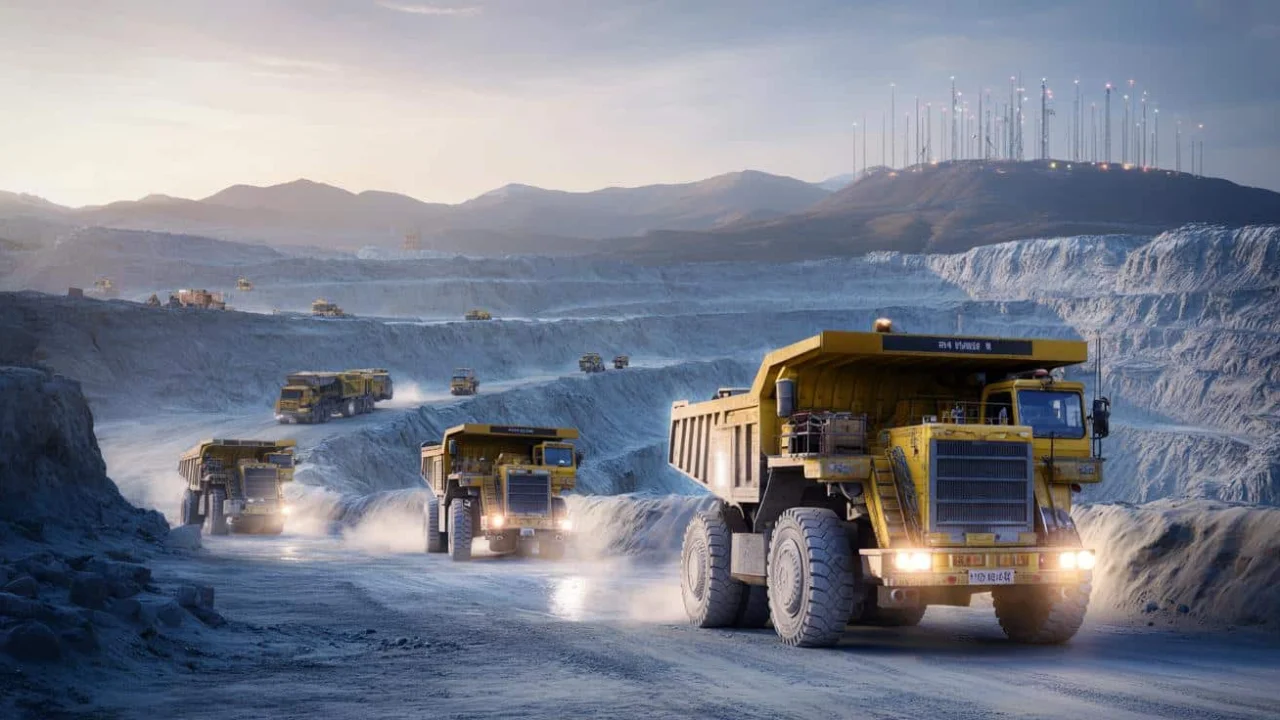
Picture this: You’re standing at the base camp of Mount Everest, gasping for breath at 5,400 meters above sea level. Your head pounds, your lungs burn, and every movement feels like running through thick honey. Now imagine trying to operate a 400-tonne mining truck in these conditions, day after day, with temperatures that can freeze your equipment solid.
This isn’t a hypothetical nightmare scenario. It’s the daily reality at China’s Huoshaoyun mine, perched even higher at 5,600 meters in the Kunlun Mountains. But here’s the twist: there are no human drivers struggling to breathe in those massive truck cabs anymore.
China has deployed a fleet of autonomous mining trucks to tackle what might be the world’s most hostile mining environment, and the stakes couldn’t be higher. We’re talking about a €45 billion treasure buried beneath some of the most unforgiving terrain on Earth.
When Human Limits Meet Mountain Peaks
The Huoshaoyun mine sits in the disputed Aksai Chin region, where the air is so thin that every breath contains about half the oxygen you’d get at sea level. To put this in perspective, this mine operates at an altitude higher than the Peruvian settlement of La Rinconada, often called the highest permanent town on Earth.
Working at this elevation isn’t just uncomfortable – it’s genuinely dangerous. Mining engineer Sarah Chen explains: “At 5,600 meters, your body is in survival mode. Heavy physical work can trigger pulmonary edema within hours, and that’s potentially fatal.”
The environmental challenges read like a survival horror checklist:
- Temperatures plummet to -20°C and below
- Oxygen levels drop to dangerous lows
- Ground remains permanently frozen
- Fierce winds strip heat from exposed skin
- Altitude sickness strikes within hours of arrival
Yet beneath this frozen wasteland lies one of the planet’s largest lead and zinc deposits. Geological surveys estimate over 21 million tonnes of combined metals, making it the seventh-largest lead-zinc mine globally.
“The math was simple,” says industrial automation specialist Dr. Wang Lei. “Either we find a way to mine without putting humans at constant risk, or we walk away from €45 billion worth of resources.”
The Rise of Robot Miners
China’s solution reads like science fiction, but it’s operating right now. Dozens of massive autonomous mining trucks navigate the treacherous mountain terrain, hauling ore without a single human driver.
These aren’t simple remote-controlled vehicles. Each truck bristles with sophisticated technology that would make a Tesla Model S seem primitive:
| Technology | Function | Benefit at High Altitude |
|---|---|---|
| LiDAR sensors | 3D terrain mapping | Works in low visibility conditions |
| Thermal cameras | Heat signature detection | Identifies obstacles in extreme cold |
| Radar systems | Long-range obstacle detection | Penetrates snow and ice |
| AI computing units | Real-time decision making | Adapts to changing conditions instantly |
| GPS + inertial navigation | Precise positioning | Functions despite satellite signal interference |
The trucks don’t follow rigid pre-programmed routes like factory robots. Instead, they constantly analyze their surroundings, adjusting speed and path based on road conditions, weather, and obstacles.
“These vehicles essentially ‘think’ their way around the mine site,” explains robotics researcher Dr. Liu Ming. “They can handle unexpected situations that would challenge even experienced human drivers.”
What This Means for the Future of Mining
The success at Huoshaoyun isn’t just about one remote mine in China. It’s a glimpse into mining’s automated future, with implications that extend far beyond the industry itself.
First, there’s the safety revolution. Mining has historically been one of the world’s most dangerous professions, with thousands of workers killed annually in accidents worldwide. Autonomous mining trucks remove humans from the most hazardous operations while maintaining productivity.
The economic impact is equally significant. Traditional mining at extreme altitudes requires enormous infrastructure investments just to keep workers alive – heated facilities, medical equipment, oxygen systems, and specialized food supplies. Autonomous trucks slash these overhead costs.
Environmental benefits emerge too. Autonomous mining trucks operate more efficiently than human drivers, using optimized routes and consistent driving patterns that reduce fuel consumption and emissions.
But the technology’s reach extends beyond mining. The sensors and AI systems developed for these harsh conditions are already finding applications in:
- Arctic shipping and logistics
- Military operations in extreme environments
- Disaster response in dangerous areas
- Deep-sea exploration vehicles
“What we’re learning at 5,600 meters will eventually make autonomous vehicles safer and more reliable everywhere,” notes transportation technology analyst Maria Rodriguez.
The Human Side of an Automated Revolution
Of course, this technological leap raises questions about employment. Mining has traditionally provided well-paying jobs for workers in remote regions, and automation inevitably reduces the need for human labor.
However, industry experts argue that autonomous mining trucks create different types of jobs rather than simply eliminating them. Someone needs to maintain the sophisticated sensor arrays, program the AI systems, and monitor operations from control centers.
“We’re not eliminating mining jobs – we’re transforming them from physically dangerous work to high-tech careers,” explains mining industry consultant James Patterson. “The miners of tomorrow will be operating from climate-controlled facilities, managing fleets of robots instead of risking their lives underground or at altitude.”
The Huoshaoyun project also demonstrates how automation can unlock previously impossible projects. Without autonomous mining trucks, this €45 billion deposit might have remained untouchable, providing no economic benefit or employment opportunities at all.
Looking Ahead: The New Normal?
China’s success with autonomous mining trucks at Huoshaoyun is already inspiring similar projects worldwide. Mining companies in Australia, Canada, and South Africa are testing their own fleets of driverless vehicles, though none yet match the extreme operating conditions of the Kunlun Mountains.
The technology will likely spread to more conventional mining operations too. Even in less hostile environments, autonomous trucks offer advantages in consistency, efficiency, and safety that make them attractive to mine operators.
As the technology matures and costs decrease, we can expect to see autonomous mining trucks become as common as automated factory equipment. The question isn’t whether this technology will spread, but how quickly mining companies will adopt it.
The frozen peaks of the Kunlun Mountains might seem like an unlikely birthplace for mining’s future, but extreme conditions often drive the most innovative solutions. When human limits meet impossible challenges, sometimes the answer isn’t to push humans harder – it’s to let machines take over entirely.
FAQs
How do autonomous mining trucks work in extreme weather conditions?
The trucks use multiple sensor types including thermal cameras, radar, and LiDAR that function effectively in snow, ice, and low visibility conditions.
Are these trucks completely autonomous or do humans control them?
The trucks operate semi-autonomously, making real-time decisions independently but with human oversight from remote control centers.
How much do these autonomous mining trucks cost?
While exact costs aren’t publicly disclosed, industry estimates suggest each truck costs several million euros including sensors and AI systems.
Can autonomous mining trucks work in normal mining conditions too?
Yes, the technology developed for extreme conditions works even better in normal environments, with several mining companies testing fleets worldwide.
What happens if the trucks break down in such a remote location?
The trucks are equipped with diagnostic systems that predict maintenance needs, and specialized repair teams can be dispatched when necessary.
How many jobs will autonomous mining trucks eliminate?
While they reduce the need for truck drivers, they create new positions in vehicle maintenance, remote monitoring, and system programming.