
Sarah stared at her electricity bill in disbelief. The number seemed impossible – $347 for one month. Her husband walked over, squinting at the paper. “Must be a mistake,” he muttered. But it wasn’t. Their home AI assistant, the smart security system, and her son’s gaming setup had quietly consumed more power than their air conditioning during the hottest summer on record.
This scene plays out in millions of homes worldwide, but it’s just the tip of the iceberg. Behind every ChatGPT conversation and AI-generated image lies a massive, hidden energy cost that’s pushing our power grids to their limits. Now, researchers think they’ve found a solution by teaching AI to learn more like the human brain.
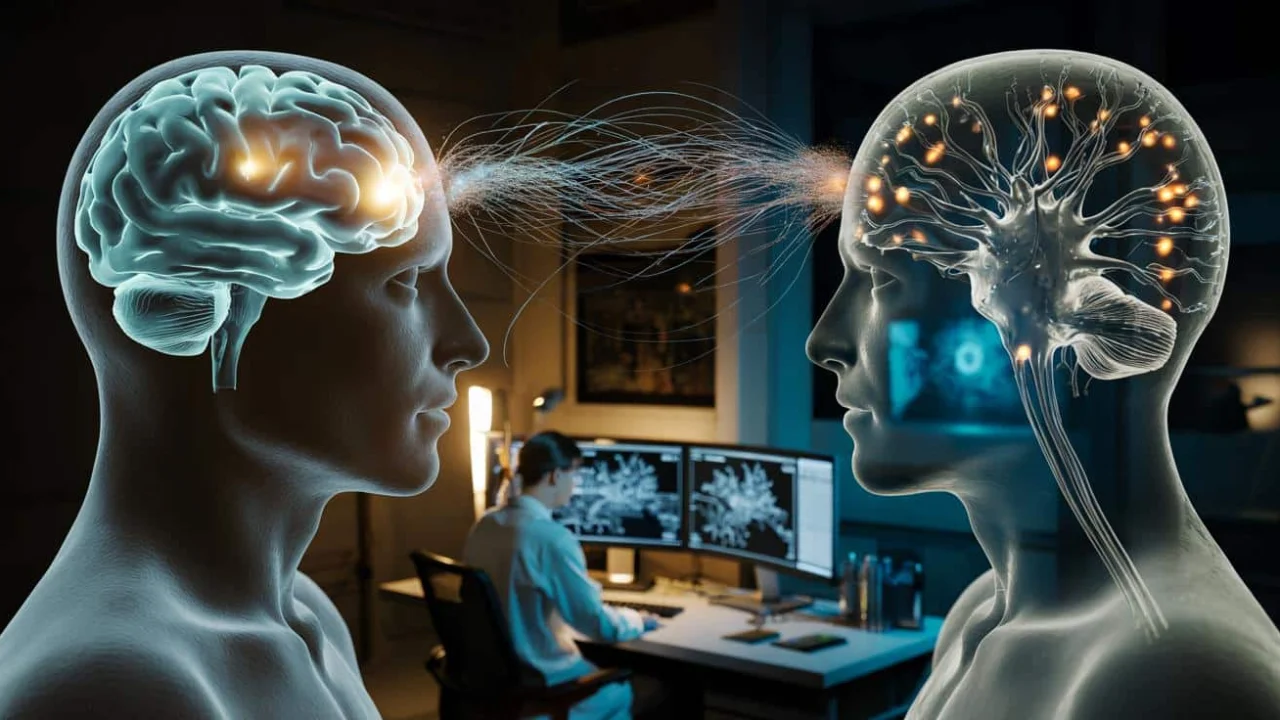
A team at Cold Spring Harbor Laboratory in New York has developed a breakthrough approach that could revolutionize ai energy efficiency. Their method doesn’t just promise to cut power consumption – it could make AI systems smarter while using a fraction of the electricity.
Why Today’s AI Burns Through Electricity Like There’s No Tomorrow
Every time you ask an AI chatbot a question, you’re essentially firing up a digital power plant. Current AI systems work by processing enormous batches of data through billions of artificial connections, all at once. Think of it like trying to solve a jigsaw puzzle by moving every piece simultaneously instead of placing them one at a time.
“Most of the effort goes into moving data around the network, not actually thinking,” explains Dr. Marina Rodriguez, an AI researcher at Stanford University. “The transport, not the logic, eats the power.”
The numbers tell a startling story. Training a single large language model can consume as much electricity as 120 American homes use in an entire year. Some experts, including Elon Musk, warn that AI development could hit an energy wall within the next year if this trend continues.
But here’s what makes this crisis particularly frustrating: our brains solve complex problems using roughly the same energy as a light bulb. While AI systems burn through megawatts, your brain hums along on about 20 watts – less power than your phone charger uses.
The Game-Changing Discovery: AI That Learns Like Your Brain
The breakthrough came when researcher Kyle Daruwalla and his team asked a deceptively simple question: what if AI could learn the way humans do, bit by bit, moment by moment?
Their solution centers on something called “working memory” – that mental notepad you use to remember a phone number for a few seconds or keep track of grocery list items. In the human brain, this system sits at the crossroads of perception, attention, and decision-making.
Here’s how their revolutionary approach works:
- Continuous learning: Instead of processing data in massive batches, the AI updates itself constantly, like a human brain
- Local processing: Information gets processed where it’s needed, reducing data transport
- Memory integration: An auxiliary memory network runs alongside the main system, mimicking human working memory
- Selective attention: The system focuses on relevant information while filtering out noise
“We’re essentially giving AI a more human-like attention span,” notes Dr. James Chen, a neuroscientist at MIT who wasn’t involved in the research. “This isn’t just about efficiency – it’s about creating smarter systems that think more like we do.”
| Traditional AI | Brain-Inspired AI |
|---|---|
| Processes data in huge batches | Updates continuously in real-time |
| High energy consumption | Dramatically lower power usage |
| Sequential learning phases | Simultaneous learning and processing |
| Limited working memory | Integrated memory system |
The results so far are remarkable. In preliminary tests, the new approach showed significant improvements in ai energy efficiency while maintaining – and sometimes exceeding – performance levels of traditional systems.
What This Means for Your Daily Life
This breakthrough could transform everything from your smartphone to your car’s navigation system. Imagine AI assistants that work for weeks on a single battery charge, or smart home systems that barely register on your electricity bill.
The implications stretch far beyond personal convenience. Data centers currently consume about 1% of global electricity – a figure projected to reach 8% by 2030. More efficient AI could dramatically slow this growth, reducing both energy costs and environmental impact.
“We’re looking at a future where AI becomes democratized,” explains Dr. Lisa Park, a technology policy researcher at Carnegie Mellon. “When the energy barrier comes down, smaller companies and developing countries can access advanced AI capabilities.”
For businesses, the economic impact could be massive. Companies spending millions on AI infrastructure costs might see those expenses cut by 70% or more. This could accelerate AI adoption across industries that previously found the technology too expensive to implement.
The technology also opens doors to AI applications that were previously impossible. Battery-powered robots could operate for days instead of hours. Medical devices could run sophisticated AI diagnostics without being plugged into the wall. Even your fitness tracker could become dramatically smarter without sacrificing battery life.
However, widespread adoption won’t happen overnight. The research team estimates it could take 3-5 years before the first commercial applications appear, and another decade before the technology becomes standard across the industry.
“This is like moving from steam engines to electric motors,” observes Dr. Chen. “The transition takes time, but once it happens, there’s no going back.”
The Road Ahead: Challenges and Opportunities
Despite the promising results, significant hurdles remain. Current AI hardware and software are designed around traditional batch processing methods. Implementing brain-inspired learning requires fundamental changes to both chip architecture and programming frameworks.
Major tech companies are taking notice. Google, Microsoft, and NVIDIA have all begun exploring similar approaches, though none have matched the Cold Spring Harbor team’s results. The race is on to commercialize this technology before competitors catch up.
For consumers, the wait might be worth it. Early estimates suggest that brain-inspired AI could cut personal device energy consumption by 60-80% while delivering faster, more responsive performance. Your next smartphone might think more like your brain – and last twice as long on a single charge.
FAQs
How much energy does current AI really use?
Training a large AI model like GPT-3 consumes about 1,287 MWh of electricity – enough to power an average American home for 120 years.
When will brain-inspired AI be available in consumer products?
Researchers estimate the first commercial applications could appear within 3-5 years, with widespread adoption taking another 5-10 years.
Will this new AI technology be more expensive?
Initially yes, but long-term costs should be dramatically lower due to reduced energy consumption and simpler hardware requirements.
Could this technology work with existing AI systems?
The approach requires significant changes to both hardware and software, so existing systems would need substantial modifications or complete replacement.
How does brain-inspired AI compare to human intelligence?
While it mimics some aspects of human learning, it’s still artificial intelligence – just one that learns more efficiently by borrowing strategies from biological brains.
What are the biggest obstacles to adoption?
The main challenges include redesigning computer chips, retraining AI developers, and convincing companies to invest in new infrastructure.