
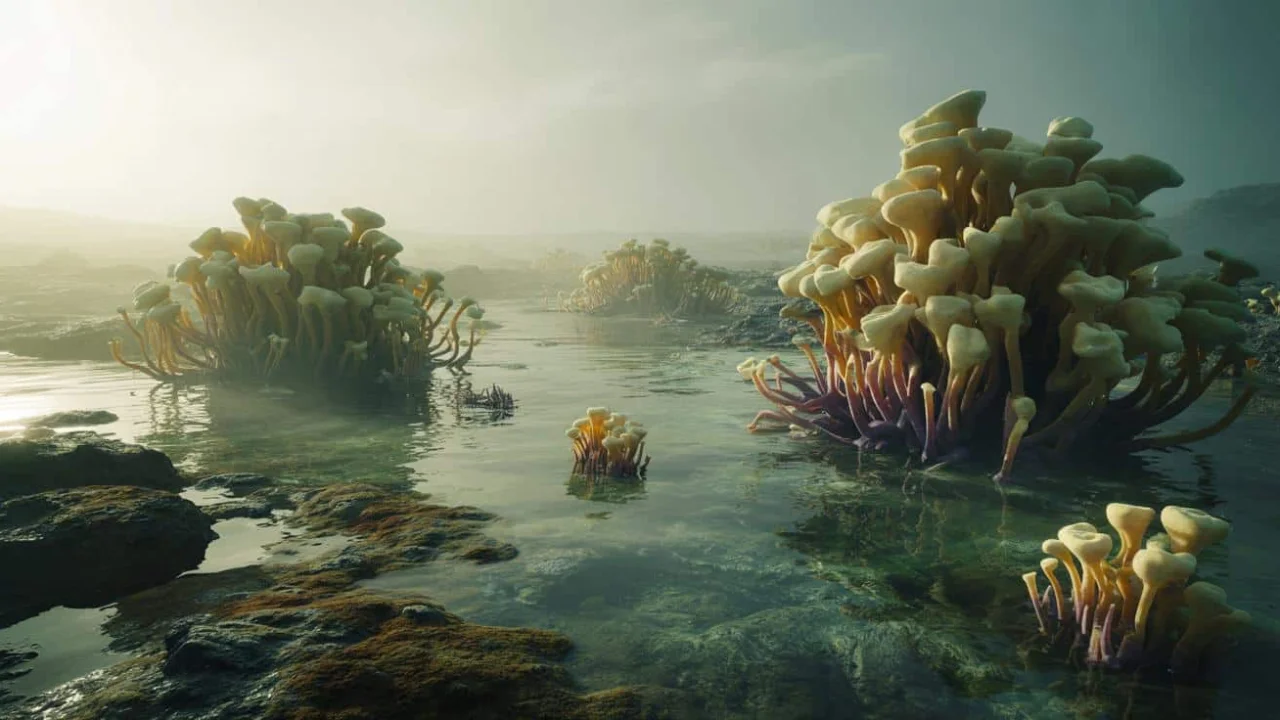
Picture this: You’re walking through your garden, admiring the towering oak tree that’s been there longer than your house. You run your fingers along its rough bark, thinking about all the history it’s witnessed. But what if I told you that long before any tree ever existed on Earth, our planet was already home to creatures so massive and strange that they’d make your oak look ordinary?
That’s exactly what happened to paleontologist Elizabeth Turner when she brushed dust off a peculiar rock formation in Canada’s frozen wilderness. What she found wasn’t just another fossil—it was evidence of an ancient giant lifeform that lived nearly 900 million years ago, rewriting everything we thought we knew about life on Earth.
Her discovery forces us to confront an uncomfortable truth: the story we’ve been telling ourselves about ancient life is incomplete, and the real history is far more mysterious than we ever imagined.
When Earth Was Ruled by Soft-Bodied Giants
Close your eyes and imagine ancient Earth. Your mind probably conjures images of massive dinosaurs stomping through dense forests or colorful trilobites scurrying across ocean floors. Now strip all that away. Go back further—much further—to a time when continents were bare rock and the oceans held nothing larger than microscopic slime.
That seemingly empty world wasn’t empty at all. Hidden in 890-million-year-old limestone from Canada’s Stone Knife Formation, Turner discovered something extraordinary: delicate, branching networks that look like three-dimensional lace frozen in time.
“When I first saw these structures under the microscope, I knew I was looking at something unprecedented,” Turner explains. “The complexity and organization suggested this wasn’t just bacterial mats or simple organic films.”
These intricate patterns bear an uncanny resemblance to the internal skeletons of modern sponges—not the colorful bath sponges we know, but their ancient relatives that would have formed massive, multi-armed colonies on long-vanished reefs.
The implications hit like a scientific earthquake. If Turner’s interpretation is correct, these fossils represent large animals that lived 350 million years before what we traditionally consider the “dawn of animal life.”
What This Ancient Giant Lifeform Discovery Really Means
Biology textbooks have long taught us that complex animal life began around 540 million years ago during the famous Cambrian explosion. Some earlier life forms, like the mysterious Ediacaran organisms, pushed that timeline back slightly. But Turner’s ancient giant lifeform evidence shatters those assumptions entirely.
Here’s what makes this discovery so groundbreaking:
- Massive timeline shift: Complex animals may have emerged 350 million years earlier than previously thought
- Survival in harsh conditions: These creatures thrived in low-oxygen environments vastly different from today’s Earth
- Unprecedented size: While most life was microscopic, these organisms grew to substantial proportions
- Advanced structure: The fossilized networks show sophisticated internal organization
- Reef ecosystem builders: They likely formed complex communities on ancient seafloors
“This pushes the origin of animals back into a time period we never thought possible,” says marine biologist Dr. Sarah Chen. “It’s like finding a smartphone in a medieval castle—it doesn’t fit our understanding of when certain technologies should exist.”
| Timeline Event | Previous Dating | New Evidence Suggests |
|---|---|---|
| First complex animals | 540 million years ago | 890 million years ago |
| Atmospheric oxygen | High levels needed | Low levels sufficient |
| Ecosystem complexity | Cambrian period | Precambrian period |
| Reef communities | After 500 million years ago | Before 800 million years ago |
The ancient giant lifeform Turner discovered challenges our understanding of early Earth’s habitability. These creatures somehow flourished in an alien world with thin oxygen levels, no protective ozone layer, and harsh radiation from space.
How This Changes Everything We Know About Life
This discovery doesn’t just add a footnote to evolutionary history—it rewrites entire chapters. The ancient giant lifeform evidence suggests that complex life is far more resilient and adaptable than we ever imagined.
Think about what this means for your understanding of evolution. We’ve always assumed that complex life required specific conditions: high oxygen levels, stable climate, protective atmosphere. But these ancient giants prove that life found a way to thrive under conditions that would be lethal to most modern organisms.
“It’s humbling to realize that our planet supported complex ecosystems long before conditions were supposedly ‘right’ for them,” notes evolutionary biologist Dr. Michael Torres. “These organisms were pioneers in the truest sense.”
The implications extend beyond Earth. If complex life can emerge and survive under such harsh conditions, it dramatically expands the possibilities for life on other planets. Those seemingly hostile exoplanets we’ve dismissed might actually harbor their own ancient giant lifeforms.
For scientists, this discovery opens entirely new research avenues:
- Reexamining old fossil sites with fresh eyes
- Developing new techniques to detect soft-tissue preservation
- Investigating how early complex life survived low-oxygen environments
- Exploring the connection between these ancient forms and modern sponges
But perhaps most importantly, it reminds us how much we still don’t know about our own planet’s history. Every rock formation, every fossil site, potentially holds secrets that could revolutionize our understanding of life itself.
Turner’s ancient giant lifeform discovery proves that Earth’s story is far stranger and more wonderful than we ever dared imagine. These mysterious soft-bodied giants ruled a world so alien it might as well have been another planet, yet they paved the way for every complex organism that followed—including us.
The next time you look at that tree in your garden, remember: its ancestors were sharing the planet with creatures so extraordinary that we’re only now beginning to understand they existed at all.
FAQs
How big were these ancient giant lifeforms?
While exact sizes are difficult to determine from the fossilized networks, evidence suggests they formed substantial colonies that could have been several feet across, making them giants compared to the microscopic life that dominated their era.
Why haven’t we found these fossils before?
Soft-bodied organisms rarely fossilize because they lack hard shells or bones. These particular specimens were preserved under very specific conditions in limestone formations, and scientists are now reexamining old sites with new techniques.
Could these creatures still exist today?
No, these exact ancient giant lifeforms went extinct long ago. However, they may be related to modern sponges, which are considered some of the simplest animals alive today.
What did Earth look like when these creatures lived?
Earth 890 million years ago was dramatically different—no trees, no flowers, very low oxygen levels, bare continents, and harsh radiation. The ancient giant lifeforms lived in shallow seas under conditions that would be hostile to most modern life.
How does this discovery affect the search for life on other planets?
It dramatically expands possibilities by showing that complex life can emerge and thrive under much harsher conditions than previously thought, meaning more exoplanets could potentially harbor life.
Are scientists certain these fossils represent ancient animals?
While the evidence is compelling, scientific debate continues. The structures strongly resemble sponge anatomy, but more fossils and analysis are needed to confirm this revolutionary interpretation definitively.