
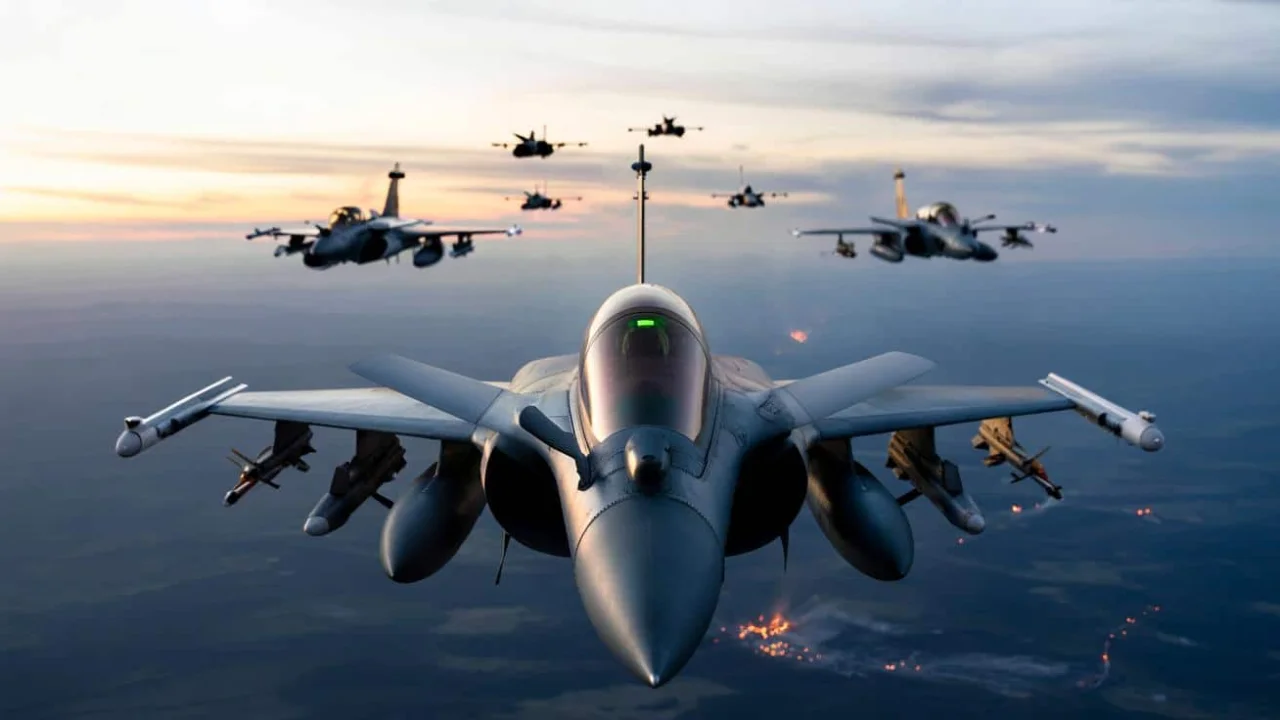
Picture this: It’s 3 AM at a quiet French airbase. Suddenly, alarms pierce the darkness. Pilots sprint to their Rafale fighters while ground crews frantically prep weapons and fuel. Within hours, these multi-million-dollar jets disappear into the night, scattering to hidden airstrips across the country.
This wasn’t a real crisis. It was Exercise Topaze, and it just showed the world how France plans to fight the next war. The dramatic finale? A precision SCALP cruise missile strike that hit its target with surgical accuracy, proving that even when scattered and stressed, French air power remains deadly.
For most of us watching the news, military exercises feel distant and abstract. But the Topaze exercise represents something much more personal: how Europe is preparing for conflicts that could reshape our daily lives in ways we’re only beginning to understand.
When War Games Mirror Real Fears
The Topaze exercise began on January 27th with a simple but terrifying scenario. Rafale fighters from the 30th Fighter Wing at Mont-de-Marsan received urgent orders to evacuate immediately. Their destination? Four separate airfields scattered across southwestern France: Cazaux, Cognac, Mérignac, and Clermont-Ferrand.
- France’s DESIR Project: Why This New Radar Imaging Satellite Has Defense Experts Buzzing
- Canada could become home to massive Gripen fighter jet assembly line under Saab’s surprising new proposal
- Italian Army’s Revolutionary KF41 Lynx Infantry Fighting Vehicles Finally Arrive After Years of Anticipation
- French Space Command Quietly Building Earth’s Defense Shield That Nobody Saw Coming
- Italy quietly deploys game-changing SAMP/T NG air defence system that could reshape European security
- Poland quietly considers A-29 Super Tucano jets to counter growing drone threats
“The message was crystal clear,” explains a senior French Air Force official. “In modern warfare, sitting ducks don’t survive. We had to prove our pilots could fight effectively even when operating from unfamiliar bases under extreme pressure.”
This exercise drew directly from harsh lessons learned in Ukraine, where concentrated air bases became sitting targets for enemy missiles. The French military watched as sophisticated Russian strikes disabled entire airfields within hours, leaving expensive aircraft vulnerable on the ground.
The solution? Never stay in one place long enough to become a target. Keep moving, keep adapting, and maintain the ability to strike back even when your home base is under attack.
Breaking Down the Topaze Exercise Operations
The complexity of the Topaze exercise becomes clear when you see what French pilots accomplished in just a few short days:
| Exercise Phase | Duration | Key Activity | Challenge Level |
|---|---|---|---|
| Emergency Dispersal | First 24 hours | Rapid deployment to 4 bases | High |
| Adaptation Period | Days 2-3 | Establishing operations at new locations | Critical |
| Mission Planning | Day 4 | Coordinating long-range strike | Extreme |
| SCALP Strike | Final day | Live missile engagement | Mission Critical |
The most impressive aspect wasn’t just moving the aircraft. Ground crews had to transport:
- Specialized maintenance equipment weighing several tons
- Advanced targeting systems and communication gear
- Live SCALP cruise missiles worth millions of euros
- Fuel, spare parts, and emergency supplies
- Complete command and control capabilities
“We’re not just moving planes,” noted a logistics coordinator involved in the exercise. “We’re relocating an entire military capability while maintaining full combat readiness. It’s like moving a hospital while keeping patients alive.”
Why the SCALP Strike Finale Matters
The climax of the Topaze exercise came with something most military drills avoid: firing real weapons. The SCALP cruise missile strike wasn’t just for show – it demonstrated France’s ability to project power even under the most challenging circumstances.
SCALP missiles represent some of the most advanced weapons in the French arsenal. These cruise missiles can:
- Strike targets over 250 kilometers away
- Navigate complex terrain using advanced GPS and terrain-following technology
- Penetrate heavily defended airspace
- Deliver precision strikes with minimal collateral damage
The successful strike proved that dispersed French forces could still coordinate complex, long-range operations. This capability sends a clear message to potential adversaries: destroying France’s main airbases won’t eliminate their ability to fight back.
“The SCALP strike was the whole point,” explains a defense analyst familiar with the exercise. “Anyone can scatter aircraft and hide them. The real test is whether you can still execute sophisticated missions when everything is improvised and you’re operating from backup locations.”
What This Means for European Security
The Topaze exercise reflects a broader shift in how European militaries think about modern warfare. The days of massive, static military installations are ending. Future conflicts will favor forces that can adapt, move, and strike from unexpected locations.
For civilians, this evolution has practical implications. Military exercises like Topaze often use civilian airports and infrastructure, meaning increased security measures and occasional disruptions at facilities we use daily.
But there’s a deeper significance. The skills demonstrated in the Topaze exercise – rapid deployment, improvised operations, and coordinated strikes – could prove essential if tensions with Russia or other adversaries escalate.
“We’re not preparing for some distant theoretical conflict,” warns a European defense official. “We’re rehearsing capabilities we might need within the next decade. The Topaze exercise showed we’re getting serious about being ready.”
The exercise also highlighted France’s role as a major military power within NATO and the European Union. While some allies focus on defensive strategies, France continues developing offensive capabilities that can project power far beyond its borders.
Lessons From Ukraine Shape French Strategy
Every aspect of the Topaze exercise bears the influence of the ongoing conflict in Ukraine. French military planners studied how Ukrainian forces adapted to losing major airfields, how they maintained operations despite constant threats, and how they coordinated strikes against superior numbers.
The dispersal tactics tested during Topaze mirror strategies Ukraine has used successfully against Russian forces. By never presenting a concentrated target, smaller forces can survive and continue operating against larger adversaries.
“Ukraine taught us that flexibility beats firepower,” observed a French military strategist. “The Topaze exercise proved we’ve learned that lesson and can apply it with our most advanced systems.”
FAQs
What exactly was the Topaze exercise?
The Topaze exercise was a French military drill that tested the ability of Rafale fighters to rapidly disperse from their main base and conduct operations from multiple improvised locations, culminating in a live SCALP missile strike.
Why did the exercise end with a real missile strike?
The SCALP missile strike proved that dispersed French forces could still coordinate complex long-range attacks, demonstrating that scattering aircraft doesn’t reduce combat effectiveness.
How does this relate to the war in Ukraine?
The exercise incorporated lessons from Ukraine, where concentrated air bases became vulnerable targets, proving the need for flexible, mobile operations that can survive initial attacks.
Which aircraft participated in the Topaze exercise?
Rafale fighters from the 30th Fighter Wing based at Mont-de-Marsan were the primary aircraft involved, representing France’s most advanced multi-role combat jets.
Could these tactics work in a real war?
The successful completion of the Topaze exercise, including the precision SCALP strike, suggests these dispersal tactics could maintain combat effectiveness even when main bases are threatened or destroyed.
What makes SCALP missiles so important?
SCALP cruise missiles provide long-range precision strike capability, allowing French forces to attack high-value targets from safe distances while minimizing risk to aircraft and pilots.