
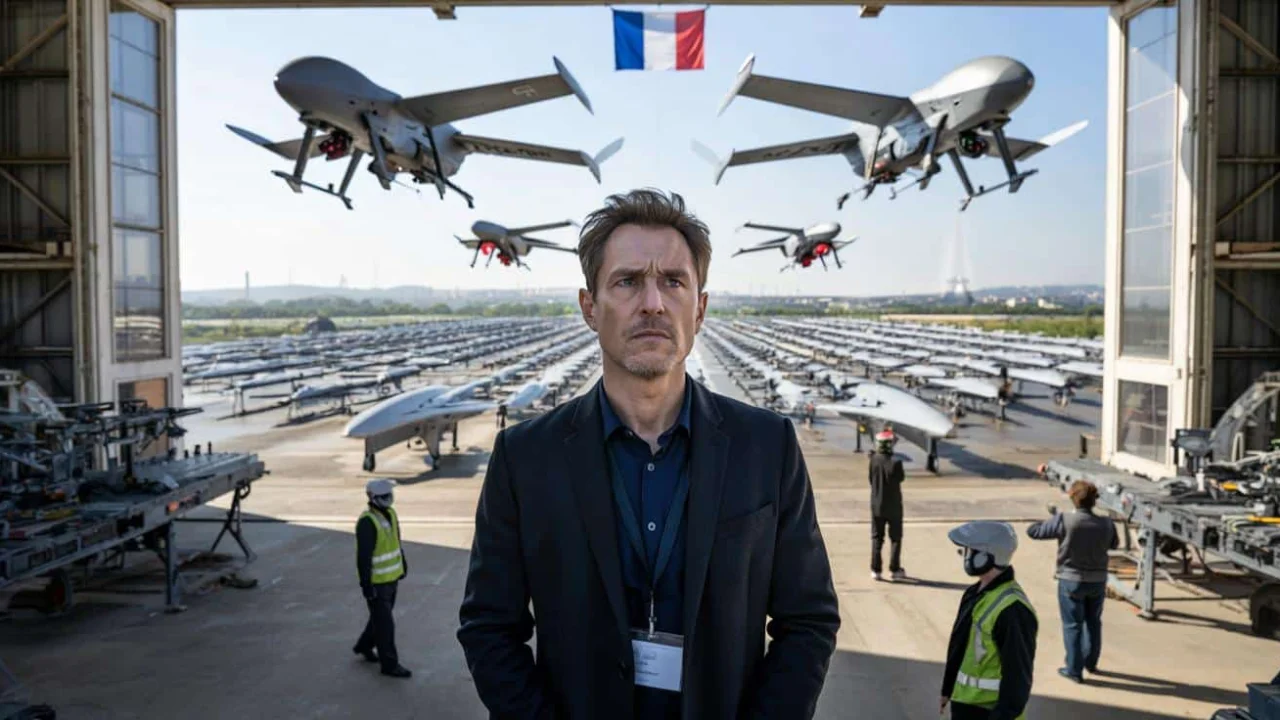
Picture this: A physics professor from a remote corner of Siberia sits in his cramped university office, watching news footage of Russian tanks rolling toward Ukraine. Most people would feel helpless. But Mikhail Kokoritch sees opportunity where others see tragedy.
Within months, he’s abandoned his hypersonic aircraft dreams and pivoted his entire company toward one mission: building drones to stop the Russian war machine. Today, his Ukraine drone factory plans could reshape how Europe defends itself.
This isn’t just another tech success story. It’s about a man who turned personal exile into Ukraine’s military advantage—and now wants to build Europe’s largest drone manufacturing hub on French soil.
From Siberian Physics Lab to European Arms Dealer
Mikhail Kokoritch grew up 6,000 kilometers from Moscow in Buryatia, a vast region where Russia meets Mongolia. The distance wasn’t just geographic—it was psychological. He calls himself part of “the only free generation” of Russians who came of age after the Soviet collapse, before Putin tightened his grip.
- Sweden’s Navy Secretly Tests Combat-Ready FDI Frigate That Could Change Everything
- China’s skyscraper meal delivery workers climb 100+ floors daily – here’s what they discovered
- Southern Ocean Current Reversal Triggers Scientists’ Urgent Climate System Collapse Warning
- France Travail launches secret defence industry recruitment unit that could change military hiring forever
- French Military Contracts Hit €42 Billion: What This Means for Defense Spending in 2026
- These 9 innocent phrases seniors use are secretly driving younger generations away from family gatherings
As a trained physicist, Kokoritch built his fortune in Russia’s high-tech and space sectors during the 2000s. But watching the Kremlin’s increasing authoritarianism, he made a bold choice in 2012: exile. First the United States, then Europe. By 2024, he went further and renounced his Russian citizenship entirely.
“If you are afraid of wolves, don’t go into the forest,” he often says. For Kokoritch, the wolves are Putin’s regime and the security services that hunt Russian dissidents abroad.
When Russia invaded Ukraine in February 2022, Kokoritch was running Destinus, an aerospace startup focused on hypersonic passenger aircraft. Within weeks, he scrapped those plans entirely. Ukraine needed drones, not luxury travel.
Building Ukraine’s Drone Lifeline
The pivot happened almost overnight. Kokoritch’s team started developing military drones specifically designed for Ukrainian forces. His Ukraine drone factory concept began taking shape—but not in Ukraine itself, where Russian missiles regularly target military production.
Instead, Kokoritch is planning something unprecedented: a massive drone manufacturing facility in France that would supply both Ukraine and European militaries. Here’s what makes his operation unique:
- Rapid production capabilities targeting thousands of drones monthly
- Specialized designs for Ukrainian battlefield conditions
- European manufacturing to avoid supply chain vulnerabilities
- Direct consultation with Ukrainian military commanders
- Integration with Western intelligence and targeting systems
The numbers tell the story of Ukraine’s drone revolution:
| Drone Type | Current Monthly Production | Planned Capacity | Primary Use |
|---|---|---|---|
| Reconnaissance Drones | 500 units | 2,000 units | Intelligence gathering |
| Attack Drones | 200 units | 800 units | Precision strikes |
| Long-range Drones | 50 units | 300 units | Deep territory operations |
“Ukraine showed the world that small, cheap drones can defeat expensive tanks,” explains defense analyst Maria Dubois. “Kokoritch understood this shift before most Western generals did.”
France’s Mega Factory Dream
Kokoritch’s vision goes far beyond helping Ukraine. He’s proposing to build Europe’s largest drone manufacturing complex in France, creating thousands of jobs while revolutionizing continental defense capabilities.
The planned Ukraine drone factory would span multiple facilities across France, with the main production hub near Lyon. French officials are reportedly enthusiastic about the economic benefits, while European Union leaders see it as crucial for strategic autonomy.
“We’re not just making weapons,” Kokoritch told European defense ministers during a recent Brussels meeting. “We’re building Europe’s technological independence from both Russian threats and American suppliers.”
The factory plans include:
- Primary manufacturing facility covering 200,000 square meters
- Research and development centers in three French cities
- Training facilities for European military technicians
- Partnerships with French aerospace giants Airbus and Thales
- Export capabilities to NATO allies and approved partners
Changing the Face of Modern Warfare
What makes Kokoritch’s operation remarkable isn’t just its scale—it’s the speed of innovation. His teams work directly with Ukrainian soldiers, receiving battlefield feedback and implementing design changes within weeks rather than years.
“Traditional defense contractors take five years to develop new systems,” notes military technology expert James Rodriguez. “Kokoritch’s people do it in five months. That’s the difference between bureaucracy and survival.”
The Ukraine drone factory concept represents a fundamental shift in how Europe thinks about defense manufacturing. Instead of massive, centralized facilities producing expensive systems, Kokoritch envisions distributed, flexible production that can rapidly adapt to changing threats.
French President Emmanuel Macron has publicly supported the project, seeing it as aligned with his vision of European strategic autonomy. The factory would reduce Europe’s dependence on American defense contractors while creating a domestic industrial base for future conflicts.
For Ukraine, the benefits are immediate and concrete. The country’s forces have already integrated hundreds of Kokoritch’s drones into their operations, with commanders praising their reliability and effectiveness against Russian positions.
“These aren’t just tools of war,” says Ukrainian Colonel Viktor Petrov, who works directly with Kokoritch’s team. “They’re symbols of European solidarity. Every drone that arrives means Europe stands with us.”
The broader implications extend beyond the current conflict. Kokoritch’s Ukraine drone factory model could become the template for how democratic nations respond to authoritarian military threats—not through massive government programs, but through agile private enterprise guided by urgent battlefield needs.
His success also represents a powerful form of resistance. A Russian exile using Western freedom and capital to arm Ukraine against his former homeland creates a compelling narrative of democracy fighting back against dictatorship.
FAQs
Why did Mikhail Kokoritch leave Russia?
He left in 2012 due to increasing authoritarianism under Putin and later renounced his Russian citizenship in 2024.
How quickly can the Ukraine drone factory produce drones?
Current production is around 750 drones monthly, with plans to scale up to over 3,000 units per month in the French facility.
Will the French factory only supply Ukraine?
No, it’s designed to serve both Ukrainian forces and European military customers, plus approved NATO allies.
What makes these drones different from others?
They’re specifically designed based on direct feedback from Ukrainian battlefield commanders and optimized for the current conflict’s unique conditions.
How does France benefit from hosting the drone factory?
The project brings thousands of high-tech jobs, strengthens France’s defense industry, and supports European strategic autonomy goals.
Are other countries interested in similar drone factories?
Yes, several European nations have expressed interest in hosting production facilities, making this potentially the first of many such operations across the continent.