
Picture this: a soldier on patrol hears a distant buzzing sound, like an angry bee. Within seconds, that innocent noise becomes a life-or-death situation as a small drone loaded with explosives dives toward his position. This scenario isn’t science fiction anymore—it’s the new reality on battlefields from Ukraine to the Middle East.
These cheap, deadly drones have changed warfare forever. What used to require expensive missiles or fighter jets can now be accomplished with a few hundred dollars worth of equipment bought online. That’s exactly why Germany is racing to upgrade its air defense systems with something that can catch these tiny killers before they strike.
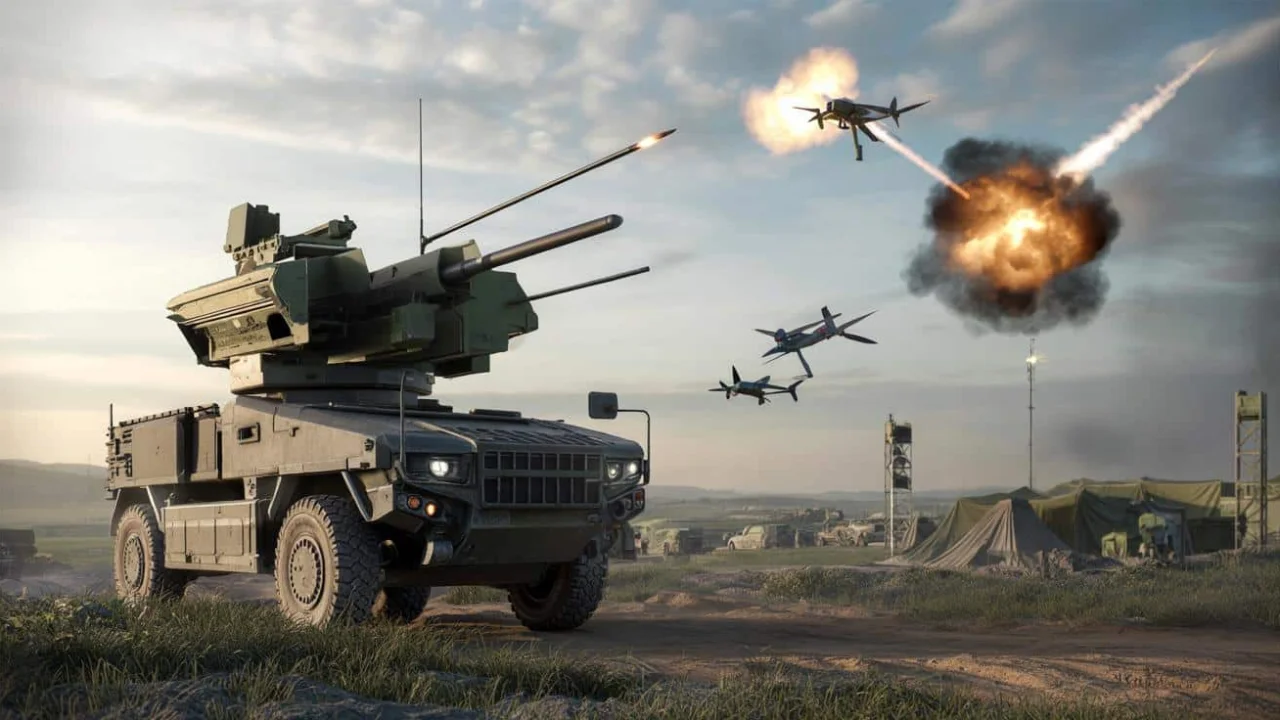
The solution? A powerful combination that pairs proven firepower with cutting-edge missile technology. The Skyranger 30 DefendAir missile integration represents Germany’s answer to the drone menace that’s keeping military planners awake at night.
Why Germany’s New Anti-Drone Weapon Matters Right Now
On November 5th, something significant happened in German defense circles. The Budget Committee of the German Bundestag approved funding for DefendAir, a specialized missile designed to hunt small drones. This isn’t just another military purchase—it’s Germany acknowledging that the rules of air defense have completely changed.
- Spain’s A400M Fleet Quietly Grows by Six Aircraft in Major Defense Expansion
- Switzerland’s Patriot missile deal hangs by a thread as officials consider dramatic Franco-Italian pivot
- Peru’s F-16 Viper selection shocks defense industry as Chinese port investments influence decision
- This Regiment’s Wire-Guided Loitering Munition Could Change Everything About Modern Warfare
- Belarus Oreshnik missile deployment sparks global alarm, but military experts reveal shocking truth
- Ukraine deploys devastating French AASM bombs in precision strike that changed everything
MBDA Deutschland will develop and produce this game-changing weapon, specifically designed to integrate with Rheinmetall’s Skyranger 30 turret system. The €500 million contract signed on November 10th with Germany’s procurement agency BAAINBw covers both development and initial production.
“DefendAir turns the Skyranger 30 from a gun-only close-in defense system into a layered interceptor, stretching its reach to several kilometers,” explains a defense analyst familiar with the project.
What makes this development so urgent? Look at what’s happening in Ukraine. Small first-person-view (FPV) drones—the kind hobbyists fly for fun—are being weaponized for kamikaze strikes. These nimble aircraft can dodge traditional air defenses and deliver devastating precision attacks at a fraction of the cost of conventional weapons.
Breaking Down the Skyranger 30 DefendAir Missile System
The Skyranger 30 wasn’t originally designed as a missile platform. It started life as a mobile gun system built around a powerful 30×173 mm automatic cannon. The system uses AHEAD programmable ammunition—smart shells that release controlled bursts of sub-projectiles at precisely the right moment to create a deadly cloud in a drone’s path.
Here’s how the upgraded system will work:
- The 30mm cannon handles close-range threats (under 3 kilometers)
- DefendAir missiles engage targets at extended ranges (up to several kilometers)
- Advanced radar and tracking systems coordinate both weapons
- Mobile platform allows rapid deployment wherever threats emerge
- Automated targeting reduces operator workload during swarm attacks
| Component | Role | Range |
|---|---|---|
| 30mm Cannon | Close-range interception | 0-3 km |
| DefendAir Missile | Extended-range hunting | 3+ km |
| Radar System | Detection & tracking | 15+ km |
| Mobile Platform | Rapid deployment | Road/cross-country |
“The beauty of this system lies in its flexibility,” notes a former German military officer. “You can park it at a forward base, protect a convoy, or defend critical infrastructure. The mobility factor is huge.”
The DefendAir missile itself is specifically tailored for drone hunting. Unlike larger surface-to-air missiles designed for aircraft or helicopters, this weapon focuses on small, agile targets that can change direction quickly. The missile’s guidance system can track erratic flight patterns and compensate for last-second evasive maneuvers.
What This Means for Soldiers and Civilians
For German troops, this development could be the difference between life and death. Current estimates suggest that a single FPV drone costs between $300-500 to build, while the damage it can inflict runs into millions of dollars. A successful strike on a tank, helicopter, or command post delivers incredible return on investment for attackers.
The psychological impact is just as important as the physical threat. When soldiers know hostile drones could appear at any moment, it affects everything they do. Patrols move differently. Vehicles take cover more frequently. Even basic maintenance becomes a high-stress activity.
“We’re seeing troops develop something like paranoid behavior patterns,” explains a military psychologist. “Every sound in the sky becomes a potential threat. That’s not sustainable for long-term operations.”
For German civilians, the implications extend beyond military bases. Critical infrastructure—power plants, bridges, government buildings—all represent potential drone targets. The mobile nature of the Skyranger 30 DefendAir missile system means it can quickly respond to emerging threats in urban environments.
Production is scheduled to ramp up toward the end of the decade, coinciding with planned deliveries of the first Skyranger 30 vehicles to German armed forces. This timeline reflects the complexity of integrating two different weapon systems while maintaining reliability under combat conditions.
The broader implications reach across NATO. If Germany’s approach proves successful, expect other allied nations to pursue similar capabilities. The drone threat isn’t limited to Europe’s eastern borders—it’s a global challenge that requires innovative solutions.
“This represents a fundamental shift in how we think about air defense,” observes a NATO defense official. “We’re moving from protecting against traditional aircraft to creating shields against swarms of tiny, intelligent weapons.”
The Skyranger 30 DefendAir missile integration also signals Germany’s commitment to domestic defense production. Rather than purchasing foreign systems, this project strengthens European defense industrial capabilities while creating jobs and technological expertise within German borders.
FAQs
What makes the DefendAir missile different from other air defense weapons?
DefendAir is specifically designed to hunt small, agile drones rather than traditional aircraft, with guidance systems optimized for erratic flight patterns and rapid direction changes.
How much will the Skyranger 30 DefendAir missile system cost?
The initial contract is worth approximately €500 million, covering development and the first production batch, though total program costs will likely be higher.
When will German forces start using these systems?
Production is expected to begin toward the end of this decade, with deliveries to German armed forces planned around the same timeframe.
Can the Skyranger 30 defend against drone swarms?
Yes, the system combines rapid-fire cannons for close threats with missiles for extended range, allowing it to engage multiple targets simultaneously during swarm attacks.
Will other countries adopt similar systems?
If Germany’s approach proves successful, other NATO allies will likely pursue comparable capabilities to address the growing drone threat across Europe and beyond.
How mobile is the Skyranger 30 platform?
The system is designed for rapid deployment on both roads and cross-country terrain, allowing it to protect convoys, forward bases, or critical infrastructure as threats emerge.