
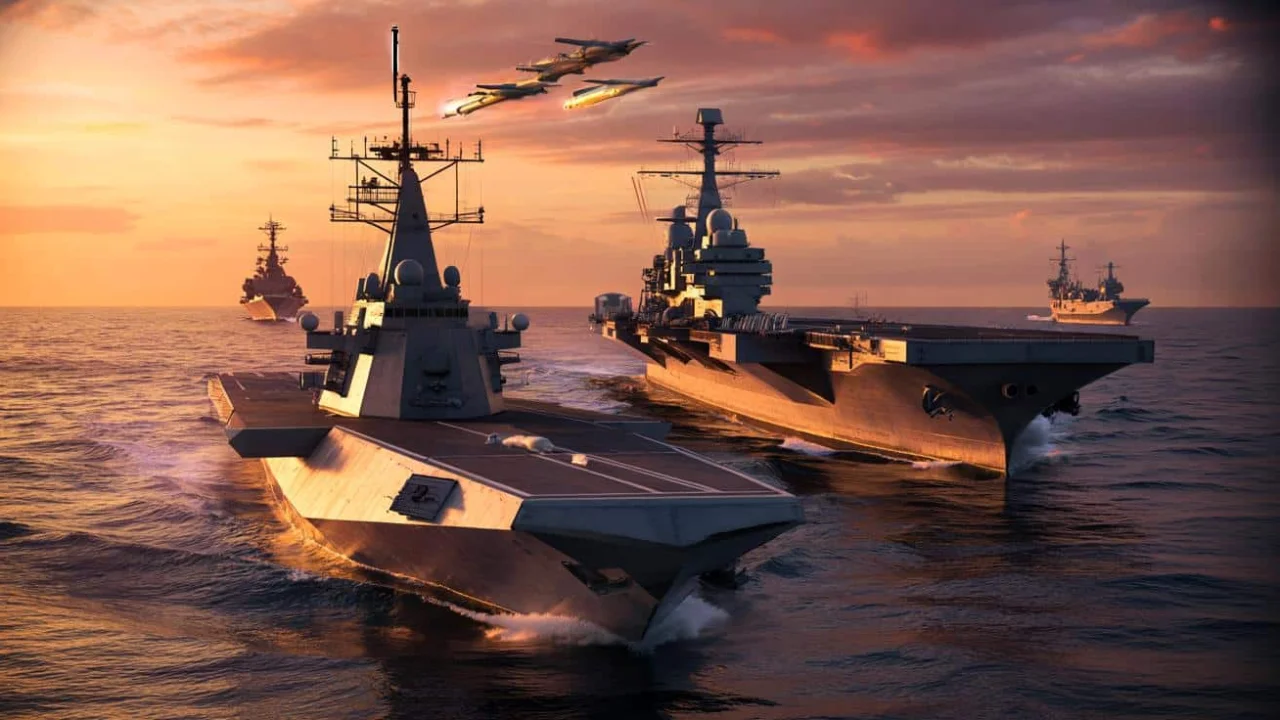
Captain Sarah Mitchell still remembers the moment everything changed. Standing on the bridge of her destroyer three years ago, watching enemy missiles streak across the horizon at impossible speeds, she knew the old playbook was obsolete. “We had seconds to react to something that should have taken minutes,” she recalls. “That’s when I realized we weren’t just behind—we were playing a completely different game.”
Today, stories like Captain Mitchell’s are driving one of the most significant transformations in naval warfare since the advent of guided missiles. The US Navy is racing to arm its entire fleet with hypersonic missiles, weapons that travel at more than five times the speed of sound and can strike targets before enemies even know they’re coming.
This isn’t just about adding new weapons to a few select ships. The Navy is fundamentally redesigning how its future fleet will fight, turning every major surface combatant and submarine into a potential hypersonic strike platform.
Why Speed Became Everything in Naval Combat
The transformation centers around the Conventional Prompt Strike (CPS) missile system, a hypersonic weapon that represents a quantum leap in naval firepower. Unlike traditional cruise missiles that give enemies time to detect, track, and potentially intercept them, hypersonic missiles compress the entire engagement timeline into minutes.
- French Navy quietly becomes first to operate Airbus’ revolutionary Aliaca Vertical UAS drone
- Ireland’s military radar negotiations with France could transform how the nation defends its skies
- USS Zumwalt gun systems removed permanently before 2026 deployment shocks Navy veterans
- Army’s Secret 50mm Cannon Test Could End the Bradley Fighting Vehicle Era Forever
- F-16 pilots get game-changing protection as L3Harris EW suite enters full production
- This Mach 4 Fighter Concept Could Reshape the F/A-XX Race Before Anyone Expected
“We’re not just talking about faster missiles,” explains Rear Admiral Derek Trinque, the Navy’s Director of Surface Warfare. “We’re talking about fundamentally changing how naval combat works. When your weapons can reach any target in theater within minutes, you’re operating in a different strategic environment.”
Currently, the US Navy relies heavily on subsonic Tomahawk cruise missiles for long-range strikes. While proven and reliable, these weapons can take hours to reach distant targets, giving adversaries ample time to relocate high-value assets or prepare countermeasures.
Hypersonic missiles eliminate this luxury of time. They follow unpredictable flight paths, making them nearly impossible to intercept with current defensive systems, and arrive at their targets before most warning systems can effectively respond.
The Technical Challenge of Fitting Giants
Integrating hypersonic missiles across the fleet isn’t as simple as swapping out existing weapons. These missiles are significantly larger than conventional weapons, requiring completely new launch systems and substantial modifications to ship designs.
The key specifications that are reshaping naval architecture include:
- Size requirements: CPS missiles need specialized vertical launch tubes that are much larger than standard systems
- Power demands: Hypersonic weapons require significantly more electrical power for their launch and guidance systems
- Structural modifications: Ships need reinforced hulls and decks to handle the stress of hypersonic launches
- Integration complexity: New fire control systems must coordinate with existing naval combat systems
| Ship Class | Current Missile Capacity | Planned Hypersonic Integration | Timeline |
|---|---|---|---|
| DDG(X) Future Destroyer | 96+ VLS cells | 12-16 CPS tubes | 2030s |
| Virginia-class Submarines | 12-40 Tomahawks | 4-8 CPS missiles | Late 2020s |
| Future Cruiser Replacement | 122+ VLS cells | 20-24 CPS tubes | 2030s |
“The engineering challenge is enormous,” admits a senior naval architect involved in the DDG(X) program. “You’re essentially designing ships around weapons that didn’t exist when we started the process.”
What This Means for America’s Naval Strategy
The proliferation of hypersonic missiles represents more than a technological upgrade—it’s a fundamental shift in how the Navy projects power globally. Instead of relying on a small number of specialized platforms, the service is building what military strategists call “distributed lethality.”
This approach spreads hypersonic strike capability across dozens of ships and submarines, making it impossible for adversaries to neutralize America’s long-range strike capacity by targeting a few high-value platforms. Every destroyer, cruiser, and attack submarine becomes a potential source of devastating, nearly unstoppable firepower.
The implications extend far beyond military circles. Allied nations are watching closely, as hypersonic-armed US Navy ships will likely become the backbone of collective defense strategies in contested regions like the South China Sea and Eastern Mediterranean.
“When every allied port can potentially host a hypersonic-capable US Navy ship, the entire strategic calculus changes,” explains Dr. Amanda Chen, a maritime security expert at the Center for Strategic Studies. “Deterrence becomes much more credible when your response capabilities are distributed and survivable.”
The Race Against Time and Competitors
The urgency behind this transformation becomes clear when considering the competitive landscape. Several nations have already deployed or are rapidly developing their own hypersonic weapons, creating what military analysts describe as a “hypersonic gap” that threatens US naval dominance.
The Navy’s timeline is aggressive but necessary. The first CPS-equipped submarines are expected to deploy by the late 2020s, followed by surface ships in the early 2030s. However, this schedule depends on overcoming significant technical and budgetary hurdles.
Cost considerations are substantial. Each CPS missile is estimated to cost several million dollars, and modifying ships to carry them requires extensive shipyard work. The Navy is working with Congress to secure funding for what could become one of the most expensive weapons programs in recent history.
“We’re not just buying missiles,” says Captain James Rodriguez, who oversees hypersonic integration planning. “We’re buying a completely new way of operating at sea, and that investment will define naval combat for the next fifty years.”
The human element remains crucial. Crews will need extensive training on hypersonic weapons systems, and naval doctrine must evolve to incorporate these game-changing capabilities effectively. Early exercises suggest that hypersonic missiles will require new approaches to target selection, battle damage assessment, and coordinated strikes.
FAQs
What makes hypersonic missiles different from regular missiles?
Hypersonic missiles travel at speeds exceeding Mach 5 (five times the speed of sound) and can maneuver unpredictably during flight, making them extremely difficult to intercept.
How much do these weapons cost?
Each CPS hypersonic missile is estimated to cost between $15-20 million, significantly more expensive than conventional cruise missiles that cost around $1-2 million each.
Which ships will get hypersonic missiles first?
Virginia-class submarines will be the first to receive CPS missiles in the late 2020s, followed by the new DDG(X) destroyers in the 2030s.
Can current ships be modified to carry hypersonic missiles?
Most existing ships cannot be easily modified due to size and power requirements, which is why the Navy is focusing on new construction and select submarine modifications.
How will this affect naval strategy?
Hypersonic missiles will enable “distributed lethality,” spreading long-range strike capability across the entire fleet rather than concentrating it on a few specialized platforms.
What countries already have naval hypersonic weapons?
Currently, no nation has fully operational ship-launched hypersonic missiles, though several countries including Russia and China are actively developing similar capabilities.