
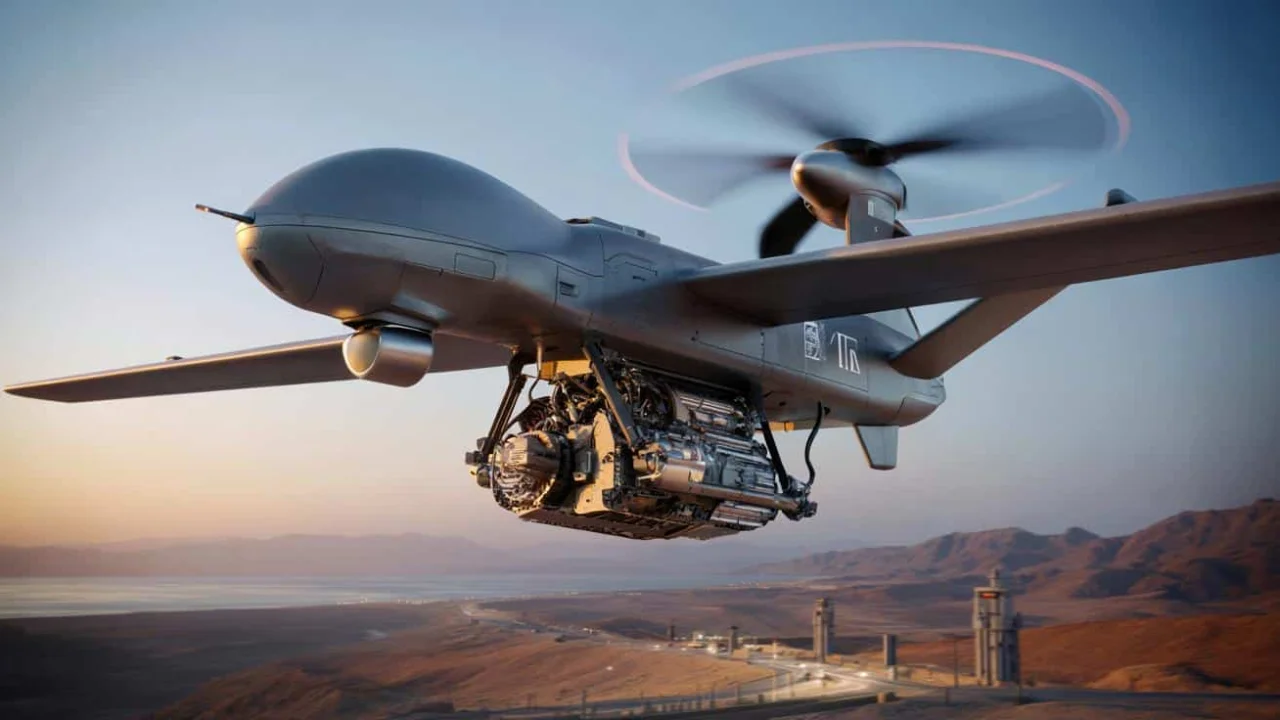
Picture a military reconnaissance mission where silence means the difference between success and failure. The drone needs to stay airborne for 12 hours, but switching to electric power cuts that time in half. Stay with combustion engines, and enemy forces will hear it coming from miles away.
This exact dilemma has plagued military planners for years. You either get long flight times with noisy engines, or quiet operations with severely limited range. But engineers at a test facility in Israel think they’ve cracked the code.
What they’ve built isn’t just another incremental improvement—it’s a complete rethinking of how drones should be powered.
Israel’s Defense Industry Takes Flight Innovation Seriously
Israeli defense giant Elbit Systems has partnered with local specialist Lowental Hybrid to develop what they’re calling the world’s first true hybrid drone propulsion system. Unlike previous attempts that simply bolted electric motors onto existing designs, this Native Parallel Hybrid system was engineered from the ground up to seamlessly blend combustion and electric power.
- Philippines prepares to receive game-changing naval vessel that could shift South China Sea dynamics
- French Navy quietly becomes first to operate Airbus’ revolutionary Aliaca Vertical UAS drone
- Why This Virginia Submarine Delivery Just Changed Everything for Naval Defense
- Navy’s quiet plan to arm every warship with hypersonic missiles sparks Pentagon concerns
- F-16 pilots get game-changing protection as L3Harris EW suite enters full production
- USS Zumwalt gun systems removed permanently before 2026 deployment shocks Navy veterans
The timing couldn’t be better. Modern military operations demand drones that can loiter quietly over targets for extended periods, then quickly switch to high-performance mode when action is required. Traditional single-power systems force operators to choose one capability over another.
“We’re seeing demand from military customers who want the best of both worlds,” explains a defense industry analyst familiar with the project. “They need the endurance of fuel-powered flight combined with the stealth characteristics of electric propulsion.”
What makes this hybrid drone propulsion system different is its ability to operate both power sources simultaneously or independently, depending on mission requirements. During surveillance phases, the drone can run whisper-quiet on electric power. When speed or extended range becomes critical, the combustion engine kicks in to provide additional thrust.
Technical Breakdown: How the Hybrid System Actually Works
The Native Parallel Hybrid system integrates several key components that work together to optimize performance across different flight phases:
- Dual Power Integration: Both combustion and electric motors can operate simultaneously or independently
- Smart Power Management: Automated systems determine optimal power source based on mission phase
- Retrofit Compatibility: Designed to fit existing airframes with minimal structural modifications
- Noise Reduction Technology: Electric mode reduces acoustic signature by up to 70%
- Extended Mission Duration: Combined system extends flight time by 40-60% compared to single-power alternatives
The system’s architecture allows for seamless transitions between power modes. During takeoff and climb phases, both engines can work together to maximize performance. Once at cruising altitude, the drone can switch to electric-only mode for silent operations.
| Flight Phase | Primary Power Source | Noise Level | Endurance Impact |
|---|---|---|---|
| Takeoff/Climb | Hybrid (Both) | Standard | Optimized |
| Surveillance | Electric Only | 70% Reduced | Extended |
| Transit/Escape | Combustion Primary | Standard | Maximum Range |
| Loitering | Electric Only | Minimal | High Efficiency |
“The key breakthrough is the power management system,” notes a propulsion engineer who has worked on similar projects. “It’s not just about having two engines—it’s about making them work together intelligently.”
Elbit Systems hasn’t revealed which specific drone platforms will receive the hybrid upgrade first, but the company’s current portfolio includes several medium and large surveillance drones used by militaries worldwide. The retrofit-friendly design means existing fleets could potentially be upgraded without requiring entirely new aircraft purchases.
Real-World Impact: What This Means for Military Operations
The implications of successful hybrid drone propulsion extend far beyond technical specifications. Military commanders constantly balance mission requirements against aircraft limitations, often having to deploy multiple drone types to cover different operational phases.
Border patrol operations, for example, require aircraft that can quietly monitor remote areas for hours while maintaining the ability to quickly pursue and track targets when detected. Current drone fleets often require operators to choose between dedicated surveillance aircraft and high-performance interceptors.
The hybrid system could eliminate this compromise. A single platform could handle extended surveillance missions while retaining the performance characteristics needed for pursuit or rapid repositioning.
“This technology could fundamentally change how we think about drone mission planning,” explains a former military drone operator. “Instead of deploying different aircraft for different mission phases, one platform could handle the entire operation.”
International defense markets are already taking notice. Several European NATO members have expressed interest in evaluating hybrid propulsion systems for their drone fleets, particularly for border security and maritime patrol missions.
The technology also has significant implications for civilian applications. Search and rescue operations, environmental monitoring, and infrastructure inspection missions could all benefit from the extended endurance and reduced noise characteristics.
Challenges and Future Development
Despite the promising capabilities, hybrid drone propulsion systems face several practical hurdles before widespread adoption. Weight remains a critical factor—carrying both combustion and electric powerplants adds complexity and mass that must be carefully managed.
Maintenance requirements also increase with hybrid systems. Ground crews need training on both traditional combustion engines and electric motor systems, potentially increasing operational costs and complexity.
“The biggest challenge is making the system reliable enough for military use,” observes an aerospace engineer familiar with drone development. “Having two power systems means twice as many potential failure points.”
However, early test results from the Israeli development program suggest these challenges are manageable. The Native Parallel Hybrid system incorporates redundancy features that actually improve overall mission reliability compared to single-engine configurations.
Looking ahead, the technology could evolve to include even more sophisticated power management capabilities. Future versions might incorporate artificial intelligence to optimize power source selection based on real-time mission conditions and threat environments.
FAQs
How does a hybrid drone propulsion system differ from traditional electric or combustion-only systems?
A hybrid system combines both combustion and electric motors in one aircraft, allowing operators to switch between or combine power sources based on mission requirements, unlike traditional systems that use only one type of propulsion.
Can existing military drones be upgraded with hybrid propulsion systems?
Yes, the Native Parallel Hybrid system was specifically designed for retrofit compatibility, meaning many current drone platforms can be upgraded without major structural modifications to the airframe.
What are the main advantages of hybrid propulsion for military operations?
The primary benefits include extended mission duration, reduced noise signatures for stealth operations, and the flexibility to optimize performance for different flight phases within a single mission.
How much quieter are hybrid drones compared to traditional combustion-powered aircraft?
When operating in electric-only mode, hybrid drones can reduce their acoustic signature by up to 70% compared to combustion-only systems, making them much harder to detect during surveillance operations.
What countries are likely to adopt hybrid drone technology first?
Israel is leading development, with several European NATO members expressing interest in evaluation programs, particularly for border security and maritime patrol applications.
Are there civilian applications for hybrid drone propulsion systems?
Yes, the technology shows promise for search and rescue operations, environmental monitoring, infrastructure inspection, and any civilian missions requiring long endurance combined with quiet operations.