
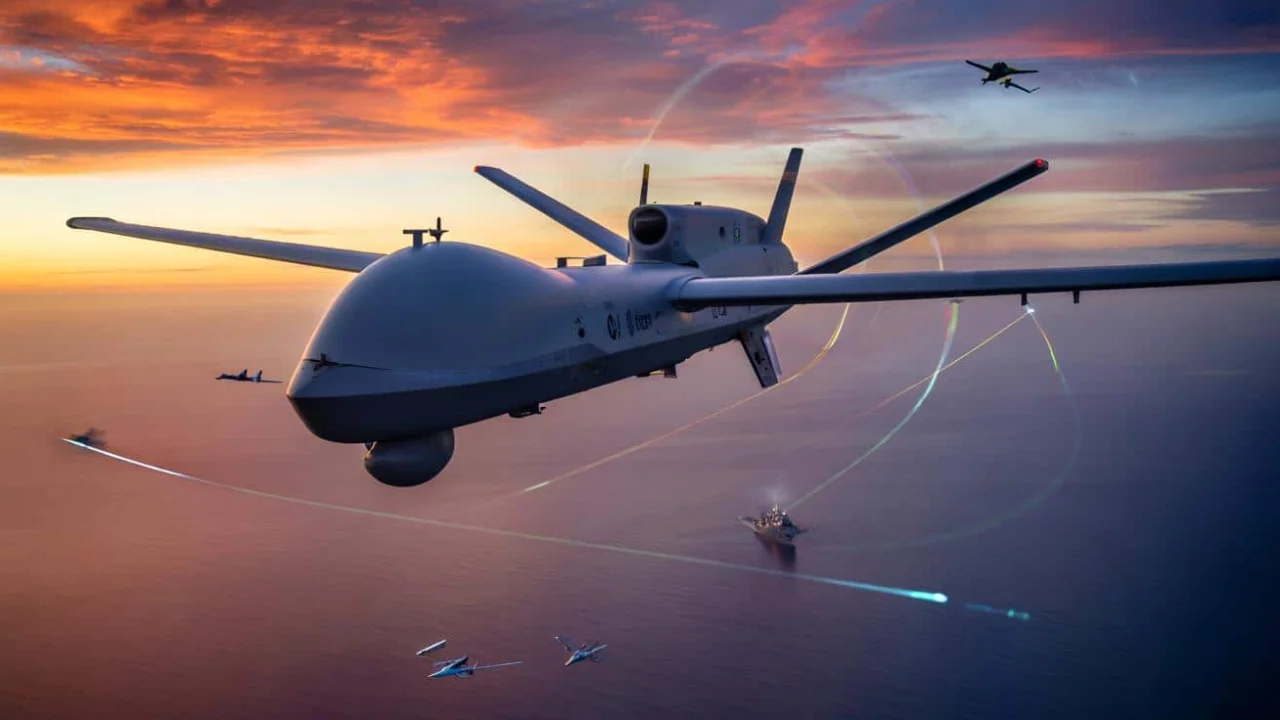
Picture this: you’re an air traffic controller at a busy airport, watching dozens of blips move across your radar screen. Now imagine that same watchful eye floating 20,000 feet above a combat zone, scanning for threats without risking a single human life. That’s exactly what’s happening as military engineers transform the trusty MQ-9B drone from a silent hunter into an all-seeing guardian of the skies.
The change feels almost surreal. These drones have spent years quietly tracking targets and gathering intelligence. Now they’re being asked to become the radar itself, watching over entire regions and feeding crucial data to ground forces and fighter jets alike.
This isn’t just another military upgrade – it’s a fundamental shift in how we think about protecting airspace and keeping our forces safe.
From Silent Stalker to Sky Sentinel
The MQ-9B AEW&C upgrade represents one of the most ambitious drone transformations we’ve ever seen. General Atomics Aeronautical Systems, the company behind the MQ-9B SkyGuardian, has joined forces with Swedish defense giant Saab to create something entirely new: a drone that carries its own powerful radar system.
- France’s massive ORION 26 war exercise reveals what military experts didn’t expect to see
- DOD drone exposure leaves military bases vulnerable due to simple paperwork mix-ups, inspector finds
- Navy’s Secret Trump-Class Battleship Timeline Leaks After Quiet Pentagon Meeting
- This F-35 center fuselage milestone reveals something unexpected about America’s defense production
- Why Saab’s surprise joint fighter jet offer to Germany could reshape European defense forever
- Bulgaria’s MMPV 90 corvette hits the water – what happened next shocked naval experts
“We’re essentially turning a reconnaissance platform into a flying radar station,” explains a defense industry analyst familiar with the project. “The MQ-9B will be able to detect, track, and coordinate responses to aerial threats across hundreds of miles.”
Traditional Airborne Early Warning and Control systems require massive aircraft like the Boeing E-3 Sentry AWACS. These planes need large crews, consume enormous amounts of fuel, and cost millions to operate. The MQ-9B AEW&C upgrade changes that equation completely.
The transformation involves mounting sophisticated radar equipment and data processing systems onto the drone’s existing airframe. Unlike its surveillance-focused cousins, this version will actively scan the skies, identifying everything from incoming missiles to enemy aircraft formations.
Technical Capabilities That Change Everything
The MQ-9B AEW&C upgrade brings impressive capabilities to the unmanned platform:
- 360-degree radar coverage with detection ranges exceeding 200 nautical miles
- Simultaneous tracking of multiple airborne targets
- Real-time data sharing with ground control centers and allied aircraft
- Extended flight endurance of up to 40 hours per mission
- Advanced electronic warfare detection and countermeasures
- Integration with existing air defense networks
The numbers tell an impressive story about what this upgrade can achieve:
| Capability | MQ-9B AEW&C | Traditional AWACS |
|---|---|---|
| Operating Cost per Hour | $5,000-7,000 | $40,000-60,000 |
| Crew Requirements | Ground-based operators | 15-20 airborne personnel |
| Mission Duration | Up to 40 hours | 8-12 hours typical |
| Risk to Personnel | Zero airborne risk | Full crew exposure |
“The beauty of this system is persistence,” notes a former air force radar operator. “You can keep these drones on station for days if needed, providing continuous coverage that would be impossible with manned aircraft.”
The radar system itself represents cutting-edge technology. Saab’s contribution includes advanced signal processing capabilities that can distinguish between different types of aircraft, missiles, and even ground vehicles from significant distances.
Game-Changing Impact on Modern Warfare
The MQ-9B AEW&C upgrade doesn’t just add another tool to the military toolbox – it fundamentally changes how air defense works. Countries operating these upgraded drones will be able to maintain constant surveillance over contested airspace without risking expensive aircraft or trained crews.
For smaller air forces, the implications are particularly significant. Nations that could never afford traditional AWACS aircraft can now access similar capabilities at a fraction of the cost. This democratization of airborne early warning technology could reshape regional power balances.
“We’re looking at a future where even medium-sized air forces can maintain sophisticated air defense networks,” explains a defense procurement specialist. “The MQ-9B AEW&C upgrade makes that possible for the first time.”
The upgrade also addresses one of modern warfare’s biggest challenges: operating in contested environments. Traditional AWACS aircraft are valuable but vulnerable targets. Enemy forces prioritize destroying these “high-value assets” because they coordinate entire air defense systems.
An MQ-9B with AEW&C capabilities presents a much smaller, harder-to-detect target. If one gets shot down, the financial and operational loss is manageable compared to losing a $270 million AWACS aircraft and its crew.
The ripple effects extend beyond pure military applications. Border security agencies could use these systems to monitor vast stretches of territory for smuggling operations or illegal crossings. Coast guards might deploy them for maritime surveillance over areas too dangerous or remote for manned aircraft.
Emergency response organizations are also watching this development closely. An MQ-9B AEW&C could coordinate disaster relief operations, track weather patterns, or provide communications relay services in areas where ground infrastructure has been damaged.
Real-World Deployment and Challenges
Several countries have already expressed interest in the MQ-9B AEW&C upgrade, with initial deliveries expected to begin within the next two years. The UK, Australia, and several NATO allies are reportedly evaluating the system for their air defense requirements.
However, the transition isn’t without challenges. Integrating drone-based early warning systems with existing air defense networks requires significant software updates and operator training. Ground control stations need modifications to handle the increased data flow from these flying radar platforms.
“The technology is impressive, but successful deployment depends on having the right support infrastructure in place,” warns a military systems integration expert.
Weather conditions also present unique challenges for drone-based radar systems. While traditional AWACS can adjust their flight patterns to work around storms or atmospheric interference, drones have more limited maneuverability options.
Despite these challenges, early testing results have been overwhelmingly positive. The MQ-9B AEW&C prototypes have successfully demonstrated their ability to detect and track multiple targets while maintaining stable communications links with ground stations.
FAQs
How does the MQ-9B AEW&C upgrade differ from regular MQ-9B drones?
The AEW&C version carries sophisticated radar equipment and data processing systems that allow it to detect and track airborne targets, rather than just providing surveillance footage.
Can these upgraded drones replace traditional AWACS aircraft entirely?
Not completely, but they can handle many routine early warning missions at much lower cost and risk, freeing up expensive manned aircraft for the most demanding operations.
How long can an MQ-9B AEW&C stay airborne?
These drones can remain on station for up to 40 hours, providing persistent coverage that’s impossible with manned aircraft.
What happens if an MQ-9B AEW&C is shot down?
While losing any military asset is serious, the financial and human cost is much lower than losing a traditional AWACS aircraft with its crew of 15-20 people.
Which countries are most likely to adopt this technology first?
The UK, Australia, and several NATO allies are reportedly evaluating the system, with initial deployments expected within two years.
How does this change affect pilot training requirements?
Since these are unmanned systems, the focus shifts to training ground-based operators and radar technicians rather than traditional aircrew.