
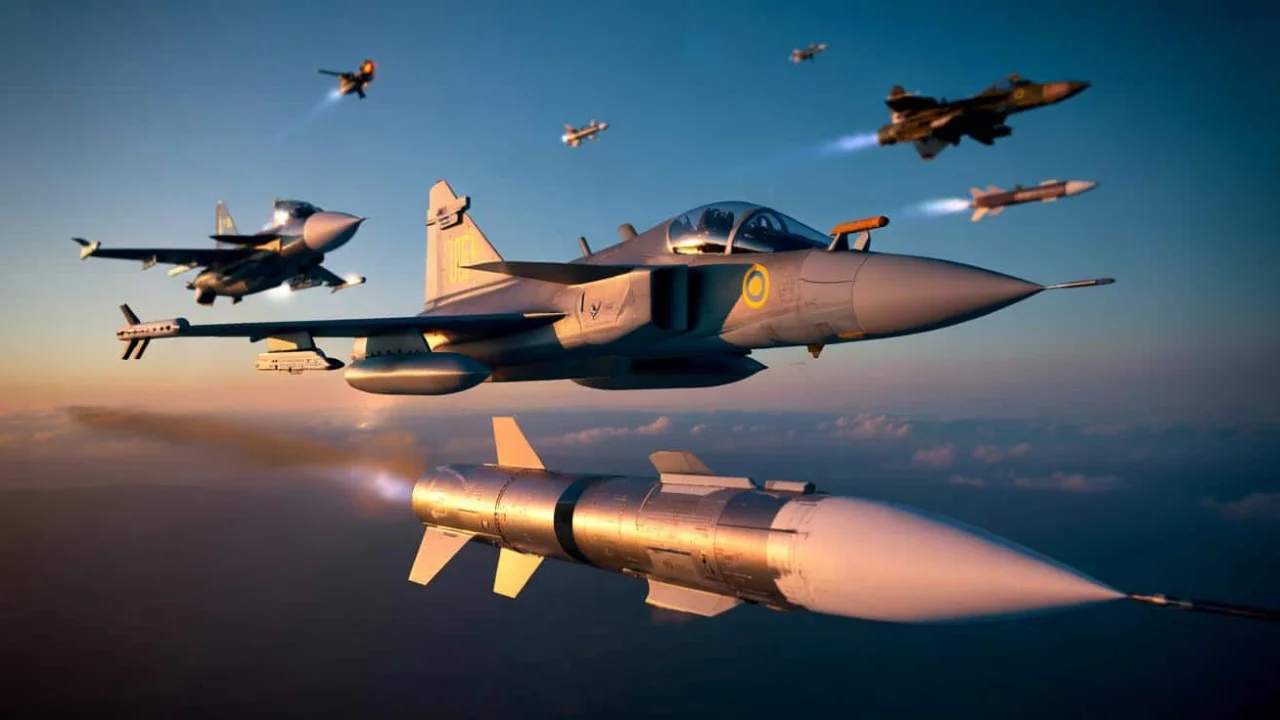
The pilot’s hands shake slightly as he checks his radar display one more time. Somewhere out there, beyond the clouds and static, enemy fighters are closing in. In a few minutes, he’ll either be heading home or becoming another casualty in a war that’s redefined modern air combat. What he doesn’t know yet is that his chances of survival might soon depend on a Swedish missile that can reach farther than anything Russia has in the sky.
This isn’t just another weapons deal making headlines. For Ukrainian pilots facing Russian jets daily, the difference between life and death often comes down to who shoots first from the longest range.
That’s why the emerging partnership between Ukraine’s Gripen fighter program and Europe’s Meteor missiles represents more than just military hardware. It’s potentially a game-changer that could shift the balance of power in Ukrainian airspace.
Sweden’s Fighter Jets Come With a Powerful Partner
Ukraine’s long pursuit of modern Western fighters has taken an interesting turn. While discussions with Sweden about JAS 39 Gripen jets continue, the conversation has expanded beyond just aircraft. The Swedish defense contractor Saab now openly suggests that any Gripen package for Ukraine would naturally include Meteor air-to-air missiles.
- France’s Secret Jet Technology Could End the Suicide Drone Crisis Forever
- France’s massive ORION 26 war exercise reveals what military experts didn’t expect to see
- Navy’s Secret Trump-Class Battleship Timeline Leaks After Quiet Pentagon Meeting
- This F-35 center fuselage milestone reveals something unexpected about America’s defense production
- MQ-9B AEW&C Upgrade Transforms Military Drones Into Flying Radar Stations
- DOD drone exposure leaves military bases vulnerable due to simple paperwork mix-ups, inspector finds
The numbers alone tell a compelling story. Sweden signed a letter of intent with Ukraine last year that could potentially involve up to 150 Gripen fighters. But without advanced missiles, even the most modern jet becomes vulnerable in combat.
“The Meteor missile transforms the Gripen from a capable fighter into a true air superiority platform,” explains a European defense analyst. “It’s like giving someone a sniper rifle instead of a pistol.”
The timing matters too. As Ukraine continues to receive F-16s from other NATO allies, adding Gripens with Meteor missiles would create a diverse fleet capable of different mission profiles. The Gripen’s reputation for operating from shorter runways and highways could prove especially valuable as Ukraine adapts to Russia’s constant targeting of airbases.
Why These Missiles Could Change Everything
The Meteor isn’t your typical air-to-air weapon. While most missiles coast toward their target after launch, burning fuel quickly and losing energy, the Meteor keeps accelerating throughout most of its flight. This ramjet-powered design gives it capabilities that have Russian pilots genuinely concerned.
Here’s what makes the Meteor special in practical terms:
- Extended range: Can engage targets at distances exceeding 200 kilometers
- Sustained speed: Maintains high velocity throughout flight, making it harder to evade
- Advanced guidance: Uses active radar homing with datalink updates from the launching aircraft
- No-escape zone: Creates a much larger area where enemy aircraft cannot outmaneuver the missile
- Multi-target capability: Gripen can guide several Meteors simultaneously
Compare this to current Russian air-to-air missiles, and the advantage becomes clear:
| Missile System | Range (km) | Propulsion | Escape Probability |
|---|---|---|---|
| Meteor | 200+ | Ramjet | Very Low |
| R-77 (Russian) | 110 | Solid fuel | Moderate |
| R-37M (Russian) | 400 | Solid fuel | High at range |
“Russian pilots know that if they see a Gripen on their radar, they’re already potentially in the Meteor’s engagement envelope,” notes a former NATO air force officer. “That changes how they operate.”
The Training Challenge Nobody Talks About
Getting these gripen meteor missiles to Ukraine represents only half the battle. Ukrainian pilots, already adapting to Western systems after decades flying Soviet-era aircraft, face another steep learning curve.
The Meteor requires more than just knowing which button to press. Pilots must understand its unique flight characteristics, optimal launch parameters, and how to maximize its datalink capabilities. Unlike fire-and-forget missiles, the Meteor performs best when the launching aircraft continues providing guidance data.
Sweden has indicated willingness to provide comprehensive training programs. These would likely include:
- Simulator-based missile employment training
- Tactical development courses covering best engagement practices
- Maintenance training for ground crews
- Integration testing with Ukrainian command systems
The training timeline could prove crucial. While Ukrainian pilots have shown remarkable adaptability in learning Western systems, mastering the Gripen-Meteor combination will take months, not weeks.
What This Means for the War’s Future
If these gripen meteor missiles reach Ukraine, the impact extends far beyond individual dogfights. Russian air operations, already constrained by Ukrainian air defenses, could face additional restrictions.
Currently, Russian pilots often operate from standoff distances, launching long-range missiles while avoiding direct confrontation with Ukrainian fighters. Gripens armed with Meteors would extend Ukraine’s defensive umbrella significantly, potentially forcing Russian aircraft even further back from the front lines.
This could affect several aspects of the conflict:
- Close air support: Russian ground forces might receive less air cover
- Strategic bombing: Russian bombers would face increased risk when approaching Ukrainian territory
- Reconnaissance: Russian surveillance flights could be intercepted at greater distances
- Supply lines: Ukrainian air power could more effectively target Russian logistics
“Air superiority isn’t just about shooting down enemy planes,” explains a military aviation expert. “It’s about controlling airspace so thoroughly that the enemy can’t effectively use theirs.”
The psychological impact shouldn’t be underestimated either. Russian pilots already face significant risks every time they take off. Knowing that Ukrainian fighters can engage them at previously safe distances could further erode morale and operational effectiveness.
The Broader European Dimension
Sweden’s willingness to provide gripen meteor missiles to Ukraine reflects broader European security calculations. As a NATO member since 2024, Sweden recognizes that supporting Ukraine directly serves Swedish national interests.
The decision also demonstrates European defense independence. While the United States continues providing substantial military aid to Ukraine, European nations are increasingly contributing their own advanced systems. The Meteor missile, developed by a European consortium, represents homegrown technological capability.
Other European nations watching these developments include those considering their own military aid packages. If the Gripen-Meteor combination proves effective in Ukrainian hands, it could influence future defense cooperation agreements across Europe.
For Sweden specifically, a successful deployment in Ukraine would provide valuable operational data and potentially boost export prospects for the Gripen platform worldwide.
FAQs
What makes the Meteor missile better than other air-to-air weapons?
The Meteor uses ramjet propulsion, which allows it to maintain high speed throughout its flight rather than losing energy like conventional missiles. This creates a much larger “no-escape zone” where enemy aircraft cannot outmaneuver it.
How many Gripen jets might Ukraine receive?
Sweden and Ukraine signed a letter of intent for up to 150 Gripen aircraft, though no final contract has been agreed upon yet.
Can Ukrainian pilots quickly learn to use these systems?
While Ukrainian pilots have shown remarkable adaptability, mastering the Gripen-Meteor combination will require several months of intensive training, including simulator work and tactical development.
Would these missiles work with Ukraine’s existing F-16 fighters?
The Meteor can be integrated with F-16s, but this would require additional modifications and training. Currently, the focus appears to be on the Gripen platform.
How would Russia likely respond to Ukraine getting these capabilities?
Russia would probably adjust its air operations to account for the increased threat range, potentially pushing its aircraft further from Ukrainian territory and reducing the effectiveness of Russian air support.
When might these weapons actually reach Ukraine?
No timeline has been officially announced, as negotiations are still ongoing and would depend on training programs, logistics, and final contract agreements between Sweden and Ukraine.