
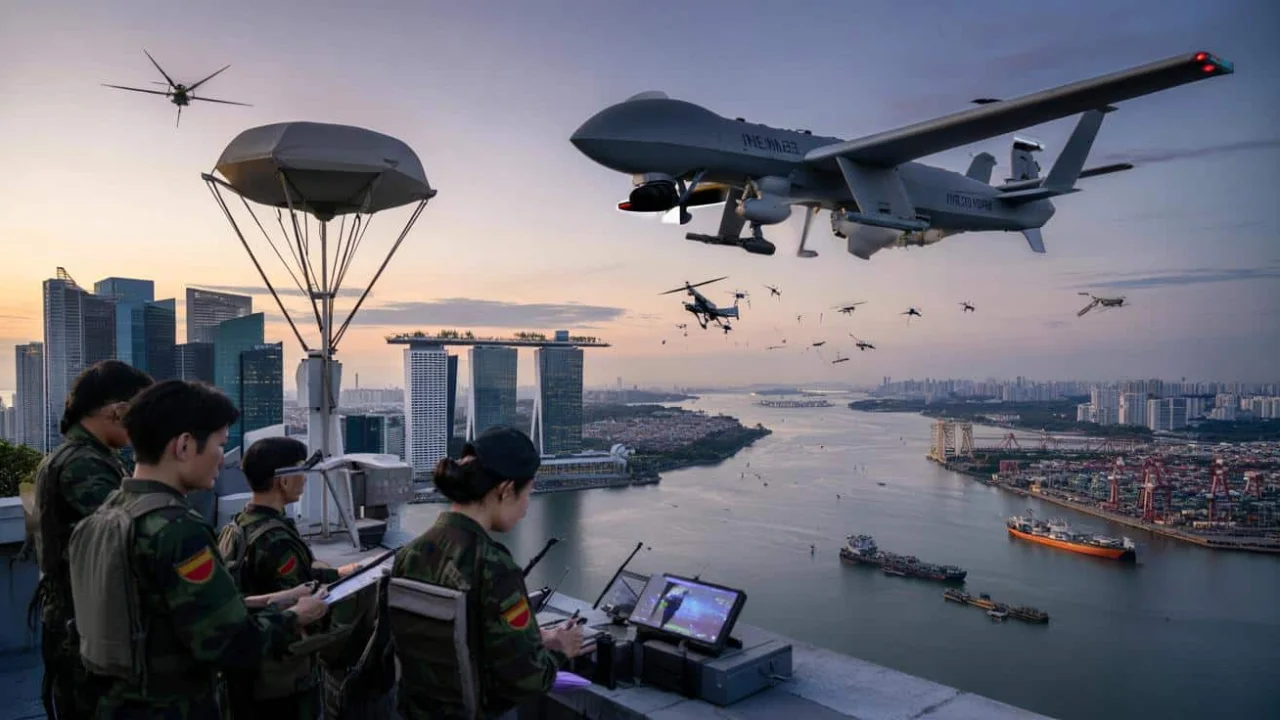
Lieutenant Sarah Chen watched the small unmanned aircraft disappear into the hazy Singapore sky during her morning patrol shift. Just two years ago, she’d been manually tracking suspicious vessels through binoculars from her coastal observation post. Now, that same job happens with surgical precision from an air-conditioned control room.
Her story isn’t unique. Across Singapore’s military bases, thousands of citizen-soldiers are discovering that drone technology has fundamentally changed how they protect their island nation. What started as a cautious experiment with surveillance drones nearly four decades ago has exploded into something much bigger.
Singapore is betting its defense future on unmanned systems, and they’re turning to Israeli technology to make it happen.
From Surveillance Tool to Military Backbone
Singapore drone warfare has reached a pivotal moment. The Republic of Singapore Air Force (RSAF) isn’t just adding more drones to its fleet – it’s reshaping its entire military philosophy around unmanned systems.
- French Navy’s mini drone gets game-changing VTOL upgrade that lets more ships launch surveillance missions
- One conversation opener researchers say instantly makes strangers trust you more
- USS John F. Kennedy Finally Sets Sail After Years of Delays and Cost Overruns
- This overlooked factor explains why homes always feel colder despite cranked-up heating
- Sweden quietly explores nuclear weapons cooperation with France and UK after joining NATO
- Romania’s €1bn H225M Caracal helicopter deal could transform local defense manufacturing forever
“We’re shifting from using drones as support tools to making them the center of how we operate,” explains Major General Kelvin Fan, chief of the RSAF. “Every major mission now starts with the question: how can drones make this more effective?”
This transformation involves replacing decades-old surveillance drones with two advanced Israeli systems: the Orbiter 4 and Hermes 900. These aren’t just upgrades – they represent Singapore’s commitment to drone-centric military operations.
The timing makes sense. Singapore’s geographic constraints – dense airspace, limited land, and strategic waterways – create perfect conditions for unmanned systems to shine. Traditional aircraft face significant limitations in such a compact environment, but drones can operate with precision in spaces where manned flights would be impractical.
Israeli Tech Takes Center Stage
Why did Singapore choose Israeli systems over American, European, or Chinese alternatives? The answer lies in proven battlefield performance and shared strategic challenges.
Both Singapore and Israel are small nations surrounded by potential threats. Both need maximum capability from minimal resources. Israeli drone manufacturers like Aeronautics Group and Elbit Systems have spent decades perfecting systems that work in complex, contested environments.
| Drone System | Manufacturer | Primary Role | Key Advantage |
|---|---|---|---|
| Orbiter 4 | Aeronautics Group | Close-range surveillance | No runway required |
| Hermes 900 | Elbit Systems | Long-range operations | Multi-mission capability |
The Orbiter 4 particularly appeals to Singapore’s military planners. With 24-hour endurance and catapult launch capability, it can operate from virtually any location without requiring precious runway space.
“The beauty of these systems is their flexibility,” notes defense analyst Dr. Michael Wong from the S. Rajaratnam School of International Studies. “Singapore doesn’t have the luxury of massive military bases, so everything needs to be compact and adaptable.”
However, early operational reports suggest some challenges. RSAF operators have noted performance issues with the Orbiter 4 during Singapore’s frequent tropical storms and high wind conditions. These real-world testing experiences are helping refine deployment strategies.
Training Thousands for the Drone Age
Singapore’s military relies heavily on national service conscripts – young men who serve two years before joining reserve forces. This presents both an opportunity and a challenge for drone warfare expansion.
The opportunity is obvious: tech-savvy young Singaporeans adapt quickly to unmanned systems. Many arrive for military service already comfortable with gaming interfaces and remote controls.
The challenge is scale. Singapore needs to train thousands of operators, not just a select few specialists. This requires new training facilities, updated curricula, and career tracks that keep experienced drone operators in active service.
Key training developments include:
- Dedicated drone operator schools at multiple military bases
- Simulator-based training that reduces actual flight hours needed
- Cross-training programs that teach traditional pilots drone operations
- Reserve units specifically focused on unmanned systems support
“We’re not just teaching people to fly drones,” explains Colonel James Lim, who oversees RSAF training programs. “We’re teaching them to think differently about airspace, missions, and coordination with ground forces.”
What This Means for Regional Security
Singapore’s drone surge sends clear signals to neighbors and potential adversaries. The city-state is demonstrating that small nations can leverage advanced technology to punch above their weight militarily.
This shift affects several key areas:
Maritime Security: Singapore’s position along critical shipping lanes means its enhanced surveillance capabilities impact global trade routes. Drone patrols can monitor vessel movements, detect suspicious activities, and coordinate with international maritime security efforts.
Border Protection: Despite its small size, Singapore has complex border security challenges. Drones provide 24/7 monitoring capabilities that human patrols simply cannot match.
Regional Balance: As neighboring countries invest in their own drone programs, Singapore’s early adoption and Israeli technology partnerships position it as a regional leader in unmanned warfare capabilities.
“Singapore is showing other Southeast Asian nations what’s possible when you commit fully to drone technology,” observes military analyst Lisa Park from the Institute of Defence and Strategic Studies.
The economic implications are equally significant. Singapore’s defense industry could become a regional hub for drone maintenance, training, and technology transfer, creating new revenue streams and strategic partnerships.
Looking Beyond the Horizon
Singapore’s drone transformation is just beginning. Military leaders hint at future developments that could include armed drones, autonomous swarm operations, and integration with artificial intelligence systems.
The partnership with Israeli manufacturers appears likely to deepen. Both countries are investing in next-generation drone technologies, including systems that can operate in contested electronic warfare environments.
For Lieutenant Chen and thousands of other Singaporean military personnel, these changes mean their jobs will continue evolving rapidly. The skills they’re learning today – remote piloting, sensor interpretation, and multi-platform coordination – will define Singapore’s defense capabilities for decades to come.
As one senior RSAF officer put it: “We’re not just buying drones. We’re buying a new way to defend Singapore.”
FAQs
Why did Singapore choose Israeli drones over other options?
Singapore selected Israeli systems because of their proven combat effectiveness and suitability for operating in small, densely populated areas similar to Israel’s operational environment.
How many drone operators is Singapore training?
While exact numbers aren’t public, Singapore is training thousands of military personnel in drone operations as part of its shift to drone-centric defense strategy.
Will Singapore’s drones carry weapons?
Singapore hasn’t publicly confirmed whether its new drones will be armed, though both the Orbiter 4 and Hermes 900 platforms can be configured to carry various payloads.
How does this affect Singapore’s neighbors?
Singapore’s advanced drone capabilities enhance regional maritime security and may encourage other Southeast Asian nations to invest more heavily in their own unmanned systems programs.
What happens to Singapore’s older drones?
The older Hermes 450 and IAI Heron 1 drones are being gradually phased out as the new systems become fully operational, though some may continue in training roles.
How long can these new drones stay in the air?
The Orbiter 4 can fly for up to 24 hours, while the larger Hermes 900 has even longer endurance capabilities, allowing for extended surveillance missions.