
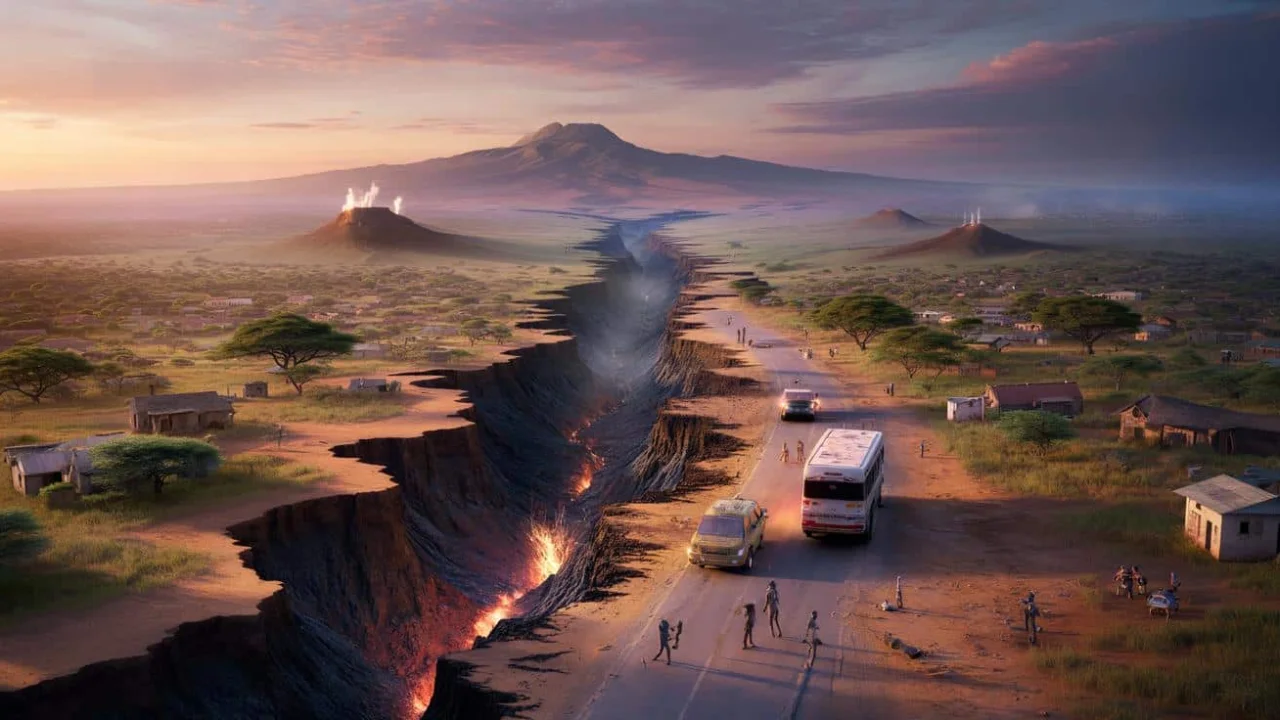
Maria Kinyanjui was hanging laundry outside her home in Kenya’s Rift Valley when the ground beneath her feet literally split open. It was March 2018, and after a night of heavy rains, the earth had cracked like a broken eggshell, creating a jagged trench that swallowed part of the main road to Nairobi.
“I thought it was the end of the world,” she told local reporters, pointing to the gaping wound in the landscape that stretched for kilometers. Cars couldn’t pass. Children walked miles around the fissure to get to school. Within hours, videos of the dramatic crack were spreading across social media, with people asking the same question: What on earth was happening?
What Maria witnessed wasn’t just a local disaster. It was a tiny preview of one of the most mind-bending geological stories on our planet—one that could eventually split Africa into two separate continents and create a brand new ocean.
The Great African Split: What’s Really Happening Underground
Those viral videos of massive cracks tearing through Kenya aren’t random disasters. They’re symptoms of something much bigger happening deep beneath our feet. Africa is slowly splitting apart along what scientists call the East African Rift System—a massive geological feature that stretches over 3,000 kilometers from the Red Sea down to Mozambique.
- This simple moisturizer dermatologists choose over $120 luxury creams is hiding in plain sight
- This maintenance planner job rewards steady planning over heroic repairs—here’s why that matters
- The emotional habits you think only you have are shared by thousands of strangers
- Your Eyes Quietly Change the Rules After 55—Here’s What Eye Doctors Want You to Know About Dry Eyes
- Parents obsessing over children’s happiness may be creating adults who can’t handle life’s challenges
- Dance Classes Beat Crosswords as the Shocking Memory Booster Seniors Need Most
“Think of it like a zipper being pulled apart, but in super slow motion,” explains Dr. James Hammond, a geophysicist who has studied the rift for over a decade. “What we’re seeing is the African continent literally tearing itself in two.”
The process started millions of years ago when hot rock from deep in Earth’s mantle began pushing upward, stretching and weakening the continental crust above. As this crust gets thinner, it cracks and splits, creating the dramatic valleys and fissures that make headlines when they appear overnight.
But here’s what makes this story incredible: if the splitting continues at its current pace, eastern Africa—including countries like Somalia, Kenya, Ethiopia, and Tanzania—could eventually break away completely, forming a new continent. And in between? A brand new ocean could fill the gap.
The Evidence Scientists Are Tracking Right Now
The signs of Africa splitting into continents are everywhere once you know what to look for. Scientists use satellites, seismic monitors, and GPS stations to track the continental breakup in real-time. Here’s what they’re finding:
- Measurable movement: The Somali Plate is moving away from the Nubian Plate at about 6-7 millimeters per year—roughly the same rate your fingernails grow
- Volcanic activity: The rift is dotted with active volcanoes, from Ethiopia’s Erta Ale to Kenya’s Mount Longonot
- Seismic events: Earthquakes regularly shake the region as the crust adjusts to the splitting forces
- Surface cracking: Dramatic fissures like the 2018 Kenya crack appear when underlying pressure becomes too much for the surface to handle
- Land subsidence: Some areas are sinking as the crust stretches and thins
| Location | Key Evidence | Rate of Change |
|---|---|---|
| Red Sea | Ocean already forming | 16mm per year spreading |
| Afar Triangle (Ethiopia) | Below sea level, active volcanism | 20mm per year extension |
| Kenya Rift Valley | Surface cracking, escarpments | 2-5mm per year widening |
| Tanzania | Lake formation, fault scarps | 1-3mm per year movement |
“The Afar region in Ethiopia is like looking into the future,” says Dr. Cynthia Ebinger, a leading expert on continental rifting. “It’s already below sea level and shows us exactly how a new ocean basin forms.”
When Will Africa Actually Split Apart?
Before you start planning your beach vacation to the future East African coast, there’s an important reality check: this process takes geological time, not human time.
Current estimates suggest that if the rifting continues at its present rate, it could take anywhere from 5 to 10 million years for the eastern part of Africa to fully separate from the main continent. That means thousands of generations of humans will come and go before Africa completes its continental divorce.
But the timeline isn’t set in stone. The splitting could speed up, slow down, or even stop entirely. “Continental rifting is unpredictable,” notes Dr. Hammond. “We’ve seen rifts that started strong and then fizzled out, leaving behind failed rift valleys.”
However, the East African Rift has several factors working in its favor. The Red Sea and Gulf of Aden have already successfully opened into ocean basins, proving the process can go the distance in this region.
What This Means for People Living in East Africa
While the full continental split is millions of years away, the ongoing rifting process affects millions of people today. The geological activity creates both challenges and opportunities for East African communities.
The frequent earthquakes pose real risks to buildings and infrastructure, especially in countries like Ethiopia and Kenya where construction standards vary widely. The 2018 crack that appeared in Kenya forced authorities to reroute the major highway connecting Nairobi to Narok, costing millions in repairs and economic disruption.
But there’s a flip side to living on an active rift. The same geological processes that create dramatic cracks also generate valuable resources. The region is rich in geothermal energy potential, with countries like Kenya already harnessing underground heat to generate clean electricity for homes and businesses.
“The rift gives us challenges, but also amazing opportunities,” explains Dr. Sarah Stamps, who studies GPS measurements across East Africa. “Understanding how the continent is moving helps us plan better for the future.”
The New Ocean That Could Eventually Form
If the East African Rift continues its journey toward becoming a full ocean basin, the result would be spectacular. The new body of water would likely connect to the existing Indian Ocean, creating a seaway that could rival the Red Sea in size and importance.
This future ocean would separate what geologists call the Somali Plate from the Nubian Plate, effectively creating two distinct African continents. The eastern portion would include Somalia, eastern Ethiopia, Kenya, Tanzania, and parts of other neighboring countries.
Scientists have even begun studying how this new ocean might affect global weather patterns, ocean currents, and marine ecosystems. The creation of a major new seaway could potentially alter rainfall patterns across the region and create new habitats for marine life.
Of course, by the time this happens, human civilization as we know it will have changed beyond recognition. But the geological processes we can observe and measure today are writing the script for Earth’s distant future.
FAQs
Is Africa really splitting into two continents?
Yes, but very slowly. The East African Rift is gradually separating eastern Africa from the rest of the continent over millions of years.
How fast is Africa splitting apart?
The continental plates are moving apart at roughly 6-7 millimeters per year, about the same rate your fingernails grow.
Will I see Africa split in my lifetime?
No. The complete separation process will take 5-10 million years, though you might see more dramatic cracks and geological activity.
What countries would be on the new continent?
The eastern portion would likely include Somalia, Kenya, Tanzania, parts of Ethiopia, and several smaller nations along the rift zone.
Could the splitting process stop?
Yes. Continental rifts sometimes fail and stop spreading, but the East African Rift shows strong signs of continuing based on current geological evidence.
Is the splitting dangerous for people living there?
The gradual process isn’t dangerous, but it does cause earthquakes and surface cracking that can damage infrastructure and require careful planning.