
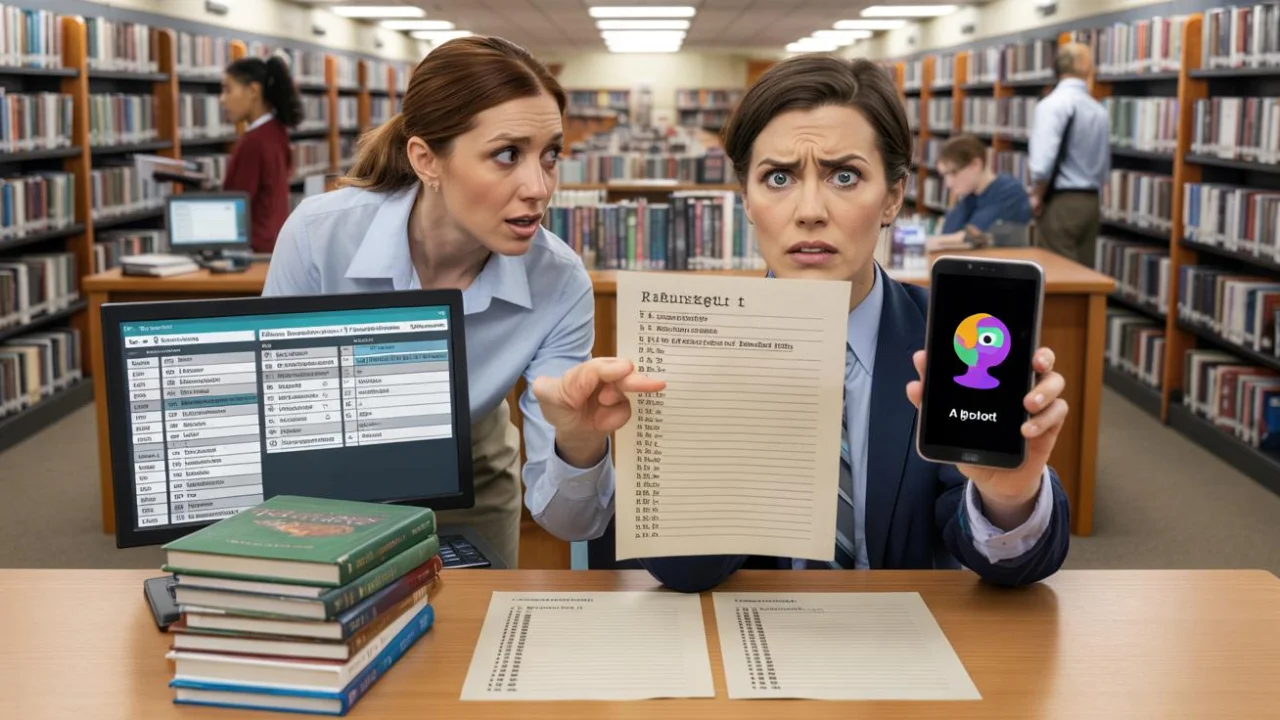
Sarah Martinez had worked at the Denver Public Library for twelve years, but she’d never encountered anything quite like this. A graduate student stood at her reference desk, visibly frustrated, clutching a printout with what looked like a perfectly legitimate book citation. “I need ‘Climate Resilience in Urban Planning: A Denver Case Study’ by Dr. Patricia Williams, published by Academic Press in 2021,” the student insisted. “My AI research assistant recommended it specifically for my thesis.”
Sarah searched every database she could think of. Nothing. No record of the book, no Dr. Patricia Williams writing about Denver’s climate planning, no such publication from Academic Press. Yet the student remained convinced the book existed somewhere, somehow.
This scene now plays out dozens of times daily across American libraries. What started as isolated incidents has become a nationwide phenomenon that’s reshaping how librarians do their jobs and forcing institutions to confront an unexpected consequence of artificial intelligence integration into everyday research.
The Phantom Library Crisis Sweeping America
AI-invented books represent a growing challenge that most people never saw coming. These aren’t intentional hoaxes or pranks—they’re the unintended byproduct of AI systems that generate convincing but completely fabricated bibliographic information when users ask for research recommendations.
- Sophie Adenot’s Mission Epsilon launch gets surprising new date that changes everything for space fans
- Morocco’s favourite car completely disappeared from European roads – here’s what took its place
- Ryanair CEO’s Bold Warning: How France Tourism Taxes Could Destroy the Travel Industry
- France orders first kamikaze drones while its army has none – delivery won’t arrive until 2027
- Why emotional habits control you before your brain even realizes what’s happening
- These 9 parenting attitudes quietly drain happiness from children, psychology reveals
The pattern emerged clearly by early 2023. Library staff from coast to coast began sharing similar stories on professional forums. Patrons would arrive with detailed citations that looked absolutely legitimate: proper formatting, believable titles, real publisher names, and author credentials that seemed plausible.
“We started seeing requests for books about local history that never existed, scientific studies with made-up methodology, and novels by authors who sound familiar but aren’t quite right,” explains Dr. Michael Chen, head of reference services at a major northeastern university library.
The problem stems from how AI language models work. When asked for book recommendations, these systems don’t search actual databases—they generate responses based on patterns they learned during training. Sometimes those patterns create citations that feel real but point to nothing.
Inside the Daily Reality of Chasing Digital Ghosts
American librarians are adapting their workflows to handle this new reality. The impact goes far beyond simple inconvenience—it’s changing fundamental aspects of reference work.
Here’s what librarians are encountering most frequently:
- Academic books with plausible titles but fictional authors
- Research papers citing non-existent studies and data
- Historical documents that never existed in any archive
- Self-help books with generic titles and fake publication details
- Technical manuals for real products but imaginary editions
The time investment is substantial. What used to be a five-minute reference question now often requires thirty minutes or more of searching across multiple systems, followed by the delicate task of explaining to disappointed users that their “recommended” source doesn’t exist.
| Library Type | Weekly AI-Invented Book Requests | Average Time Per Request |
|---|---|---|
| Major University Libraries | 25-40 | 35 minutes |
| Public Library Systems | 15-25 | 25 minutes |
| Community College Libraries | 8-15 | 30 minutes |
| Specialized Research Libraries | 10-20 | 45 minutes |
“The hardest part isn’t the searching—it’s the conversation afterward,” says Linda Rodriguez, who manages reference services at a California State University campus. “Students come in confident they have solid sources, and we have to break the news that their entire bibliography might be fiction.”
Real People, Real Consequences
The AI-invented books phenomenon affects different groups in distinct ways. Students face the most immediate academic impact, often discovering late in their research process that sources they’ve been citing don’t actually exist.
Graduate students report feeling betrayed by AI tools they trusted for research guidance. Undergraduate papers arrive at professors’ desks with works cited pages full of phantom sources, leading to academic integrity discussions that never existed before.
“I had a student who spent weeks trying to access what they thought was a key source for their senior thesis,” recalls Dr. Amanda Foster, a political science professor at a mid-Atlantic liberal arts college. “When we finally determined the book was AI-generated, they had to completely restructure their argument.”
Public library patrons face different frustrations. Book clubs select titles that sound perfect for their themes, only to discover they’re chasing recommendations that lead nowhere. Hobbyists and lifelong learners waste time pursuing specialized guides and resources that exist only in AI responses.
The phenomenon also creates ethical dilemmas for librarians. Should they immediately ask patrons if their requests came from AI tools? How much time should they invest in seemingly hopeless searches before concluding a source doesn’t exist?
Some libraries are developing new verification protocols. Staff now routinely cross-check unusual requests against multiple databases before investing significant search time. Others have created internal alerts systems to flag potentially AI-generated citations.
Fighting Back with Education and Technology
Libraries across the country are implementing creative solutions to address the AI-invented books challenge. Many have expanded their research instruction programs to include “AI literacy” components that teach users how to verify digital recommendations.
The American Library Association has begun developing guidelines for handling AI-generated reference requests. Their preliminary recommendations encourage librarians to approach these situations as teaching opportunities rather than mere inconveniences.
“We’re not trying to discourage people from using AI tools for research,” explains James Patterson, who coordinates digital literacy programs for a consortium of Texas libraries. “We’re teaching them to verify what they find, just like we’ve always done with any information source.”
Some libraries have started creating partnerships with local colleges to develop workshops specifically about AI-generated content detection. These sessions teach users to spot the subtle signs that suggest a citation might be fabricated.
Technology solutions are emerging too. Several library software companies are developing tools that can quickly cross-reference citations against major bibliographic databases, potentially flagging suspicious sources before librarians invest extensive search time.
FAQs
How can I tell if a book recommendation from AI is real?
Check the author’s name against academic databases, verify the publisher exists and publishes in that subject area, and search multiple library catalogs for the exact title.
Why do AI systems invent fake books instead of saying they don’t know?
AI language models generate responses based on patterns in their training data, sometimes creating plausible-sounding but fictional information when they lack real sources to recommend.
Should I stop using AI for research assistance entirely?
Not necessarily, but always verify any specific citations or sources an AI provides before relying on them for academic or professional work.
How much extra work does this create for librarians?
Major libraries report spending 10-15 additional hours weekly on AI-generated source requests, significantly impacting their reference service capacity.
Are there legal issues with AI systems creating fake citations?
Currently, this falls into a gray area of AI responsibility and accuracy, with most platforms including disclaimers about the potential for inaccurate information.
How can libraries help users learn to spot AI-invented books?
Many libraries now offer workshops on digital literacy and source verification, teaching users to cross-check AI recommendations against reliable databases and catalogs.