
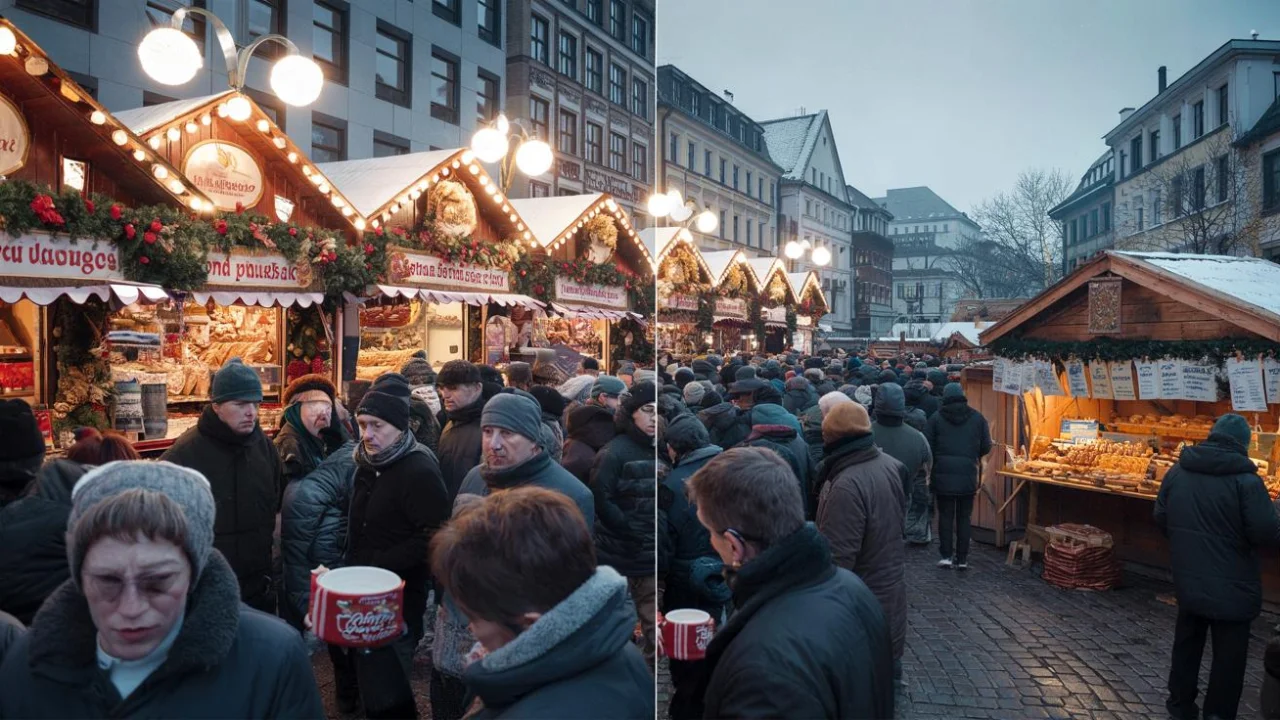
Sarah pulled her scarf tighter as she walked through the entrance of what the brightly colored banner promised would be “Manchester’s Most Magical Christmas Market.” The wooden chalets looked picture-perfect under the string lights, steam rising from various food stalls creating an almost movie-like atmosphere. But something felt off.
As she wandered deeper into the market, a strange sense of déjà vu washed over her. These weren’t just similar stalls to the ones she’d visited in Birmingham last weekend – they were identical. Same red-painted wooden huts, same vendor selling “authentic German bratwurst,” same woman behind the mulled wine counter. Even the Christmas ornaments hanging from the display racks looked familiar.
“Haven’t we been here before?” her friend Emma asked, voicing exactly what Sarah was thinking. They both laughed, but it wasn’t the joyful kind of laughter you’d expect at a festive market.
The Cookie-Cutter Christmas Market Problem
Christmas markets across Britain are facing an identity crisis. What once promised unique local experiences has transformed into a predictable touring circuit where the same vendors, selling identical products, simply pack up and move to the next city.
The issue isn’t just about repetitive stalls – it’s about the slow erosion of what made christmas markets special in the first place. Traditional markets were community gatherings where local artisans showcased their crafts, where regional foods told the story of a place, and where families could experience something genuinely different.
“We’re seeing the McDonaldization of Christmas markets,” explains Dr. Rebecca Thomson, a cultural heritage specialist at Sheffield University. “Everything becomes standardized, predictable, and ultimately less meaningful.”
The transformation has been gradual but unmistakable. City councils, eager to attract visitors and boost local economies, have increasingly turned to event management companies that can deliver turnkey Christmas market solutions. These companies bring established vendor networks, proven logistics, and guaranteed crowds – but they also bring uniformity.
What’s Actually Happening at Modern Christmas Markets
A closer look at the typical modern christmas market reveals just how standardized the experience has become. Here’s what visitors can expect to find at almost every major market across the UK:
- Identical wooden chalet designs painted in the same red and green color schemes
- The same handful of food vendors offering “traditional” bratwurst, churros, and overpriced hot chocolate
- Mass-produced ornaments and gifts labeled as “handcrafted” despite obvious factory origins
- Standardized pricing that seems to ignore local economic conditions
- Background music playlists that rotate through the same 20 Christmas songs on endless repeat
The economics tell an even starker story. Many of the most prominent stalls are operated by just a handful of companies that specialize in the Christmas market circuit. These operators can afford the premium pitch fees that have priced out genuine local artisans.
| Market Element | Traditional Markets | Modern Markets |
|---|---|---|
| Vendors | Local artisans and producers | Touring commercial operators |
| Products | Regional specialties | Mass-produced imports |
| Pricing | Varied by local economy | Standardized premium pricing |
| Atmosphere | Community-focused | Tourist-oriented |
| Layout | Adapted to local spaces | Template-based design |
“It’s heartbreaking to see the genuine makers being pushed out,” says James Mitchell, who has run a small pottery stall at various markets for fifteen years. “I used to be able to afford prime spots where families could watch me work. Now I’m lucky to get a corner pitch behind the commercial food trucks.”
The Human Cost of Commercialized Christmas Spirit
The shift toward standardized christmas markets isn’t just disappointing for visitors – it’s devastating for the local artisans and small businesses that these events were originally designed to support.
Real craftspeople are being systematically priced out of their own local markets. Pitch fees have skyrocketed as councils and event organizers prioritize vendors who can guarantee high-volume sales and commission payments. A local candlemaker who might sell 50 carefully crafted items over a weekend can’t compete with a commercial operation selling hundreds of imported trinkets.
The ripple effects extend beyond just the markets themselves. Local communities lose opportunities to showcase their unique character and creativity. Visitors leave with mass-produced souvenirs instead of genuine mementos that connect them to a specific place and time.
“We’re creating a generation of families who think Christmas markets are supposed to be generic experiences,” observes cultural anthropologist Dr. Maria Santos. “Children grow up expecting the same stalls, same foods, same decorations everywhere they go.”
The environmental impact is significant too. Instead of supporting local producers with minimal transportation needs, the current system involves trucks crisscrossing the country to deliver identical products and booth structures to dozens of different cities.
Why Some Markets Still Get It Right
Not every christmas market has succumbed to the cookie-cutter approach. A few standout examples show what’s possible when organizers prioritize authenticity over convenience.
The Grassmarket Winter Market in Edinburgh deliberately limits commercial vendors and requires proof of local production for craft stalls. Bath’s Christmas Market still features a significant number of regional food producers alongside carefully vetted artisans. These markets feel different because they are different – they reflect the character of their communities rather than following a corporate template.
“The secret is saying no to the easy money,” explains Caroline Webb, who helps organize one of the few remaining traditional-style markets in the Cotswolds. “Yes, it’s harder work to find genuine local makers. Yes, our profit margins are smaller. But families come back year after year because they know they’ll discover something new.”
These successful markets share common characteristics: vendor application processes that prioritize local makers, pricing structures that keep events accessible to families, and layouts that encourage browsing and discovery rather than maximum throughput.
What the Future Holds for Christmas Markets
The growing dissatisfaction with homogenized christmas markets is creating opportunities for change. Some cities are beginning to recognize that authentic experiences attract more repeat visitors than generic ones.
Smaller towns are finding success by emphasizing what makes them unique rather than trying to compete with larger commercial markets. Pop-up markets in unusual venues – from historic buildings to working farms – offer experiences that touring operators can’t easily replicate.
Technology is also creating new possibilities. Virtual reality experiences can transport visitors to authentic German Christmas markets, while local markets use social media to highlight the stories behind their genuine artisans.
“The pendulum is starting to swing back,” predicts retail consultant Simon Fletcher. “Consumers are craving authentic experiences, and the most successful christmas markets will be those that deliver genuine local character.”
FAQs
Why do Christmas markets all look the same now?
Most modern christmas markets are operated by the same handful of commercial companies that use standardized booth designs, vendor networks, and layouts to minimize costs and maximize efficiency.
Are Christmas market prices getting too expensive?
Yes, many visitors report significant price increases over recent years, with standardized premium pricing that doesn’t reflect local economic conditions or actual production costs.
How can I find authentic Christmas markets?
Look for markets that emphasize local vendors, have application processes for craft stalls, and are organized by community groups rather than commercial event companies.
What happened to local artisans at Christmas markets?
Many have been priced out by dramatically increased pitch fees and competition from commercial operators who can afford premium locations and offer higher commission payments to organizers.
Do Christmas markets still support local communities?
Traditional markets do, but many modern commercial markets primarily benefit touring vendors and event management companies rather than local businesses and artisans.
Will Christmas markets ever return to being more authentic?
Some markets are already moving back toward authenticity as organizers recognize that unique experiences attract more loyal visitors than generic commercial operations.