
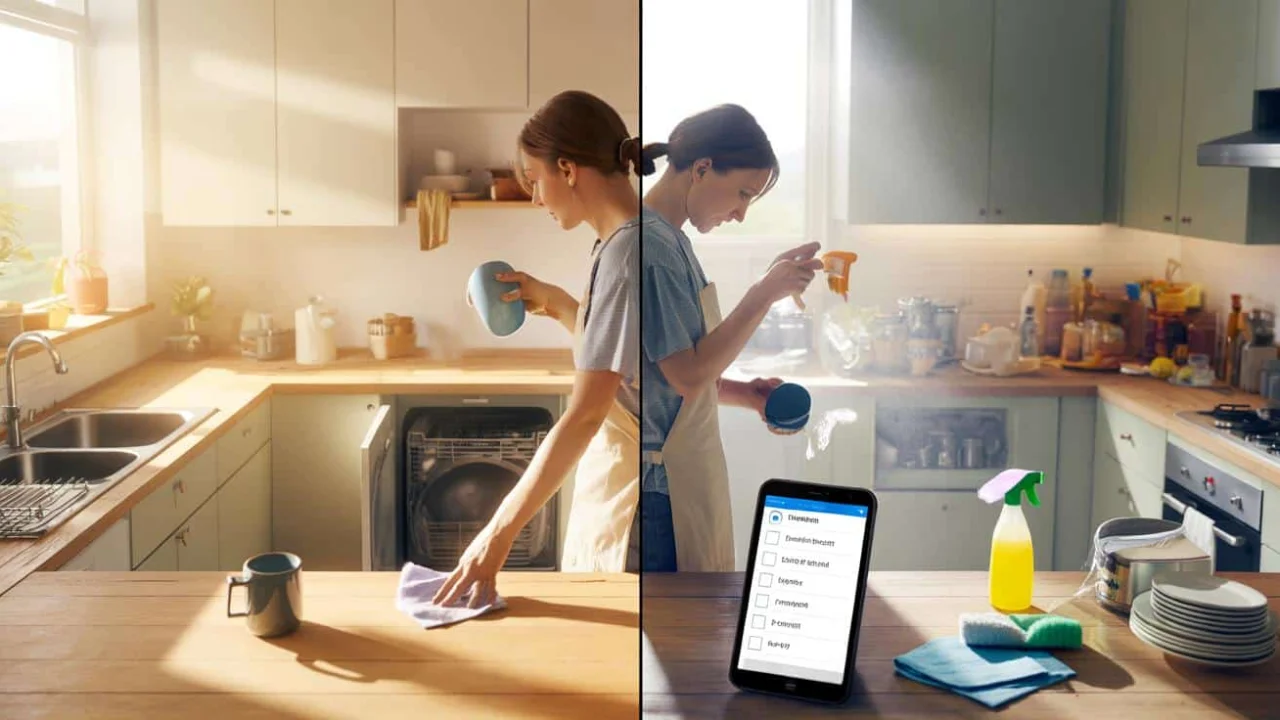
Maria stares at her kitchen every Saturday morning, coffee mug in one hand, cleaning schedule in the other. The list says “deep clean pantry, organize spice rack, scrub cabinet doors.” She sighs, scrolls through her phone instead, and feels guilty about it for the rest of the weekend.
But Tuesday evening? She’s washing dinner dishes, and somehow the counters get wiped, the stove gets a quick scrub, and the sink sparkles. No list, no guilt, no forcing herself through motions that feel fake.
Same person, same kitchen, completely different experience. The difference isn’t willpower or discipline—it’s about working with your natural rhythms instead of fighting them.
Why Some Cleaning Routines Flow Like Water
The cleaning routines that stick are rarely the ones we plan in detail. They’re the tiny actions that attach themselves to things we’re already doing. You rinse your coffee mug while the kettle boils. You fold laundry during your favorite TV show. You wipe the bathroom mirror after brushing your teeth.
These natural cleaning routines work because they piggyback on existing habits. Dr. Jennifer Lee, a behavioral psychologist, explains: “When we anchor new behaviors to established routines, the brain doesn’t register them as separate tasks. They become part of the flow.”
Your brain loves efficiency. It wants to group related actions together, creating what researchers call “habit stacks.” The most successful cleaning routines exploit this tendency.
Think about how you automatically lock your car after parking, or how you hang up your coat without thinking about it. These aren’t conscious decisions—they’re choreographed responses to environmental cues.
The Science Behind Natural vs. Forced Habits
Research from University College London found that habits take an average of 66 days to become automatic, but only when they’re anchored to strong existing triggers. The key factors that separate natural cleaning routines from forced ones are surprisingly specific.
| Natural Cleaning Routines | Forced Cleaning Routines |
|---|---|
| Triggered by daily activities | Scheduled at arbitrary times |
| Take 2-5 minutes | Require 30+ minute blocks |
| Immediate visible results | Results not immediately apparent |
| Match current energy levels | Demand peak performance |
| Fit existing lifestyle | Require lifestyle changes |
Natural routines respect what psychologists call “cognitive load.” When you’re already in the kitchen making breakfast, wiping the counter requires almost no additional mental energy. But when you schedule “kitchen deep clean” as a separate weekend task, your brain treats it as a whole new project.
The most effortless cleaning routines happen during transition moments—when you’re already moving between activities. Professional organizer Sarah Chen notes: “The magic happens in those in-between spaces. Walking from room to room, waiting for something to heat up, during commercial breaks.”
These micro-moments don’t feel like cleaning time because they weren’t designated as such. They’re just life happening, with tidying woven seamlessly into the fabric.
The Hidden Psychology of Cleaning Resistance
When cleaning routines feel forced, it’s usually because they violate our sense of autonomy. Behavioral economist Dan Ariely’s research shows that people resist tasks that feel imposed, even when they’re self-imposed.
The cleaning schedule that looked perfect on Pinterest becomes a source of stress when it doesn’t account for your actual Tuesday evenings—kids needing homework help, work calls running late, or simply being too tired to tackle baseboards with enthusiasm.
Forced routines often fail because they’re based on an idealized version of ourselves. They assume we’ll wake up earlier, have more energy, and feel motivated by detailed checklists. Real life has other plans.
Here are the warning signs that a cleaning routine is fighting your natural patterns:
- You need multiple alarms or reminders to start
- You regularly postpone or skip sessions
- The routine requires you to change other established habits
- You feel guilty or frustrated when you don’t complete it perfectly
- The tasks feel disconnected from your daily life flow
Dr. Maria Rodriguez, who studies habit formation, explains: “Sustainable routines don’t require discipline—they require design. When you have to force yourself repeatedly, the design is wrong for your life.”
Building Routines That Actually Stick
The most successful cleaning routines start small and build on patterns that already exist in your life. Instead of creating new time blocks, look for moments when you’re already in motion.
If you always check your phone while coffee brews, that’s three minutes you could spend wiping surfaces. If you watch evening news, fold laundry during commercial breaks. If you listen to music while cooking, extend that playlist by one song and tackle the dishes.
The key is matching tasks to your natural energy rhythms. Morning people might naturally tidy up during their energetic start to the day. Night owls might find that cleaning helps them wind down before bed.
Time-blocking expert Cal Newport suggests: “Don’t schedule cleaning—schedule the triggers that make cleaning inevitable. When you create the right environmental cues, the behavior follows naturally.”
Some of the most effective cleaning routine triggers include:
- Starting the dishwasher triggers wiping all kitchen surfaces
- Taking off work clothes triggers hanging them up and tidying the bedroom
- Making the bed triggers a quick bathroom wipe-down
- Feeding pets triggers sweeping the kitchen floor
- Starting laundry triggers decluttering the laundry room
These connections feel logical because they’re spatially and temporally related. Your brain can easily remember them because they make sense.
Why Perfectionist Cleaning Plans Backfire
The cleaning routines that feel most natural are often the messiest ones on paper. They don’t follow perfect schedules or complete comprehensive checklists. They work with interruptions, adapt to changing circumstances, and prioritize consistency over perfection.
Perfectionist approaches to cleaning create all-or-nothing thinking. You either follow the complete routine or you’ve failed. This binary mindset makes it easy to abandon the entire system when life gets complicated.
Flexible routines, on the other hand, can bend without breaking. If you usually wipe surfaces after dinner but tonight you have guests, you adapt. Maybe surfaces get wiped after breakfast instead, or while coffee brews tomorrow morning.
The goal isn’t to become a cleaning robot—it’s to create sustainable patterns that improve your life without dominating it. The best cleaning routines are the ones you hardly notice you’re doing.
FAQs
How long does it take for a cleaning routine to feel natural?
Most people report that simple, well-anchored cleaning habits feel automatic within 3-4 weeks, though complex routines may take longer.
Should I clean at the same time every day?
Timing matters less than triggers. It’s better to clean “after dinner” than “at 7 PM” because life happens and schedules change.
What if I miss a day of my cleaning routine?
Missing one day doesn’t break a habit. The key is getting back to it the next time your usual trigger occurs, without guilt or dramatic restart plans.
How do I know if my cleaning routine is too ambitious?
If you’re regularly skipping it, postponing it, or feeling stressed about it, the routine is probably too big or poorly timed for your actual lifestyle.
Can cleaning routines work for people with ADHD or other executive function challenges?
Yes, but they often work better when broken into smaller pieces and attached to very strong existing habits or environmental cues.
What’s the biggest mistake people make when creating cleaning routines?
Trying to change too much at once and creating routines based on their ideal life rather than their actual daily patterns and energy levels.