
Picture this: You’re running a pizza shop, and everyone in town suddenly wants your pizza at the same time. The phone won’t stop ringing, customers are lining up outside, and you could easily make twice as much money by hiring more cooks and buying bigger ovens. But instead, you keep making exactly the same number of pizzas every day. Sounds crazy, right?
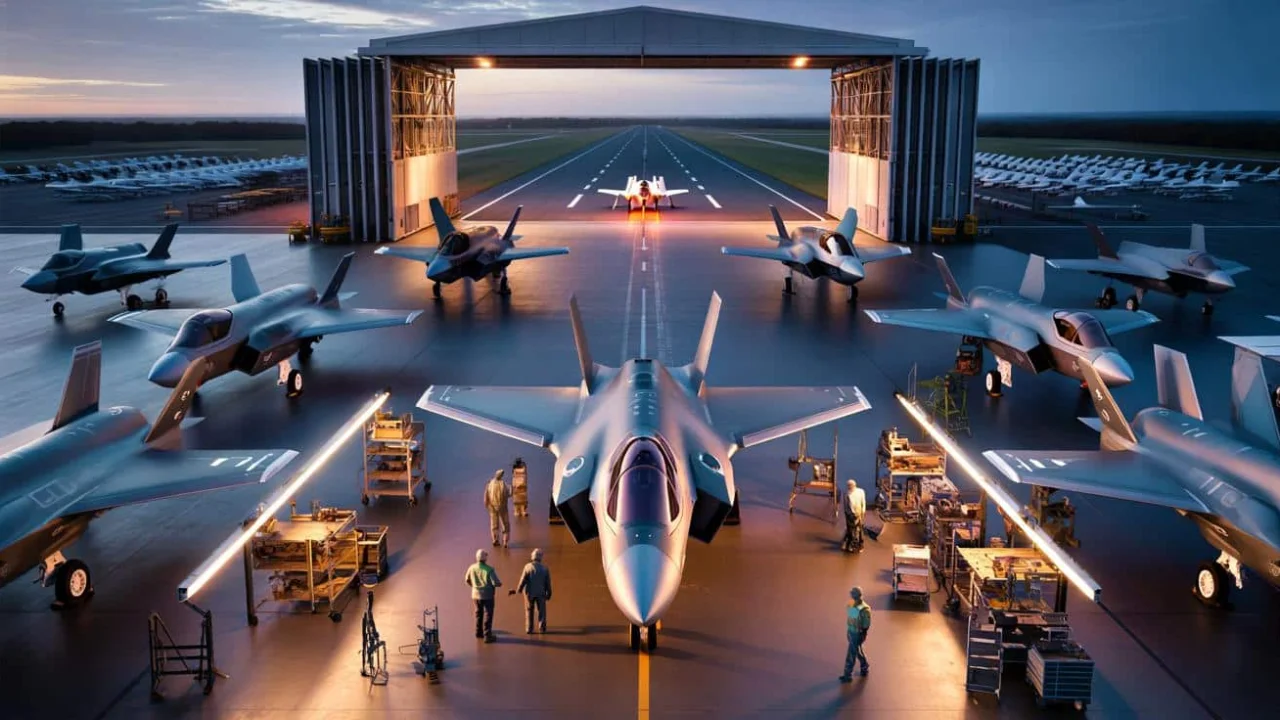
That’s exactly what’s happening with one of the most expensive and complex military projects in history. Lockheed Martin, the company behind the F-35 stealth fighter, is deliberately keeping F35 production at current levels despite skyrocketing global demand.
While countries from the United States to Saudi Arabia are practically begging for more of these advanced jets, Lockheed is saying “not so fast” – and their reasons might surprise you.
Why Lockheed Is Pumping the Brakes
At the recent Dubai Airshow, Steve Sheehy, Lockheed Martin’s vice president for aeronautics strategy, was refreshingly blunt when reporters asked about ramping up F35 production. “At this moment, no,” he said, making it clear that the company could build more jets but is choosing not to.
- America’s rare earth elements crisis could cripple future weapons production if China cuts supply
- Canada Quietly Moved Up Tank Timeline By 6 Years—Here’s What Military Planners Are Seeing
- China’s Fujian aircraft carrier revealed in rare TV footage – and it’s almost as big as US supercarriers
- Why Type 26 Frigates Are Getting This Game-Changing Stealth Weapon That Nobody Saw Coming
- Scientists discover why your brain either loves or hates remembering directions—and it’s not what you think
- Singapore drone warfare takes shocking turn as city-state abandons surveillance-only approach
This isn’t about technical limitations or lack of demand. Lockheed currently plans to build up to 156 F-35s annually across all three variants. But here’s the kicker – that number isn’t their maximum capacity. It’s what they call a “smart” production level designed to protect their massive supply chain.
“We’re balancing demand, affordability, and economic stability for the vast network of companies feeding parts into the fighter,” Sheehy explained. Think of it like conducting an orchestra – you can’t just tell the violins to play faster without making sure the whole ensemble can keep up.
The Numbers Tell an Interesting Story
The contrast between current F35 production and future demand is striking. Here’s what we’re looking at:
| Current State | Future Projections |
|---|---|
| 156 F-35s per year total | 100+ F-35As for US Air Force alone by 2030 |
| 40 F-35As for US Air Force in Lot 19 | Dramatic increase needed for all services |
| Controlled production tempo | Aggressive expansion plans |
The three F-35 variants each serve different purposes:
- F-35A: Conventional takeoff and landing version for air forces
- F-35B: Short takeoff and vertical landing for Marines and smaller carriers
- F-35C: Carrier-capable version for Navy operations
US Air Force internal planning documents show they’re plotting a much more aggressive future. By fiscal year 2030, they want to order around 100 F-35A aircraft annually – more than double what they’re getting now. That’s just one branch of the military from one country.
The Global Appetite Is Growing Fast
The demand isn’t just coming from America. Countries across Europe, the Middle East, and Asia are lining up for these stealth fighters. The F-35’s advanced technology makes it incredibly attractive to allies who want to stay ahead of potential threats.
But ramping up production isn’t like turning up the volume on your stereo. The F-35 program involves thousands of suppliers across multiple countries. Each component has to arrive at exactly the right time, meet strict quality standards, and integrate perfectly with incredibly complex systems.
“There’s a healthy amount of skepticism over whether industry can sustainably reach those volumes,” admitted one US official, highlighting the challenge of scaling up such a sophisticated manufacturing process.
The ripple effects of rushing production could be catastrophic. If suppliers can’t keep up, quality might suffer. If quality suffers on a fighter jet, people die. It’s that simple and that serious.
What This Means for Everyone
This cautious approach to F35 production affects more than just military planners. Defense contractors, taxpayers, and international allies all have skin in this game.
For allied nations, the steady production rate means longer wait times for their orders. Countries that need these jets for their defense strategies will have to be patient or explore alternatives. Some might turn to European competitors like the Eurofighter Typhoon or France’s Rafale.
Taxpayers should pay attention because the F-35 program has already cost hundreds of billions of dollars. Rushing production and causing supply chain disruptions could make an expensive program even more costly.
The defense industry is watching closely too. Lockheed’s approach of prioritizing stability over speed could become a model for other complex military programs. It’s a lesson in thinking long-term rather than chasing short-term profits.
One industry analyst noted, “This is actually smart business. Better to build a sustainable system than to create a boom-bust cycle that hurts everyone involved.”
The Pentagon seems to agree with Lockheed’s measured approach. The F-35 Joint Program Office worked with the company to establish current production levels, showing that military planners value supply chain stability over rapid expansion.
The Bigger Picture
This situation reveals something important about modern military manufacturing. Unlike the World War II era when factories could quickly retool and ramp up production, today’s advanced weapons systems require incredibly sophisticated supply chains that can’t be rushed without serious consequences.
The F-35 represents the cutting edge of stealth technology, advanced sensors, and network warfare capabilities. Every component must work flawlessly because there’s no room for error when lives are on the line.
“We could flood the market with jets, but that might mean compromising on quality or bankrupting key suppliers,” explained another industry expert. “Neither outcome serves anyone’s interests.”
As global tensions continue to rise and more countries seek advanced fighter capabilities, the pressure to increase F35 production will only grow. But Lockheed’s current strategy suggests they’re playing the long game – building a sustainable system that can deliver quality aircraft for decades to come.
FAQs
Why isn’t Lockheed Martin increasing F-35 production to meet demand?
They’re prioritizing supply chain stability and quality control over rapid expansion to avoid disrupting their complex network of suppliers.
How many F-35s does Lockheed currently build per year?
Up to 156 F-35s annually across all three variants, though they have the technical capacity to build more.
Which countries are demanding more F-35s?
The United States, European allies, and Middle Eastern nations including Saudi Arabia are all seeking increased deliveries.
Could rushing production hurt the F-35 program?
Yes, rapid expansion could strain suppliers, compromise quality, or create boom-bust cycles that damage the industrial base.
When might F-35 production increase?
The US Air Force projects needing around 100 F-35As annually by 2030, suggesting production will eventually need to expand significantly.
What are the three F-35 variants?
The F-35A for conventional operations, F-35B for short takeoff/vertical landing, and F-35C for aircraft carrier operations.