
Picture this: You’ve just bought the latest smartphone, but when you open the box, there’s a gaping hole where the camera should be. The manufacturer promises they’ll install it “soon,” but for now, you’re stuck with a cutting-edge device that can’t perform its most basic function.
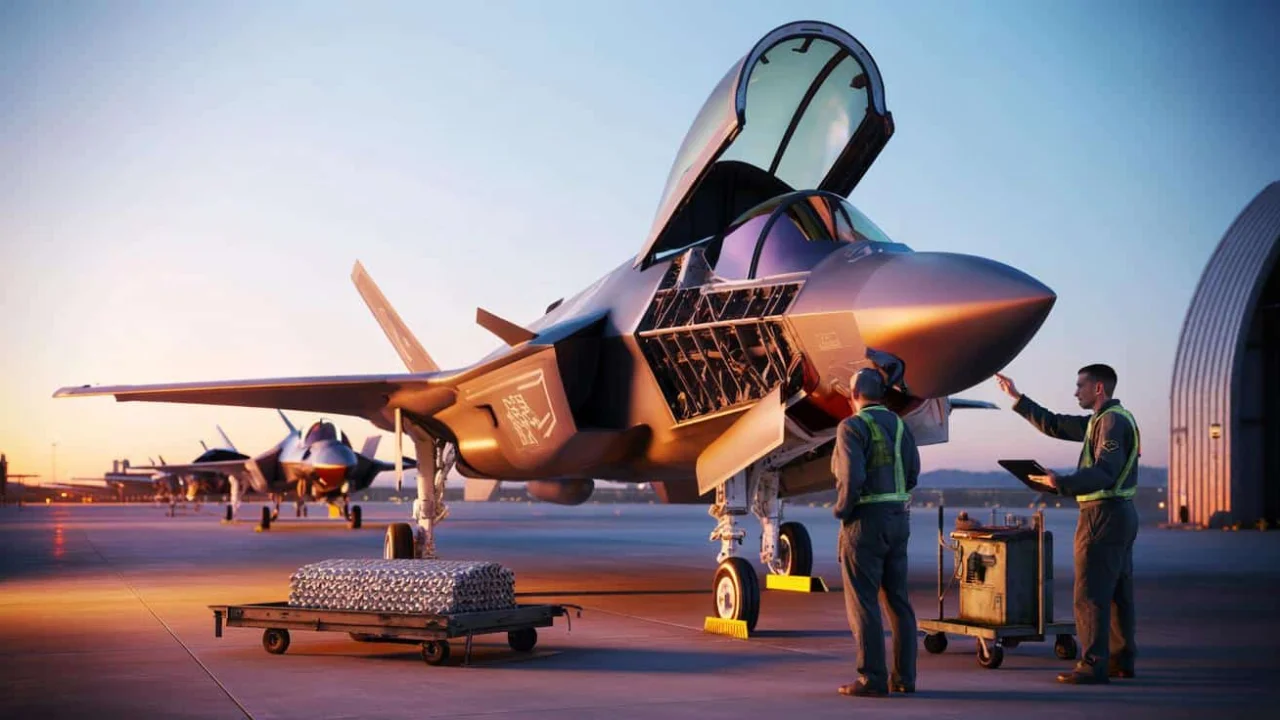
That’s essentially what’s happening to the US Air Force right now. Their brand-new F-35A Lightning II fighters are rolling off the production line with state-of-the-art computers, advanced wiring, and pristine stealth coatings. But where the radar should be? There’s literally an empty space.
This isn’t some manufacturing mistake or budget cut gone wrong. It’s the unintended consequence of an ambitious upgrade program that’s hit a snag, leaving America’s most expensive fighter jet temporarily blind in an increasingly dangerous world.
When Cutting-Edge Technology Meets Reality
The F-35A radar issues stem from a complex transition between old and new technology. The Pentagon designed the F-35 program around continuous upgrades rather than building entirely new aircraft every few decades. It seemed like a smart approach – keep the jets fresh with the latest tech without starting from scratch.
- Portugal quietly considers multi-billion euro deal for three powerful French FDI frigates
- Germany quietly begins testing reusable hypersonic aircraft that could change warfare forever
- South African Company Secretly Tried Selling US Military P-8A Poseidon Simulators to China
- Belgium just ordered 5 more H145M helicopters – here’s why your neighborhood might get louder
- Why Daher’s bold move into male drones is catching defense experts off guard
- One Operator Just Controlled 200 Drones at Once – What This Means for Warfare Will Shock You
But that philosophy is now creating a peculiar problem. The Air Force is receiving jets configured with Technology Refresh 3 (TR-3) specifications, complete with more powerful computers and upgraded electrical systems. These new jets were designed to work with Northrop Grumman’s advanced AN/APG-85 radar system.
The catch? That new radar isn’t ready yet.
“The F-35 program has always been about evolution, not revolution,” explains a defense analyst familiar with the situation. “But sometimes evolution leaves you in an awkward in-between stage.”
Meanwhile, the older AN/APG-81 radar that equipped earlier F-35s doesn’t fit the new TR-3 configuration. The upgraded electrical systems and computer architecture simply aren’t compatible with the legacy sensor.
The Technical Details Behind the Delay
Understanding the scope of these F-35A radar issues requires looking at what makes modern fighter jet radar systems so complex. Here’s what’s involved in this technological transition:
| System Component | Old AN/APG-81 | New AN/APG-85 |
|---|---|---|
| Detection Range | Classified (baseline) | Significantly improved |
| Target Tracking | Multiple simultaneous targets | Enhanced multi-target capability |
| Ground Imaging | Standard resolution | Higher resolution imaging |
| System Integration | Compatible with TR-2 | Designed for TR-3 and Block 4 |
The AN/APG-85 represents a significant leap forward in radar technology. It’s designed to detect stealth aircraft at longer ranges, track hypersonic missiles more effectively, and provide clearer images of ground targets. These capabilities are crucial as potential adversaries like China and Russia field more advanced air defense systems.
Key improvements include:
- Enhanced processing power for real-time threat assessment
- Better integration with the F-35’s sensor fusion capabilities
- Improved electronic warfare resistance
- More reliable performance in contested environments
“The AN/APG-85 isn’t just an upgrade – it’s a generational leap that will keep the F-35 competitive for decades,” notes a former Pentagon official.
But developing such advanced technology takes time, and the production schedule didn’t account for potential delays.
Real-World Consequences for Air Force Operations
These F-35A radar issues aren’t just a technical curiosity – they have serious implications for military readiness and taxpayer investment.
The Air Force is essentially receiving $80 million fighter jets that can’t perform their primary mission. Without radar, an F-35A can’t effectively engage air-to-air targets, identify threats at long range, or provide detailed ground surveillance. It’s like having a race car without an engine.
Several key impacts are already becoming apparent:
- Training delays for new pilots who need to learn radar operations
- Reduced operational readiness for squadrons expecting new aircraft
- Storage costs for jets waiting for radar installation
- Potential delays in international deliveries to allied nations
The timing couldn’t be worse. With tensions rising in the Pacific and ongoing commitments in Europe, the Air Force needs every available F-35A at full capability.
“Every month of delay means jets sitting in hangars instead of patrolling the skies,” warns a retired Air Force general. “That’s not just a capability gap – it’s a strategic vulnerability.”
The ripple effects extend beyond the US military. Allied nations that have ordered F-35As are watching nervously, wondering if their deliveries will face similar delays.
Looking Ahead: Solutions and Timeline
Lockheed Martin and Northrop Grumman are working around the clock to resolve these F-35A radar issues. The companies have several options on the table, though none are perfect.
One possibility involves retrofitting the new jets with temporary radar systems that can at least provide basic functionality. Another approach focuses on accelerating AN/APG-85 development and testing to get the advanced radar into production faster.
“We’re committed to delivering fully capable aircraft to our customers,” states a Lockheed Martin spokesperson. “These delays are temporary, but we understand the urgency.”
Industry insiders suggest the first AN/APG-85 equipped F-35As might not arrive until late 2026 or early 2027. That means months of jets sitting without their most critical sensor.
The Pentagon is also reviewing its upgrade procedures to prevent similar situations in future programs. The goal is maintaining the F-35’s evolutionary approach while avoiding capability gaps.
FAQs
Why can’t the Air Force just install the old radar in new F-35As?
The new TR-3 configuration has different electrical systems and computer architecture that aren’t compatible with the older AN/APG-81 radar system.
How many F-35As are affected by this radar issue?
The exact number hasn’t been disclosed, but it potentially affects all new F-35As in the current production lots until the AN/APG-85 becomes available.
Can F-35As fly combat missions without radar?
Technically yes, but their effectiveness would be severely limited. Radar is essential for air-to-air combat, threat detection, and ground attack missions.
Will this delay affect international F-35 customers?
Potentially yes, as many allied nations are waiting for deliveries of new F-35As that would include the same TR-3 configuration.
How much will these delays cost taxpayers?
The full financial impact isn’t clear yet, but storing incomplete aircraft and potential schedule delays typically add millions to program costs.
When will the AN/APG-85 radar be ready?
Current estimates suggest late 2026 or early 2027, though the Pentagon hasn’t confirmed an official timeline for addressing these F-35A radar issues.