
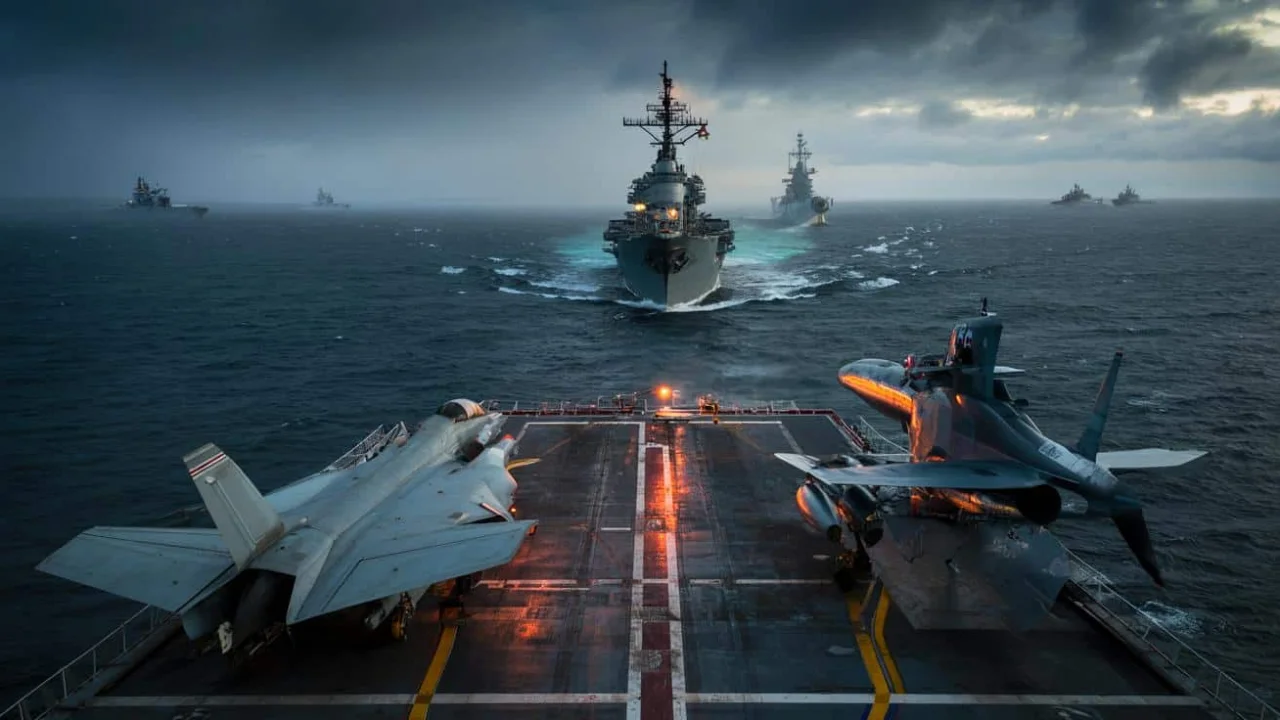
Picture this: You’re standing on the deck of a French warship in the English Channel, coffee in hand, watching the sunrise paint the water gold. Suddenly, sonar picks up a contact. Another Russian submarine, silently prowling just outside French territorial waters. For the crew, it’s Tuesday.
This isn’t some Cold War thriller – it’s the reality French sailors face every single week. While most of us worry about our morning commute, they’re tracking foreign warships that could be carrying enough firepower to level a city.
Welcome to the new age of sea power, where the world’s oceans have become a chessboard for global tensions. And right in the middle of it all stands one man with perhaps the clearest view of what’s really happening beneath the waves.
The Admiral’s Warning: Russia Isn’t Going Anywhere
Admiral Nicolas Vaujour, the French Navy chief, doesn’t mince words when he talks about Russia’s naval presence. His recent assessment paints a picture that should concern anyone who cares about global stability.
- Taiwan’s Secret Military Strategy That Has China Deeply Worried
- Royal Navy’s autonomous submarine Excalibur operates completely unmanned – here’s what that means
- Greece quietly doubles naval fleet with fourth advanced FDI frigate order from French shipbuilder
- Why the Pentagon’s MQ-20 Avenger drone is quietly changing warfare as we know it
- Europe’s secret stealth aircraft project could reshape military aviation by 2035
- Naval laser weapon breakthrough could change everything we know about sea warfare
“On average, a Russian warship sails past our coasts in the Channel once a week. We are eyeball to eyeball with the Russians in the Baltic and the North Atlantic,” Vaujour explains with the matter-of-fact tone of someone who’s watched this unfold for years.
Think about that for a moment. While Russia’s army struggles in Ukraine, losing thousands of tanks and personnel, their naval forces remain largely untouched. French radar operators and sonar technicians track Russian vessels and submarines almost continuously, like a deadly game of hide-and-seek that never ends.
The French Navy chief emphasizes that Moscow’s submarine fleet has emerged “almost intact” from the Ukraine conflict. While headlines focus on battlefield losses, Russia continues modernizing their underwater capabilities – the part of their military that can strike anywhere, anytime.
How the Naval Chess Game Is Changing
But here’s where things get interesting. Russia’s naval options are shrinking fast, creating a more dangerous and unpredictable situation. Let’s break down what’s happening:
- Black Sea Setbacks: Ukrainian strikes have forced Russian naval units to retreat eastward, away from their traditional operating areas
- Syrian Base Loss: The fall of Assad’s regime closed off Russian access to the Tartus naval facility, eliminating their Mediterranean foothold
- Baltic Squeeze: Finland and Sweden joining NATO transformed the Baltic Sea into what French officers call a “NATO lake”
- Port Pressure: Saint Petersburg, Russia’s crucial commercial port, now faces complicated naval access routes
This maritime chess match affects more than just military strategists. Global shipping routes, energy supplies, and international trade all depend on these same waters where naval forces now play their deadly games.
| Maritime Region | Russian Challenges | NATO Response |
|---|---|---|
| Baltic Sea | Finland/Sweden NATO membership | Enhanced surveillance, joint patrols |
| Black Sea | Ukrainian strikes on fleet | Intelligence sharing, weapon supplies |
| Mediterranean | Loss of Tartus base | Increased French/Italian presence |
| North Atlantic | Submarine detection improvements | Advanced sonar networks |
“The strategic landscape has fundamentally shifted,” notes a senior NATO maritime analyst. “Russia’s naval flexibility has been dramatically reduced, but that makes their remaining capabilities more concentrated and potentially more dangerous.”
Why France Is Betting Big on Sea Power
The French Navy chief isn’t just describing problems – he’s preparing solutions. France is investing billions in a new nuclear aircraft carrier, signaling their commitment to maintaining naval superiority in an increasingly dangerous decade.
This isn’t just about national pride. Aircraft carriers project power across thousands of miles, provide humanitarian aid during disasters, and serve as floating bases for everything from fighter jets to rescue helicopters.
Modern naval warfare extends far beyond ship-to-ship combat. Today’s conflicts involve:
- Cyber warfare: Attacking enemy navigation and communication systems
- Economic pressure: Controlling shipping lanes that carry global trade
- Information warfare: Demonstrating strength without firing a shot
- Humanitarian missions: Disaster relief and evacuation operations
“Every major power understands that control of the seas means control of global commerce,” explains a maritime security expert. “The French Navy chief is simply acknowledging what others prefer to keep quiet.”
What This Means for the Rest of Us
You might wonder why any of this matters to ordinary people going about their daily lives. The answer is simpler than you’d expect – almost everything you use probably traveled by ship at some point.
That smartphone in your pocket? The rare earth minerals likely came by sea. Your morning coffee? Shipped across oceans. The gas in your car? Much of it traveled through maritime chokepoints that naval forces now watch with increasing intensity.
When the French Navy chief talks about being “eyeball to eyeball” with Russian forces, he’s describing a situation that could disrupt global supply chains within days. Modern warfare doesn’t just affect soldiers – it touches every part of our interconnected world.
The implications stretch beyond commerce. Climate change is opening new Arctic shipping routes, creating fresh areas for potential conflict. Rising sea levels threaten island nations that depend on naval protection. Refugee crises often require maritime rescue operations.
“We’re not just talking about military strategy,” emphasizes a international relations professor. “Naval power shapes everything from energy prices to food security. When tensions rise at sea, everyone feels the effects eventually.”
The Dangerous Decade Ahead
Admiral Vaujour’s assessment comes at a time when multiple global flashpoints could explode simultaneously. Taiwan tensions with China, ongoing conflicts in the Middle East, and the ever-present possibility of expanded Russian aggression create a perfect storm of naval challenges.
The French Navy chief’s candid remarks about Russian naval encounters highlight how close we are to miscalculations that could spiral out of control. When warships pass “eyeball to eyeball” on a weekly basis, the margin for error shrinks dramatically.
France’s commitment to naval modernization reflects a broader reality – sea power will determine much of the 21st century’s geopolitical landscape. Countries that control the oceans control global trade, energy flows, and ultimately, economic prosperity.
FAQs
How often do French and Russian naval forces encounter each other?
According to the French Navy chief, Russian warships pass French coasts in the English Channel approximately once per week, with constant tracking in the Baltic and North Atlantic.
Why is Russia’s submarine fleet still dangerous despite Ukraine war losses?
Russia’s submarine capabilities have remained largely intact throughout the Ukraine conflict, allowing them to continue modernization while other military branches suffer heavy losses.
How has NATO expansion affected Russian naval operations?
Finland and Sweden joining NATO has transformed the Baltic Sea into what French officers call a “NATO lake,” significantly complicating Russian naval access from Saint Petersburg.
What happened to Russia’s Mediterranean naval presence?
The fall of Bashar al-Assad’s regime in Syria closed Russian access to the Tartus naval facility, eliminating their primary Mediterranean base of operations.
Why is France investing in a new nuclear aircraft carrier?
The investment reflects France’s commitment to maintaining naval superiority and power projection capabilities during what the French Navy chief calls “a dangerous decade” of rising maritime tensions.
How do naval tensions affect ordinary civilians?
Maritime conflicts can disrupt global shipping routes, affecting everything from consumer goods prices to energy supplies, since most international trade travels by sea.