
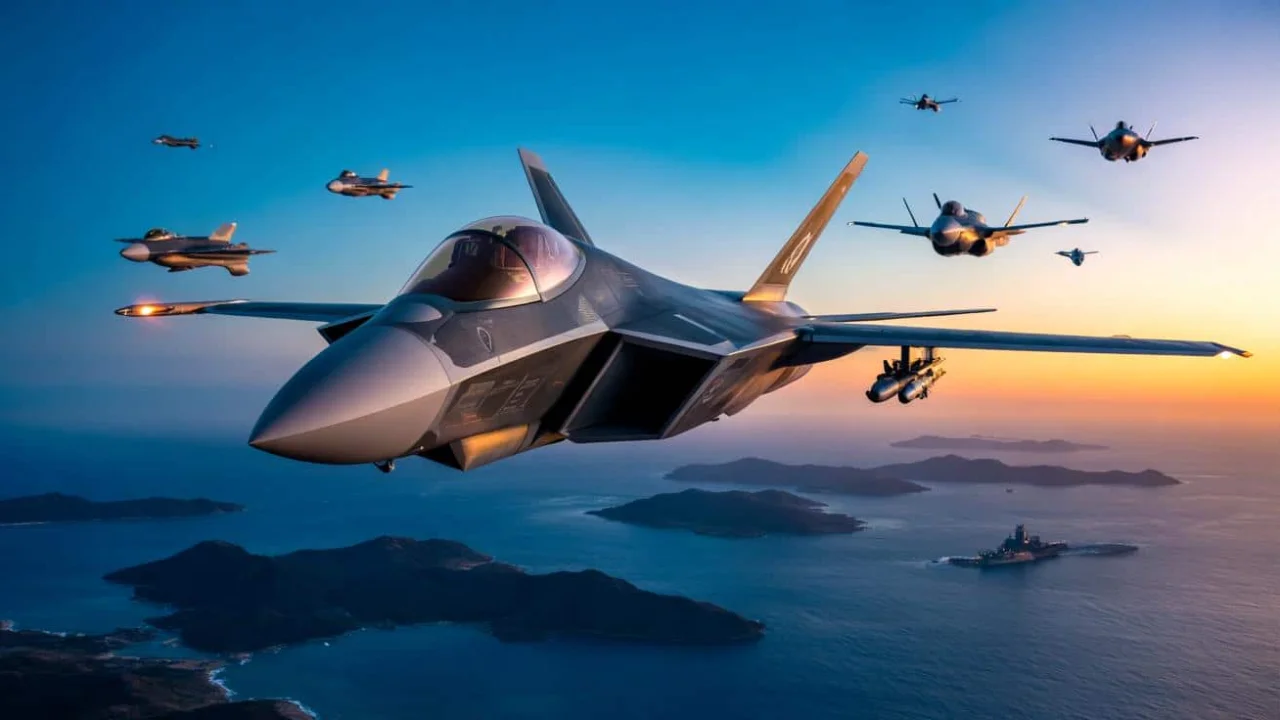
Picture this: A pilot in the cockpit of Japan’s aging F-2 fighter jet peers through the canopy at the vast Pacific Ocean below. The aircraft beneath him has served faithfully for decades, but in today’s world of hypersonic missiles and stealth drones, even the most experienced aviator knows that staying competitive means staying ahead. That pilot might very well be among the last generation to fly these trusted workhorses.
By 2035, everything changes. Japan has just locked in the timeline for its revolutionary next-generation fighter aircraft, and this isn’t just another military upgrade—it’s a complete transformation of how the nation protects its skies and projects power across the Indo-Pacific region.
The stakes couldn’t be higher. With tensions rising across East Asia and military technology advancing at breakneck speed, Japan’s commitment to the 2035 rollout represents more than just replacing old planes. It’s about survival, deterrence, and maintaining the delicate balance of power in one of the world’s most strategic regions.
Japan Sets the Clock on Its Aviation Future
Japan’s Ministry of Defense has officially confirmed that 2035 will mark the entry into service of their cutting-edge GCAP fighter aircraft. This announcement came after the 11th meeting of the Next-Generation Fighter System Development Promotion Committee, where Vice Defense Minister Masahisa Miyazaki made clear that this timeline isn’t just a hopeful target—it’s a firm commitment.
- Japan’s F-35B Fighter Jets Now Operational: What This Means for Regional Security Balance
- Japan’s hypersonic missile defense system enters mass production—what this means for regional security
- Two Europe defense winners quietly secured billions while major fighter jet project crumbles
- Italy’s GCAP warplane price soars to $21 billion as defense officials scramble to justify the massive cost overrun
- US warship docks at Chinese-built Cambodia port in historic first that changes everything
- Washington’s Quiet Plan to Make America’s Factories the New Defense Frontline
The Global Combat Air Program represents one of the most ambitious international defense collaborations in recent history. Japan, the United Kingdom, and Italy have pooled their expertise, resources, and strategic needs to create a sixth-generation fighter that will dominate the skies for decades to come.
“The 2035 timeline aligns perfectly with our partners in the UK and Italy, ensuring we can deploy this revolutionary aircraft simultaneously across all three nations,” explained a senior defense official familiar with the project.
This GCAP fighter aircraft will directly replace Japan’s aging Mitsubishi F-2 fleet, which has been the backbone of Japanese air power since the early 2000s. The transition represents a quantum leap in capability, moving from fourth-generation technology to cutting-edge sixth-generation systems.
Breaking Down the GCAP Fighter Aircraft Program
The scope of the GCAP fighter aircraft development is staggering. Here’s what makes this program truly revolutionary:
| Program Partners | Japan, United Kingdom, Italy |
| Service Entry | 2035 (all three nations) |
| Aircraft Generation | Sixth-generation stealth fighter |
| Replaces | Japan’s F-2, UK’s Typhoon, Italy’s Typhoon |
| Expected Service Life | Until 2070s-2080s |
| Key Technologies | AI integration, advanced sensors, directed energy weapons |
The technical specifications being developed push the boundaries of what’s possible in modern aviation. Key features include:
- Advanced stealth capabilities that surpass current fifth-generation fighters
- Artificial intelligence-assisted combat systems
- Next-generation radar and sensor fusion technology
- Directed energy weapons integration
- Enhanced electronic warfare capabilities
- Improved fuel efficiency and extended range
“We’re not just building a better fighter jet—we’re creating a flying computer that happens to carry weapons,” noted a defense analyst who has been following the program closely.
The fiscal year 2026 budget allocations focus heavily on design work and core technology development. Japanese officials have emphasized that maintaining the 2035 timeline requires sustained funding and seamless cooperation between the three partner nations.
What This Means for Regional Security and Beyond
The implications of the GCAP fighter aircraft extend far beyond Japan’s borders. In the Indo-Pacific region, where military modernization has become an arms race, this development sends a clear message about allied resolve and technological superiority.
For Japan specifically, the new fighter addresses several critical strategic needs. The F-2 fleet, while capable, was designed for a different era of threats. Today’s challenges include hypersonic missiles, advanced enemy stealth aircraft, and sophisticated electronic warfare systems that require completely new approaches to air combat.
“The 2035 timeline isn’t just about replacing old aircraft—it’s about ensuring Japan can deter aggression and protect its interests in an increasingly dangerous neighborhood,” explained a former Japanese Air Self-Defense Force commander.
The economic impact within Japan will be substantial. The GCAP fighter aircraft program is expected to support thousands of high-tech jobs and drive innovation across multiple industries. From advanced materials to artificial intelligence, the spillover effects could benefit Japan’s broader technology sector for decades.
Regional allies are watching closely. While the GCAP fighter aircraft is being developed by Japan, the UK, and Italy, other nations may eventually seek to purchase the aircraft or participate in related programs. This could reshape alliance structures and defense partnerships across multiple regions.
The program also represents a significant shift in Japan’s defense posture. Historically focused on defensive capabilities, the GCAP fighter aircraft will provide Japan with enhanced power projection abilities, potentially changing how it responds to regional crises.
Challenges and Risks on the Horizon
Despite the confident 2035 timeline, the GCAP fighter aircraft program faces several significant challenges. International defense collaborations are notoriously complex, with technical disagreements, cost overruns, and political changes potentially derailing even the best-laid plans.
The technological ambitions of the program are extraordinary, but they also carry risks. Developing sixth-generation capabilities means pushing into largely uncharted territory, where technical setbacks could easily delay the entire program.
“Every major fighter program in the past two decades has faced delays and cost increases. The question isn’t whether GCAP will encounter problems—it’s how well the three partners handle them when they arise,” cautioned a defense industry expert.
Budget pressures in all three partner nations could also impact the program. The global economic environment and competing defense priorities mean that sustained political and financial commitment cannot be taken for granted.
FAQs
When will Japan’s new GCAP fighter aircraft enter service?
Japan has confirmed a 2035 timeline for the GCAP fighter aircraft to enter service, replacing the current F-2 fleet.
Which countries are developing the GCAP fighter aircraft?
The GCAP fighter aircraft is being developed jointly by Japan, the United Kingdom, and Italy as part of the Global Combat Air Program.
What makes the GCAP fighter aircraft different from current fighters?
The GCAP fighter aircraft is a sixth-generation stealth fighter featuring AI integration, advanced sensors, and directed energy weapons capabilities far beyond current aircraft.
How much will the GCAP fighter aircraft program cost?
While specific costs haven’t been publicly disclosed, the program represents a multi-billion dollar investment shared among the three partner nations.
Will other countries be able to buy the GCAP fighter aircraft?
While the initial focus is on the three partner nations, future export opportunities may be considered once the aircraft enters service.
What aircraft will the GCAP fighter replace?
The GCAP fighter aircraft will replace Japan’s F-2 fighters, as well as Typhoon aircraft operated by the UK and Italy.