
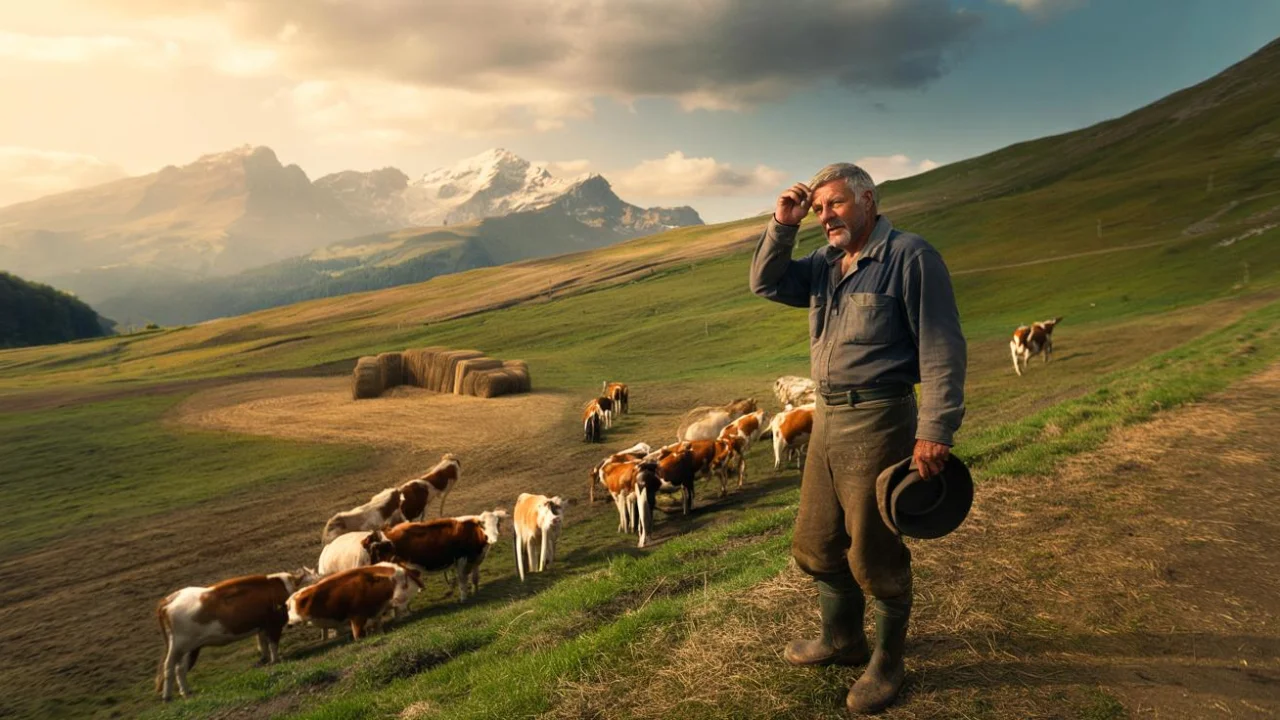
When André Montmayeur’s grandfather started farming in the French Alps seventy years ago, he could predict the seasons like clockwork. Spring thaw came in March, summer rains fell steadily through July, and there was always enough grass to fill the barn with hay. André remembers his grandfather saying the mountains would always provide.
But standing in his scorched pastures during the brutal summer of 2019, André realized his grandfather’s world was gone forever. The grass had stopped growing by mid-June. His feed stores were empty by August. And for the first time in three generations, he genuinely worried whether he’d have enough food to keep his cows alive through winter.
That’s when André made a decision that shocked everyone in his valley – including himself. Instead of buying more feed or expanding his storage, he decided to shrink his herd. On purpose.
When Traditional Farming Meets Climate Reality
André’s farm, Gaec Cap 13, sits high in the Savoie region of eastern France, where dairy farming has been the backbone of mountain communities for centuries. Like most Alpine farmers, André had always followed a simple rule: maximize milk production from every hectare, and supplement with purchased feed when needed.
- Researchers force AI to spit out entire copyrighted books with simple trick that breaks copyright law
- State officials reveal Trump administration’s shocking silence on election security threats
- Why French prosecutors just quietly formed a secret Epstein files team that changes everything
- Sydney streets erupt as Israeli President’s surprise visit triggers massive police crackdown
- How France fell behind Cyprus: The economic decline nobody saw coming
- Trump still wants Iran anti-nuclear deal despite what Netanyahu told him behind closed doors
But climate change is rewriting the rulebook for herd management. Summers now stretch longer and hotter than ever before. Rain comes in violent bursts that run off the slopes instead of soaking into the soil. The reliable growing season that André’s family had counted on for generations has become unpredictable and shorter.
“We used to have steady rain through July and August,” André explains. “Now we get nothing for weeks, then flash floods that wash away the topsoil. The grass just can’t handle it anymore.”
Before 2019, André ran 170-180 dairy cows plus young stock – nearly 300 animals total on 308 hectares. That’s almost one livestock unit per hectare, a stocking rate that works fine in normal years but becomes unsustainable when drought strikes.
The Numbers Behind Herd Reduction Strategy
André’s solution wasn’t what most farmers would consider. Instead of adapting to climate change by buying more feed or installing irrigation, he chose to reduce his herd size to match what the land could actually support.
| Metric | Before (2019) | After (2023) |
|---|---|---|
| Total Livestock Units | 300 | 220 |
| Dairy Cows | 170-180 | 130 |
| Annual Feed Purchases | €85,000 | €45,000 |
| Grazing Pressure | 0.97 LU/hectare | 0.71 LU/hectare |
| Net Farm Income | €42,000 | €48,000 |
The key benefits of this herd management climate change strategy include:
- Reduced dependence on purchased feed during drought years
- Lower veterinary costs due to less stressed animals
- Improved pasture recovery and soil health
- Greater financial stability during extreme weather events
- More time for farm diversification projects
But the most surprising result? André’s farm is actually more profitable now, despite producing less milk. Lower input costs and reduced financial stress during tough years more than made up for the lost production.
“I was terrified at first,” André admits. “Everyone thought I was crazy. But when I looked at the numbers after two years, I realized we were making more money and sleeping better at night.”
What This Means for Mountain Agriculture
André’s approach represents a fundamental shift in how Alpine farmers think about sustainability and climate adaptation. Rather than fighting against changing conditions with more inputs and technology, he’s working with the land’s natural capacity.
This herd management climate change strategy is starting to spread across the Alps. The regional agricultural extension service reports that 15% of dairy farms in Savoie have reduced their stocking rates by at least 20% since 2020.
“It’s not just about surviving the next drought,” explains Marie Dubois, a livestock specialist with the Savoie Chamber of Agriculture. “It’s about building farms that can thrive for the next fifty years, regardless of what the climate throws at them.”
The ripple effects extend beyond individual farms. Lower stocking rates mean less erosion on steep slopes, better water retention in mountain watersheds, and healthier ecosystems overall. Some environmental groups that once opposed intensive mountain agriculture are now cautiously supportive of these adapted farming systems.
Challenges and Trade-offs
André’s success story doesn’t mean herd reduction is easy or right for every farm. Smaller herds mean less milk flowing to local cheese cooperatives, potentially affecting the viability of traditional Alpine cheese production.
“We’re producing 30% less milk than we were five years ago,” André notes. “That’s milk that isn’t going into Beaufort cheese or other local products. It’s a trade-off we had to make.”
Bank managers and agricultural advisors initially pushed back against his plans. Many still believe that the only path forward is increased efficiency and higher production. But extreme weather events keep proving that resilience matters more than maximum output.
Other farmers are experimenting with different approaches – drought-resistant forage crops, improved water storage, or even switching from dairy to beef production. What works depends heavily on each farm’s specific location, soil type, and financial situation.
“There’s no one-size-fits-all solution,” explains Dr. Jean-Luc Perraud, who studies climate adaptation in agriculture at the University of Grenoble. “But André’s results show that sometimes less can genuinely be more.”
Looking Forward
André’s farm is now being studied by agricultural researchers across Europe as an example of successful climate adaptation. His reduced herd continues to produce high-quality milk, his pastures are recovering their vigor, and his stress levels have dropped dramatically.
The approach requires patience and financial cushioning that not all farmers have. But for those who can make the transition, the benefits appear to compound over time as soils improve and weather resilience increases.
As climate change continues to reshape mountain agriculture, André’s experience suggests that the future might belong to farmers who can think beyond traditional metrics of success. Sometimes the boldest move is knowing when to pull back.
FAQs
How much did André reduce his herd by?
He reduced from about 300 total livestock units to 220, cutting his dairy cows from 170-180 down to 130.
Did reducing the herd hurt his income?
Actually, his net farm income increased from €42,000 to €48,000 due to lower feed costs and reduced expenses.
Why didn’t he just buy more feed instead of cutting the herd?
Feed costs were becoming unpredictable and expensive during droughts, making the farm financially vulnerable to extreme weather.
Are other Alpine farmers copying this approach?
Yes, about 15% of dairy farms in Savoie have reduced their stocking rates by at least 20% since 2020.
What are the environmental benefits of smaller herds?
Reduced grazing pressure leads to less erosion, better water retention, improved soil health, and stronger mountain ecosystems.
Is this strategy suitable for all dairy farms?
No, it depends on each farm’s location, financial situation, and ability to maintain income with lower production levels.