
Imagine watching a sleek aircraft taxi down a runway, its engines humming quietly in the morning air. To most observers, it looks like any other experimental plane. But as it lifts off and climbs toward the stratosphere, this machine will soon be traveling at speeds that make Formula 1 cars look like they’re standing still – faster than five times the speed of sound.
This isn’t science fiction. On German airfields right now, engineers are preparing exactly this kind of machine, designed to push the boundaries of what’s possible in atmospheric flight.
The future of hypersonic flight just got a major boost from an unexpected source. Germany has quietly contracted Munich-based startup Polaris Spaceplanes to develop what could become one of Europe’s most advanced hypersonic test vehicles – a reusable, two-stage system that promises to revolutionize how we think about high-speed flight.
Germany Places Its Bet on Hypersonic Technology
The project, officially called the Hypersonic Test and Experimentation Vehicle (HYTEV), represents Germany’s most ambitious step into the hypersonic race. While countries like the United States, China, and Russia have dominated headlines with their hypersonic weapons programs, Germany is taking a different approach – building a reusable platform that can serve as both a research tool and a practical defense asset.
- India’s hypersonic missile program just achieved a breakthrough that could change everything
- Norway quietly doubles down on Type 212CD submarines – here’s what this means for Arctic security
- Germany quietly spends $4.9 billion on 200 Puma IFVs while neighbors scramble to keep up
- US Space Command Quietly Hands SpaceX America’s Most Critical Defense Contract
- Belgium holds key to unlocking billions in frozen Russian assets as Germany applies pressure
- UK’s 270 km/h highspeed drone solution leaves security experts stunned by what it can actually catch
“HYTEV is designed as a reusable flying laboratory for hypersonic research, with an option to act as a compact spaceplane for defense and reconnaissance,” explains a spokesperson from Polaris Spaceplanes.
The timeline is remarkably aggressive. Concept work began in 2024 and wrapped up in 2025, with the full system expected to be ready for flight tests by the end of 2027. That’s lightning speed in the world of aerospace development, where projects typically span decades.
What makes this contract particularly noteworthy is its rarity in Europe. According to Polaris, they’re not aware of any similar system being ordered from a private company anywhere on the continent. This makes the project a genuine first – a startup taking on the challenge of building a national military hypersonic test vehicle.
The Technical Details That Matter
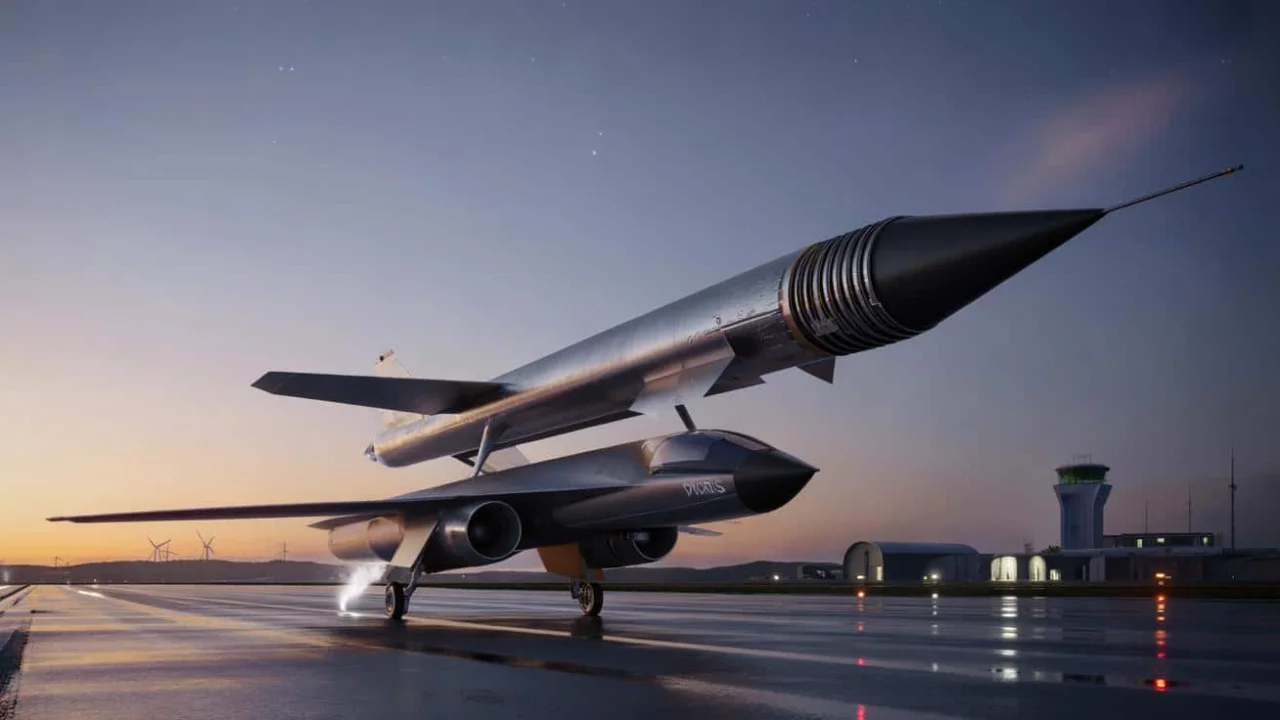
HYTEV breaks the mold of traditional hypersonic systems in several key ways. Unlike most hypersonic vehicles that launch vertically like rockets, this system operates more like a conventional aircraft – taking off and landing horizontally on runways.
The two-stage design is where things get interesting:
- Lower Stage: Powered by twin turbofan engines, handles takeoff and initial acceleration
- Upper Stage: The hypersonic vehicle itself, designed to reach extreme speeds
- Reusability: Both stages return to base for refurbishment and reuse
- Dual Purpose: Functions as both a test platform and operational reconnaissance vehicle
| Feature | HYTEV Specification | Traditional Approach |
|---|---|---|
| Launch Method | Horizontal runway takeoff | Vertical rocket launch |
| Landing Method | Horizontal runway landing | Parachute or expendable |
| Reusability | Fully reusable system | Often single-use |
| Operational Flexibility | Aircraft-like operations | Complex launch procedures |
“The horizontal launch and landing approach gives us operational flexibility that traditional hypersonic systems simply can’t match,” notes an industry analyst familiar with the project.
Why This Matters for Defense and Beyond
The primary customer driving this project is the Bundeswehr, Germany’s armed forces, which has been watching the global hypersonic arms race with growing concern. As major powers develop increasingly sophisticated hypersonic weapons – missiles and aircraft that can travel at Mach 5 or faster – Germany needs its own capability to understand and counter these threats.
But the implications stretch far beyond military applications. The hypersonic test vehicle could revolutionize several industries:
- Commercial Aviation: Testing technologies for ultra-fast passenger flights
- Space Access: More affordable and flexible satellite deployment
- Research: Conducting experiments in extreme flight conditions
- Emergency Response: Rapid deployment of sensors and equipment anywhere in the world
The reusable design is particularly significant. Traditional hypersonic tests often involve expensive, single-use vehicles. HYTEV’s airplane-like operations could dramatically reduce the cost per test flight, making hypersonic research more accessible.
“We’re looking at a system that could fly multiple times per week, not once per year,” explains a former aerospace engineer now working in defense consulting.
The Startup Taking On a Giant Challenge
Polaris Spaceplanes might be based in Munich, but they’re thinking globally. The company has positioned itself as a pioneer in reusable space and hypersonic technology, with HYTEV serving as their flagship demonstration of what’s possible when you combine startup agility with serious engineering expertise.
The fact that Germany chose a startup over established aerospace giants like Airbus or Thales speaks volumes about confidence in Polaris’s approach. It also reflects a broader trend in defense procurement – governments increasingly turning to nimble companies that can innovate faster than traditional contractors.
“This contract validates our belief that the future of hypersonics lies in reusable, aircraft-like systems rather than expensive rockets,” says a company representative.
The project timeline suggests Polaris has already made significant progress. Moving from concept to flight-ready hardware in just three years requires either exceptional preparation or groundbreaking efficiency – likely both.
What Happens Next
As 2027 approaches, all eyes will be on German test ranges to see whether this ambitious hypersonic test vehicle can deliver on its promises. Success could position Germany as a major player in hypersonic technology, while failure might set back European hypersonic development by years.
The broader implications are enormous. If HYTEV proves that reusable, runway-based hypersonic systems are practical, it could trigger a fundamental shift in how the world approaches high-speed flight. Airlines might start planning hypersonic passenger routes. Military strategists would need to completely rethink defense against hypersonic threats.
For now, though, the focus remains on getting this revolutionary hypersonic test vehicle off the ground and proving that sometimes, the most ambitious dreams really can take flight.
FAQs
What exactly is a hypersonic test vehicle?
A hypersonic test vehicle is an aircraft designed to fly at speeds exceeding Mach 5 (five times the speed of sound) for research and testing purposes.
How fast will Germany’s HYTEV actually fly?
While exact speeds haven’t been disclosed, hypersonic vehicles typically operate between Mach 5 and Mach 10, or roughly 3,800 to 7,600 mph.
Why is Germany developing this instead of buying from the US or other allies?
Hypersonic technology is highly classified and strategically sensitive, making most countries reluctant to share advanced capabilities even with close allies.
When will we see the first test flights?
According to current timelines, HYTEV should be ready for initial flight testing by the end of 2027.
Could this technology eventually be used for passenger flights?
Yes, the reusable design and horizontal takeoff/landing capability make it more suitable for eventual commercial adaptation than traditional rocket-based hypersonic systems.
How does this compare to other countries’ hypersonic programs?
Most other hypersonic programs focus on weapons systems, while Germany’s approach emphasizes reusable testing and research capabilities.