
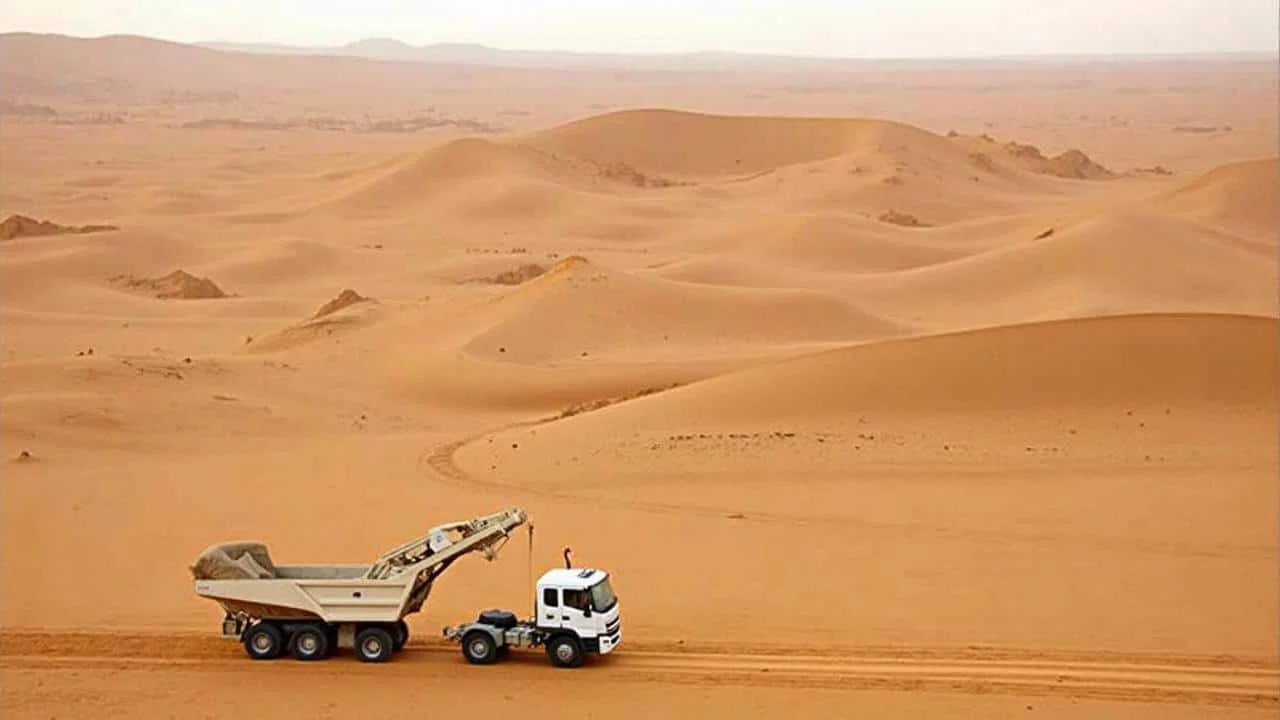
Ahmed watched another cargo ship dock at Jebel Ali port, its hull heavy with what looked like the most ordinary thing imaginable: sand. As a construction supervisor working on Dubai’s latest skyscraper project, he’d learned something that still amazed him every day. Here they were, surrounded by endless golden dunes stretching to every horizon, yet his team couldn’t use a single grain of it.
“We’re literally standing on millions of tonnes of sand,” he told his colleague that morning, “but we have to import better sand from thousands of miles away.” It sounds absurd until you understand the science behind one of the world’s most surprising trade secrets.
This is the hidden reality of sand imports in the Gulf states – a multi-billion-dollar industry that reveals how even the most abundant resources aren’t always what they seem.
The Great Sand Paradox of Desert Nations
Saudi Arabia and the UAE possess some of Earth’s largest sand deposits, yet their sand imports tell a fascinating story of modern construction demands. The numbers are staggering when you dig into the customs data.
The UAE alone imported over six million tonnes of sand in 2023, spending approximately $40.6 million on this seemingly abundant resource. Most of these sand imports came from neighboring Saudi Arabia, followed by Egypt and Belgium. Meanwhile, Saudi Arabia itself imports specialized sand varieties to fuel its ambitious Vision 2030 megaprojects.
“Desert nations that look like seas of sand are spending tens of millions of dollars each year to bring in better sand,” explains Dr. Sarah Mitchell, a materials engineer who has worked on Gulf construction projects for over a decade.
The reason lies in a simple but crucial difference: not all sand is created equal. While desert sand looks perfect to the untrained eye, it’s essentially useless for modern construction and high-tech manufacturing.
Why Desert Sand Fails the Construction Test
The fundamental problem with desert sand comes down to physics and thousands of years of natural sculpting. Wind-driven sand grains tumble against each other endlessly, creating perfectly rounded particles that look like tiny glass marbles under a microscope.
These smooth, rounded grains simply won’t stick together properly. Construction-grade concrete requires angular sand particles with rough, jagged edges that can grip cement paste and create strong bonds. Round desert grains slide past each other like ball bearings, producing weak concrete that can’t support massive structures.
Here’s what makes sand imports essential for different construction needs:
- Concrete production – Requires angular river or marine sand with sharp edges
- Glass manufacturing – Needs ultra-pure silica sand with minimal iron content
- Electronics – Demands high-grade silica for semiconductor production
- Solar panels – Requires specially processed sand with exact purity levels
- Land reclamation – Uses specific sand grades for artificial islands and coastal projects
“Wind-polished grains from dunes are too smooth and rounded, so they struggle to cling to cement inside concrete,” notes construction materials specialist Dr. James Harrison. “It’s like trying to build with tiny ball bearings instead of rough gravel.”
The purity issue adds another layer of complexity. Desert sand often contains iron oxides, clay particles, and other minerals that discolor glass or interfere with electronic manufacturing. Processing desert sand to remove these impurities costs more than importing pre-sorted materials.
The Global Sand Trade Hidden in Plain Sight
Sand imports represent one of the world’s largest commodity trades by volume, yet most people never think about where construction sand comes from. The Gulf states have become major players in this global market, both as importers and exporters of different sand types.
| Country | 2023 Sand Imports (Million Tonnes) | Primary Sources | Main Uses |
|---|---|---|---|
| UAE | 6.2 | Saudi Arabia, Egypt, Belgium | Construction, glass, land reclamation |
| Saudi Arabia | 4.8 | Australia, India, Egypt | Megaprojects, manufacturing |
| Qatar | 2.1 | UAE, Oman | Infrastructure, World Cup projects |
Marine sand, extracted from coastal areas and riverbeds, commands premium prices because water action creates the angular particles that construction demands. Australian beach sand, for instance, travels thousands of miles to help build Dubai’s skyline because it offers the perfect combination of strength and workability.
The irony extends beyond construction. Saudi Arabia exports its own desert sand for specialized applications like golf course construction and landscaping while simultaneously importing marine sand for its cities. Different projects require different sand specifications, creating complex trade flows that seem counterintuitive.
Environmental and Economic Consequences
The massive scale of sand imports creates ripple effects across industries and ecosystems. Beach mining for construction sand has become controversial in supplier countries, where entire coastlines disappear to feed global construction booms.
“We’re seeing beaches in India and Southeast Asia literally vanishing overnight,” warns environmental scientist Dr. Patricia Chen. “The sand trade is reshaping coastlines faster than natural erosion ever could.”
For Gulf states, sand imports represent both opportunity and vulnerability. While these countries can afford premium-grade materials, their construction industries depend on stable supply chains stretching across oceans. Disruptions in marine sand supplies could delay mega-projects worth billions of dollars.
The economic impact goes beyond direct costs. High-quality sand enables the advanced manufacturing that Gulf states want to develop as they diversify away from oil dependence. Solar panel production, electronics assembly, and precision glass manufacturing all require specific sand grades that local deserts cannot provide.
Labor markets feel the impact too. Sand processing, logistics, and specialized construction techniques create jobs that didn’t exist when oil was the only game in town. Port facilities in Dubai and Jeddah now dedicate significant capacity to sand imports, supporting thousands of workers in what outsiders might consider the most mundane trade imaginable.
Climate change adds another dimension to sand imports. Rising sea levels threaten the coastal areas where the best construction sand originates, potentially making this resource even more valuable and contested in coming decades.
FAQs
Why can’t desert countries use their own sand for construction?
Desert sand grains are too smooth and rounded from wind erosion, making them unable to bind properly with cement in concrete applications.
How much does sand importing cost Gulf countries annually?
The UAE alone spends over $40 million yearly on sand imports, with Saudi Arabia and other Gulf states spending similar amounts.
What type of sand works best for construction projects?
Angular sand from rivers, beaches, or quarries provides the rough edges needed to create strong bonds in concrete and other construction materials.
Do Gulf countries export any sand despite being importers?
Yes, they export desert sand for specific uses like landscaping and golf courses while importing marine sand for construction and manufacturing.
Is the global sand trade environmentally sustainable?
Current sand mining practices raise serious environmental concerns, with beaches and riverbeds being depleted faster than they can naturally replenish.
What happens if sand import supplies are disrupted?
Supply disruptions could delay major construction projects and affect the Gulf states’ economic diversification plans, particularly in manufacturing sectors.