
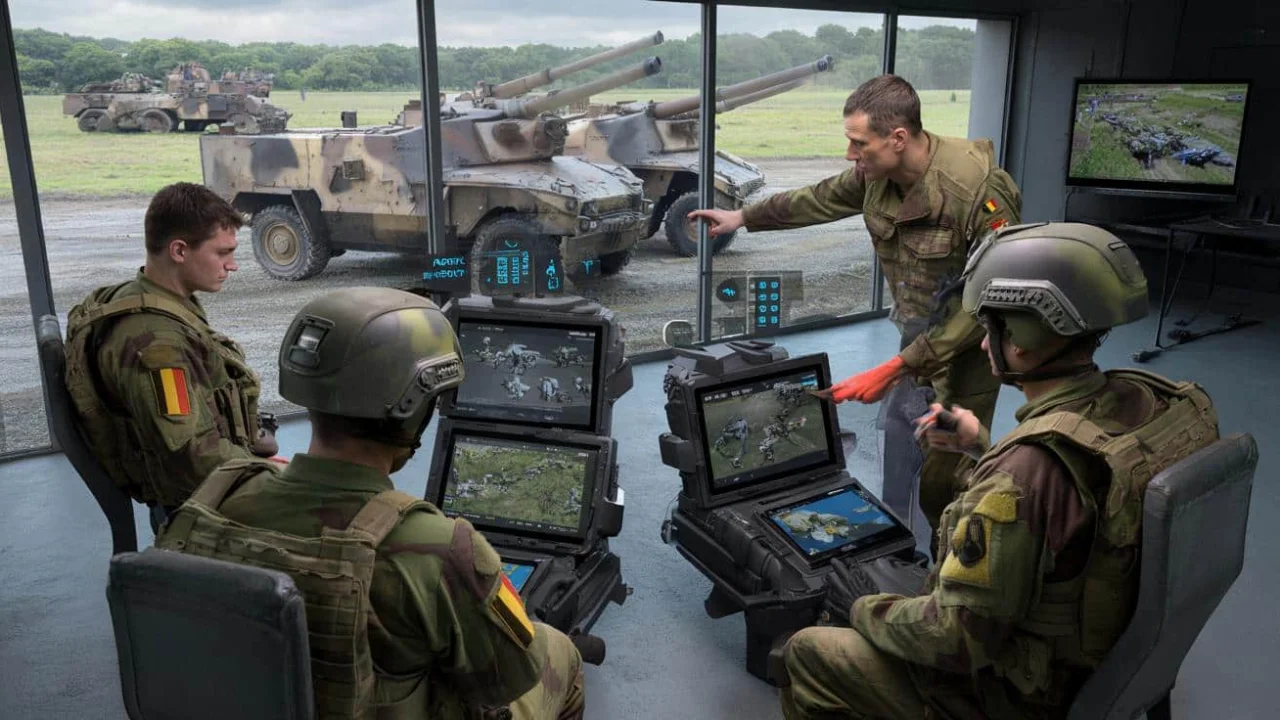
Lieutenant Sarah Delcroix adjusts her headset and stares at the glowing screen in front of her. Around her, fellow Belgian soldiers tap frantically on ruggedized tablets, their voices mixing French and Flemish as they coordinate simulated attacks. For the first time in her military career, she’s not just reading maps or relying on radio chatter. Real-time data streams across her display—enemy positions, friendly locations, ammunition levels, even weather conditions.
“It’s like having X-ray vision,” she whispers to her sergeant. What Sarah doesn’t realize is that she’s witnessing a fundamental shift in how modern armies fight. The Belgian military is embracing the SCORPION combat information system, and soldiers like her are the first to master this digital revolution.
This isn’t just about new gadgets or fancy software. Belgium is quietly transforming its entire approach to warfare, adopting French technology that could redefine how European allies fight together in future conflicts.
Why Belgium Chose the SCORPION Combat Information System
Back in 2018, Belgium made a strategic decision that few people noticed outside military circles. They joined France’s SCORPION programme through something called the CaMo partnership—short for Motorised Capability. But this wasn’t your typical arms deal.
- M1E3 Abrams Tank Prototypes Will Change Everything We Know About Modern Warfare
- Warsaw quietly redirects SAFE funds to American weapons makers in controversial defense spending shift
- Marines quietly upgrade AH-1Z Viper helicopters with game-changing 370km strike capability
- This garage-built drone just shattered speed records at nearly 700 km/h—and big manufacturers are worried
- Russia’s oil revenues crash as war funding crisis deepens behind closed doors
- Russia’s Bold Su-57 Export Promises Fall Apart After Delivering Only 2 Jets in 2025
Belgium ordered 382 Griffon multi-role armoured vehicles and 60 Jaguar reconnaissance vehicles. More importantly, they committed to adopting the entire SCORPION digital ecosystem. The goal was ambitious: make Belgian and French armoured units so compatible they could seamlessly operate together.
“The vehicles are impressive, but the real game-changer is the information system,” explains Colonel Marc Thys, a Belgian army logistics specialist. “We’re not just buying equipment—we’re joining a network.”
The SCORPION combat information system, known as SICS in French military circles, creates a real-time tactical internet. Every vehicle, every soldier with a tablet, every command post becomes a node in this network. Information flows instantly: enemy contacts, friendly positions, supply status, mission updates.
What Makes This System Special
Think of the SCORPION combat information system as WhatsApp for soldiers, but infinitely more sophisticated. Here’s what Belgian troops are learning to use:
- Real-time battlefield mapping: Every friendly and enemy position appears instantly on digital maps
- Automatic target sharing: When one unit spots an enemy, all connected units see it immediately
- Resource tracking: Ammunition, fuel, and medical supplies are monitored across the entire formation
- Mission coordination: Orders flow digitally, reducing radio chatter and confusion
- Weather and terrain data: Environmental conditions update automatically to support planning
But Belgium faces a unique challenge that France doesn’t: language. The SCORPION system operates primarily in French, while Belgium’s military uses both French and Flemish (Dutch).
| System Component | Language Support | Belgian Challenge |
|---|---|---|
| Vehicle interfaces | French only | Flemish speakers need translation |
| Command software | French primary | Bilingual training required |
| Training manuals | French | Local adaptation needed |
| Technical support | French | Language barriers in maintenance |
“We’re essentially becoming bilingual in military technology,” notes Captain Lisa Van Der Berg, a Flemish-speaking officer involved in SCORPION training. “It’s challenging but necessary for interoperability.”
How Belgian Soldiers Are Adapting
Training centers across Belgium now buzz with activity as soldiers learn to fight digitally. The learning curve is steep. Many troops who grew up with smartphones find the military tablets intuitive, but older soldiers sometimes struggle.
The Belgian army has developed a phased approach:
- Basic digital literacy: All personnel learn tablet operation and network basics
- System-specific training: Specialized courses for vehicle crews and command staff
- Joint exercises: Practice sessions with French units to test interoperability
- Language support: French language training for Flemish-speaking personnel
Master Sergeant Peter Janssen, a veteran with 20 years of service, initially resisted the digital shift. “I thought maps and radios worked fine,” he admits. “But after my first exercise with SCORPION, I realized we were fighting blind before.”
The system’s impact becomes clear during training scenarios. Units using the SCORPION combat information system complete objectives 30-40% faster than those relying on traditional methods. Communication errors drop dramatically, and commanders gain unprecedented situational awareness.
What This Means for European Defense
Belgium’s adoption of the SCORPION system reflects broader changes in European military cooperation. As NATO faces new challenges, member nations are seeking deeper integration beyond just standardized ammunition and fuel.
The implications extend far beyond Belgium’s borders:
- Enhanced NATO interoperability: Standardized systems make alliance operations smoother
- Reduced training costs: Shared platforms mean shared training resources
- Industrial cooperation: Joint procurement strengthens European defense industry
- Strategic autonomy: Less dependence on non-European military technology
“When Belgian and French units can plug into each other’s networks seamlessly, you’ve achieved something remarkable,” observes Dr. Anna Kellerman, a defense analyst at the Brussels Institute for Strategic Studies. “This is how modern alliances should work.”
The Belgian experience also serves as a test case. If a smaller nation with complex language requirements can successfully integrate the SCORPION combat information system, other European countries may follow suit.
Several nations are already watching closely. Estonia, with its advanced digital infrastructure, has expressed interest. Poland, upgrading its armoured forces, is evaluating the system. Even Germany, typically cautious about French military technology, is paying attention.
Challenges Still Ahead
Despite early successes, Belgium faces significant hurdles. The language barrier remains problematic, particularly for technical maintenance. Some Flemish-speaking soldiers report feeling excluded when French becomes the default language during joint operations.
Cybersecurity presents another challenge. The more connected military systems become, the more vulnerable they are to cyber attacks. Belgium must balance digital advantages with security risks.
Cost is also a factor. Beyond the initial hardware purchase, ongoing software updates, training, and maintenance require sustained funding. Military budgets are always under pressure, and high-tech systems are expensive to maintain.
“Technology is only as good as the people using it,” warns Colonel Thys. “We need continuous investment in human capital, not just hardware.”
Looking Forward
As Belgian soldiers become more comfortable with the SCORPION combat information system, the military is planning expanded integration. Future phases will include artillery units, logistics formations, and even special forces.
The ultimate goal remains unchanged: creating truly interoperable European forces. In an era of great power competition and regional instability, allies must fight together more effectively than ever before.
For soldiers like Lieutenant Delcroix, the future has already arrived. She no longer fights with just her rifle and radio—she commands through data, coordinates through networks, and thinks through screens. It’s a new kind of warfare, and Belgium is determined to master it.
FAQs
What exactly is the SCORPION combat information system?
It’s a French-designed digital network that connects military vehicles, soldiers, and command posts in real-time, sharing tactical information instantly across all units.
Why did Belgium choose this French system over others?
Belgium selected SCORPION as part of a broader partnership with France to ensure complete interoperability between their armoured forces, allowing units to operate seamlessly together.
How does the language barrier affect Belgian troops using the system?
The system operates primarily in French, requiring Flemish-speaking soldiers to learn French military terminology and interface commands, though Belgium is working on local adaptations.
Will other European countries adopt the SCORPION system?
Several nations including Estonia and Poland are evaluating the system, seeing Belgium’s experience as a test case for wider European adoption.
What are the main advantages of this digital combat system?
Units complete missions 30-40% faster, communication errors drop significantly, and commanders gain real-time awareness of all friendly and enemy positions.
When will Belgian forces be fully operational with SCORPION?
The rollout is happening in phases, with basic training underway now and full operational capability expected as new Griffon and Jaguar vehicles are delivered through 2026-2028.