
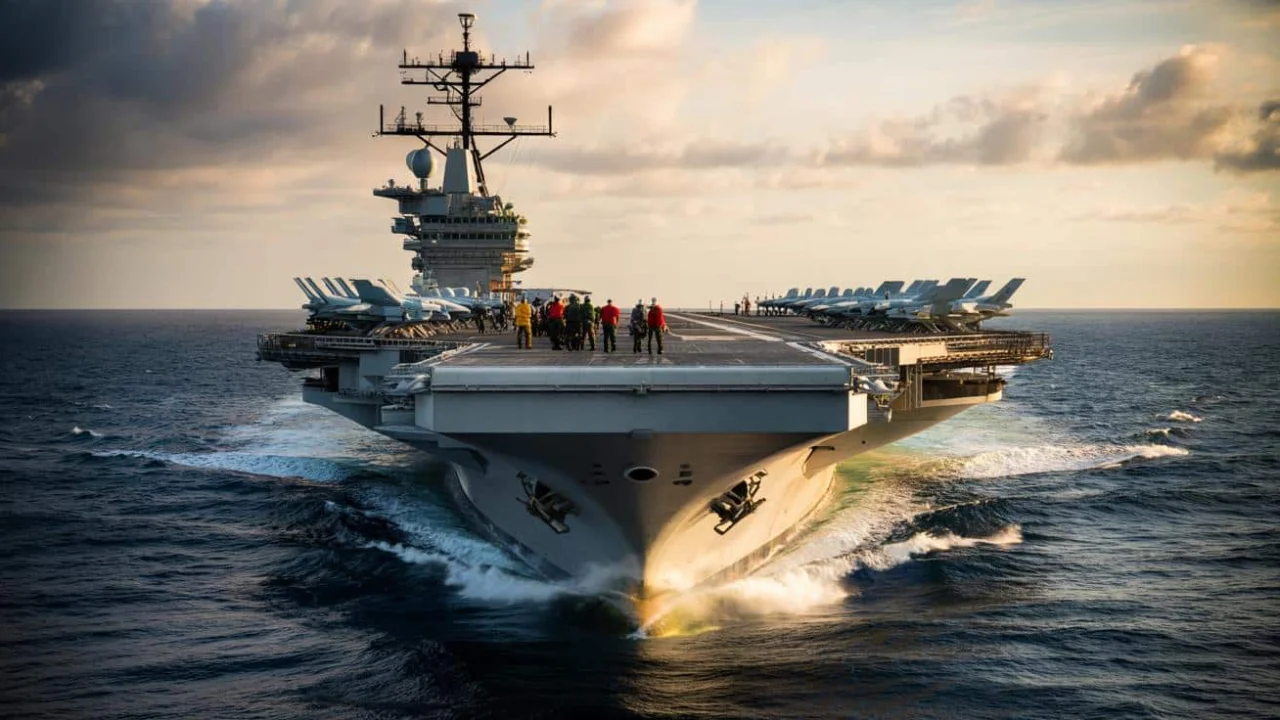
Picture a massive floating city slowly pulling away from the dock for the very first time. Workers who spent years welding, wiring, and building wave from the pier as their creation begins to move under its own power. For the families watching, this isn’t just another ship launch – it’s watching a decade of their lives sail into the horizon.
That emotional moment happened recently in Newport News, Virginia, when the future USS John F. Kennedy left port for its maiden sea trials. After years of delays, cost overruns, and technical headaches, America’s second Ford-class aircraft carrier finally proved it could do the most basic thing a ship needs to do: sail.
The departure marks more than just a construction milestone. It represents a crucial step toward filling a growing gap in America’s naval power projection capabilities.
Why This Moment Matters More Than You Think
The USS John F. Kennedy isn’t just another warship rolling off the production line. This 100,000-ton nuclear-powered aircraft carrier represents the future of American naval aviation, designed to operate well into the 2070s and beyond.
- Sweden quietly explores nuclear weapons cooperation with France and UK after joining NATO
- Su-57M1 Felon Fighter: Why Russia’s “Invisible” Jet Suddenly Appeared After Years of Secrecy
- Saudi Arabia quietly pauses Neom project construction after costs spiral out of control
- This overlooked factor explains why homes always feel colder despite cranked-up heating
- French Navy’s mini drone gets game-changing VTOL upgrade that lets more ships launch surveillance missions
- Romania’s €1bn H225M Caracal helicopter deal could transform local defense manufacturing forever
Huntington Ingalls Industries confirmed that CVN-79 successfully departed Newport News to begin its initial sea trials. These aren’t casual test drives – they’re make-or-break evaluations where every critical system gets pushed to its limits.
“The first sea trial is where a carrier stops being a construction project and starts becoming a warship,” explains a naval engineering expert familiar with the Ford-class program.
The timing couldn’t be more critical. America’s carrier fleet faces a coming shortage as older Nimitz-class ships reach retirement age. Without new carriers like the John F. Kennedy entering service, the Navy risks losing its ability to project power globally.
Despite this progress, the USS John F. Kennedy won’t officially join the fleet until 2027 – years behind the original schedule. The delays stem from the same complex technologies that make Ford-class carriers revolutionary but challenging to build.
What Makes the John F. Kennedy Different
While the USS John F. Kennedy looks nearly identical to its predecessor, the USS Gerald R. Ford, significant improvements lurk beneath the surface. These changes represent lessons learned from Ford’s troubled early years.
The most visible difference sits atop the ship’s island superstructure. Kennedy swaps Ford’s problematic Dual Band Radar for the AN/SPY-6(V)3 Enterprise Air Surveillance Radar system.
| Feature | USS Gerald R. Ford | USS John F. Kennedy |
|---|---|---|
| Radar System | Dual Band Radar | AN/SPY-6(V)3 EASR |
| Island Design | Original configuration | Redesigned mast structure |
| Maintenance | Complex, expensive | Modular, simplified |
| Detection Range | Advanced but troubled | Improved reliability |
“Switching to SPY-6 is a bet that newer, modular radar technology will be more reliable than Ford’s problematic Dual Band Radar,” notes a defense industry analyst.
The radar change required extensive modifications to the ship’s island structure. New mast arrangements and sensor placements are clearly visible in recent shipyard photos, showing how Kennedy’s profile differs subtly but importantly from Ford.
Other improvements include:
- Enhanced electromagnetic aircraft launch system reliability
- Improved advanced arresting gear for landing aircraft
- Better integration of weapons elevators
- Streamlined maintenance procedures
- Updated crew habitability features
The Real-World Impact on Naval Operations
The USS John F. Kennedy’s successful sea trials represent more than technical achievement – they signal America’s commitment to maintaining naval superiority in an increasingly contested world.
For naval aviators, Kennedy means access to the most advanced flight deck technology ever built. The ship’s electromagnetic catapults can launch heavier aircraft with greater precision than steam catapults on older carriers.
Taxpayers have watched costs balloon throughout the Ford-class program. Each ship originally budgeted at around $10 billion now costs significantly more. Kennedy’s successful trials help justify those investments by proving the technology actually works.
“Every successful milestone on Kennedy validates the entire Ford-class concept and makes future ships more affordable,” explains a former Navy procurement official.
Internationally, Kennedy sends a clear message about American technological capabilities and long-term naval commitments. Allies gain confidence in American security guarantees, while potential adversaries must account for another advanced carrier in their strategic planning.
The ship will eventually deploy to hotspots around the globe, from the South China Sea to the Persian Gulf. Its advanced sensors and communication systems will serve as floating command centers for complex multi-national operations.
For the shipbuilding industry, Kennedy’s progress provides crucial validation. Success here translates into continued orders for future Ford-class carriers, supporting thousands of specialized jobs in Virginia and across the defense industrial base.
What Happens Next
Sea trials typically last several months, with the ship returning to port periodically for adjustments and repairs. Kennedy will test everything from basic navigation to complex combat systems integration.
The Navy expects to take delivery in 2027, followed by additional testing and crew training before the first operational deployment. This timeline reflects lessons learned from Ford, which experienced significant delays in reaching full operational capability.
“We’re applying everything learned from Ford to make Kennedy’s path to service smoother and faster,” confirms a Navy spokesman involved in the carrier program.
Future Ford-class carriers will benefit from Kennedy’s trials, as each ship incorporates improvements and cost-saving measures developed during predecessor construction and testing.
FAQs
When will the USS John F. Kennedy enter active service?
The Navy expects to take delivery in 2027, with operational deployment likely following additional testing and crew training.
How much does the USS John F. Kennedy cost?
The total program cost exceeds $13 billion, though exact figures remain classified due to ongoing construction and testing.
What makes Ford-class carriers better than Nimitz-class ships?
Ford-class carriers feature electromagnetic catapults, advanced radar systems, improved flight deck efficiency, and enhanced crew accommodations.
How many aircraft can the USS John F. Kennedy carry?
The ship can accommodate approximately 75 aircraft, including F/A-18 Super Hornets, F-35C Lightning IIs, and various support aircraft.
Why did the USS John F. Kennedy take so long to build?
Complex new technologies, design changes based on lessons from USS Gerald R. Ford, and supply chain challenges contributed to construction delays.
Where will the USS John F. Kennedy be stationed?
The Navy hasn’t announced Kennedy’s home port, though Norfolk, Virginia remains the most likely location given existing infrastructure and support facilities.